August’s wider US trade deficit invites a weaker growth forecast, but the gold inside it requires a separate calculation. BEA replaces reported nonmonetary-gold trade with a production-based adjustment before calculating GDP; treating bullion’s entire trade contribution as lost domestic output would misprice the signal.[1][4]
Data checked October 10, 2026, using the August trade release published October 6. Figures below are seasonally adjusted, current-dollar changes unless stated otherwise.[1]
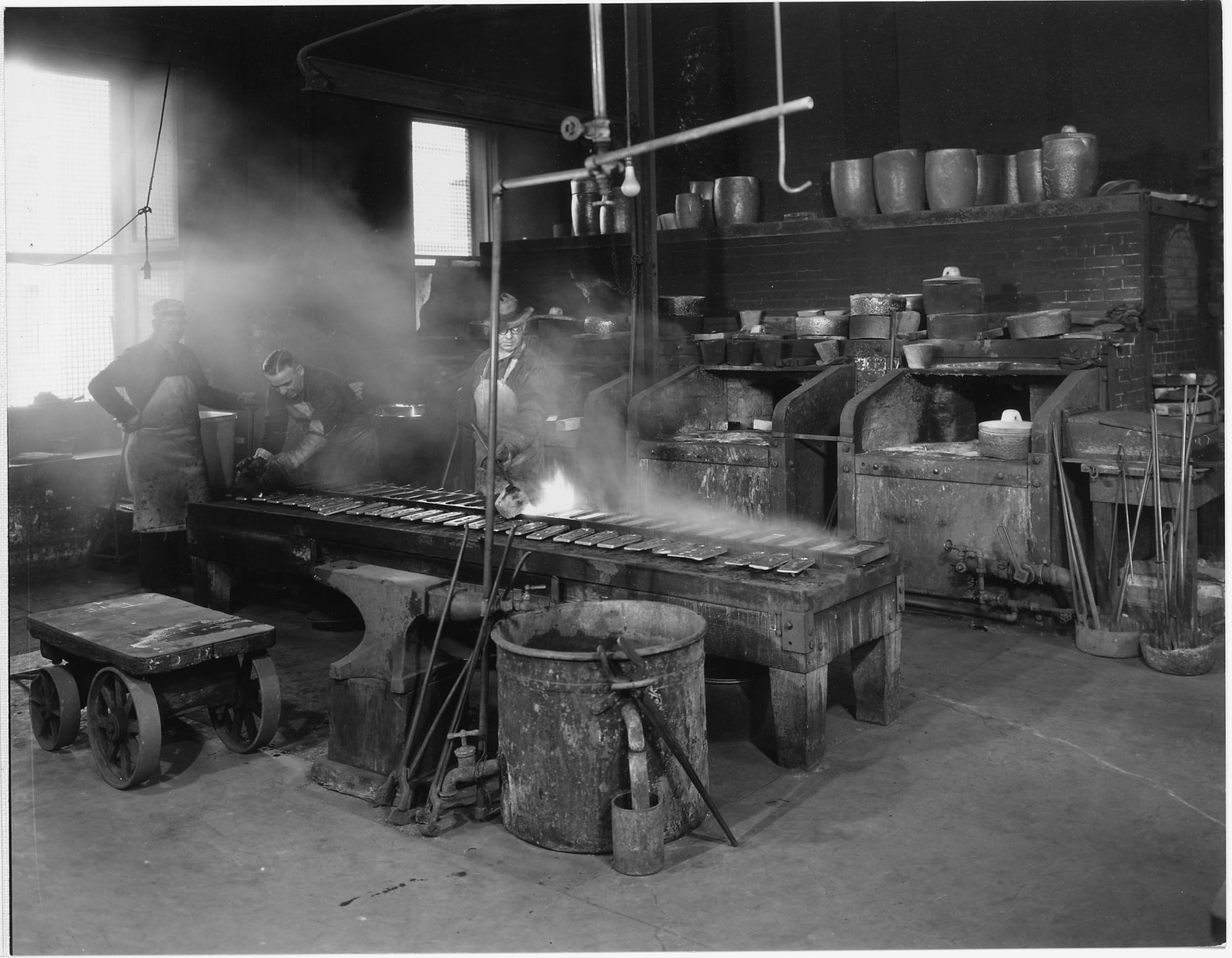
Follow the metal into the ledger
The August goods-and-services deficit reached $105.6 billion, widening by $12.7 billion. Within the Census-basis goods detail, nonmonetary-gold imports rose $3.1 billion and exports rose $2.3 billion. Subtracting those rounded changes gives a $0.8 billion movement toward a larger deficit.[1]
That arithmetic establishes scale. It does not produce a GDP adjustment. The headline balance uses balance-of-payments concepts, while the cited gold components come from customs-based categories. BEA expands the gold coverage when moving between those systems.[2]
“Nonmonetary” describes an accounting category, not a judgment that the metal has no financial purpose. Monetary gold belongs to monetary authorities and is held as a reserve asset. Nonmonetary gold includes investment bullion; finished gold jewelry is recorded separately as a consumer good.[2]
Even a national border need not be the decisive threshold. BEA records an export when a foreign official agency buys gold from a private US entity and sends it to the New York Fed for storage. The gold can remain in New York while its ownership crosses the statistical boundary.[2]
For a growth forecast, that distinction is decisive: the transaction tells us who acquired an asset. It does not, by itself, tell us how much new American production occurred.
Why an ordinary import gets subtracted
The familiar GDP equation adds consumption, investment, government spending and exports, then subtracts imports. That last subtraction removes foreign production already present in the spending measures. Retail sales and business inventories generally do not distinguish domestic goods from imported ones.[3]
Imagine a retailer adding imported appliances to its warehouse. Inventory investment rises, but the import entry offsets the foreign-made goods. Reading the negative import contribution alone would miss the matching positive entry. A contribution table divides the arithmetic into components; it does not establish that every imported purchase destroys an equal amount of domestic output.[3]
Investment gold creates a different problem. The US national accounts do not include purchases of valuables held as investments in household consumption, business investment or government spending. Deducting imported investment bullion anyway would introduce a subtraction without the corresponding expenditure entry.[4]
This is why simply copying the trade report into a GDP forecast fails. The accounts need the same boundary on both sides of the calculation.
The replacement preserves production
BEA removes the international-accounts exports and imports of nonmonetary gold and substitutes an adjustment based on domestic gold production minus industrial use. This appears in the reconciliation between the international accounts and the national accounts, NIPA table 4.3C.[4]
Gold production still counts. The handbook describes a production estimate incorporating mine output and secondary production from scrap, with industrial uses including jewelry and electronics. The excess of domestic production over industrial use enters net exports through an adjustment recorded on the import side with the opposite sign.[5]
The location in the table is bookkeeping. Its purpose is to retain domestic production while keeping investment purchases of stored metal out of ordinary expenditure categories. A newly produced bar and an existing bar changing owners can look identical in a vault; they answer different questions in the production accounts.[5]
An investor should therefore resist both shortcuts: counting every bullion import as a direct GDP loss, and declaring that gold never contributes to GDP. The relevant distinction is between producing the metal, using it in production, and transferring it as wealth.
Gold cannot explain away August
The strongest counterweight is already in the release. The modest net movement in the cited gold categories sits inside a much larger widening of the total deficit. Capital-goods imports also rose $6.2 billion. Removing bullion from the discussion leaves substantial activity to interpret.[1]
That activity can have different meanings for different assets. Imported equipment may accompany stronger domestic investment even as its foreign-produced value is deducted from GDP. A supplier’s order book, an importer’s spending and US production need not move together.[3]
My working interpretation is that August’s deterioration remains substantial after gold is removed. The falsifier would be revised, consistently classified data showing that investment-gold flows account for essentially all of the widening. The size of any quarterly GDP effect remains open: monthly nominal balances cannot establish a real growth contribution on their own.
Three releases that can change the reading
- October 29, the scheduled third-quarter advance GDP estimate: compare the real net-export contribution with equipment investment and inventories. Test whether the apparent trade deterioration survives the move into the production accounts.[3][6]
- November 4, the scheduled September trade report: inspect both sides of gold trade and the remaining goods categories. A reversal concentrated in bullion would carry a different growth message from a broad recovery in exports.[6]
- November 25, the scheduled second GDP estimate: check revisions to real exports, imports and domestic spending together. This is the next test of whether the initial quarterly interpretation survives fuller evidence.[6]
Sources
- U.S. Bureau of Economic Analysis and U.S. Census Bureau, “U.S. International Trade in Goods and Services, August 2026,” October 6, 2026 — deficit, gold and capital-goods changes, reporting bases, and release dates.
- BEA, “How are exports and imports of gold recorded in BEA’s International Economic Accounts?” — customs and balance-of-payments coverage, monetary gold, jewelry, and official purchases held in New York.
- BEA, “The Expenditures Approach to Measuring GDP,” June 3, 2025 — why imports are deducted and why expenditure contributions require joint interpretation.
- BEA, “How are exports and imports of nonmonetary gold treated in BEA’s National Economic Accounts?” — investment valuables and the replacement gold adjustment.
- BEA, NIPA Handbook, Chapter 8, “Net Exports of Goods and Services,” pages 8-13–8-14 — production, industrial use, and the reconciliation entries for gold.
- BEA, 2026 release schedule — scheduled October 29, November 4, and November 25 releases; checked October 10, 2026.
- U.S. Mint / National Archives, “Photograph of refinery process of testing gold,” circa 1935, NAID 296603 — archival photograph and provenance, via Wikimedia Commons.