As of April 7, 2026, the easiest mistake in U.S. funding-market reading is to treat a quiet SOFR print as proof that the standing repo facility is irrelevant. Priced is that overnight funding looks calm: the FOMC's target range is 3.50%-3.75%, the interest rate on reserve balances is 3.65%, and the latest SOFR print is also 3.65%.[1][4][5] New is that the Fed's backstop has become more explicitly scalable. Since December 11, 2025, standing overnight repo operations no longer carry an aggregate operational limit and run in a full-allotment format, which means the facility matters precisely when nobody is panicking enough to use it yet.[2][3]
That is the real mechanism. In an ample-reserves regime, stability is not just a story about how many reserves exist in aggregate. It is also a story about whether cash and collateral can move fast enough, at a predictable enough rate, to stop pressure in Treasury financing from pushing overnight rates through the ceiling. The SRF is the part of the corridor that tells eligible counterparties what the upper bound should feel like before stress becomes visible in the headline rate.[1][2]
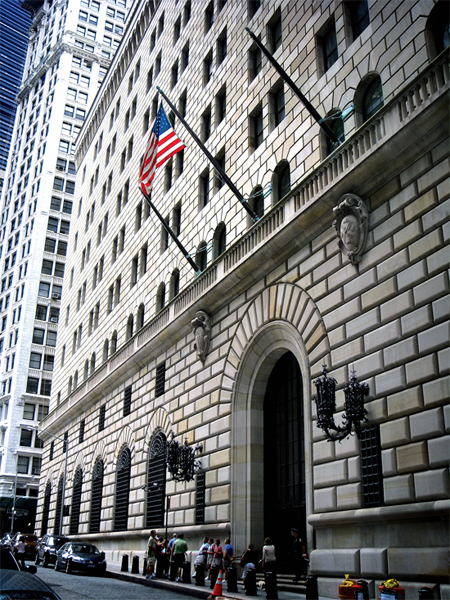
Image context: the cover uses the New York Fed's 33 Liberty Street entrance rather than a symbolic chart image. That is the right visual anchor because the article is about operating plumbing and institutional backstops, not about abstract market mood.[8]
Why the ceiling matters even when usage is small
The floor system has more than one floor-like component and more than one ceiling-like component. IORB helps anchor where banks should be willing to leave balances at the Fed. The ON RRP facility helps set a lower money-market alternative for eligible nonbanks, currently at an offering rate of 3.50% with a $160 billion per-counterparty daily limit.[1] The SRF does something different. It offers Treasury, agency debt, and agency MBS financing at a posted rate, currently 3.75%, so eligible firms know that if repo funding tightens sharply, there is a standing official alternative.[1][2]
That posted ceiling matters because the private market is forward-looking. Dealers and other counterparties do not wait for a full-blown scramble before adjusting quotes. If the official backstop is clear, operationally ready, and large enough, it can compress the premium that would otherwise appear in private financing before the facility itself sees meaningful take-up. In that sense, a low-usage SRF can still be doing its job.
What changed after December 2025
The December 10, 2025 New York Fed operating-policy note is the key update. Going forward, standing overnight repo operations "will no longer have an aggregate operational limit" and will be conducted in a full-allotment format.[3] The New York Fed FAQ adds the operational detail: there are two operations each business day, from 8:15 to 8:30 a.m. ET and 1:30 to 1:45 p.m. ET, and each eligible counterparty can submit one proposition per security type up to $40 billion per operation.[2]
That change matters more than the daily usage headline. A capped facility can reassure markets only up to the cap. A full-allotment facility changes the distribution of outcomes because counterparties no longer have to guess whether the aggregate amount will run out in the middle of a stress window. The operational promise becomes closer to "if you have eligible collateral and you meet the terms, the ceiling is there."
Why quiet SOFR still deserves interpretation
The latest data do show calm. SOFR stood at 3.65% on April 6, 2026, exactly in line with the latest IORB reading of 3.65%.[4][5] Reserve balances with Federal Reserve Banks were 3,026,708 million dollars on April 1, 2026, or about $3.03 trillion.[6] ON RRP take-up, by contrast, was only $0.227 billion on April 6, 2026, which is effectively near zero in system terms.[7]
The tempting conclusion is that ample reserves plus near-zero ON RRP usage mean the funding system can look after itself. That conclusion is too fast. Near-zero ON RRP usage means there is very little surplus cash still being passively parked at the Fed by eligible nonbanks.[7] Once that buffer is mostly gone, the system depends more on reserve distribution across institutions and on confidence that Treasury collateral can always be financed near the top of the corridor. The SRF is therefore less a relic of 2019-style repo stress than a live piece of insurance for a regime where spare cushion is thinner in the places that used to absorb it automatically.
Six numeric anchors
- Policy corridor: federal funds target range 3.50%-3.75%; IORB 3.65%; SRF rate 3.75%; ON RRP offering rate 3.50%.[1]
- Latest SOFR: 3.65% on April 6, 2026.[4]
- Reserve stock: $3.03 trillion in reserve balances on April 1, 2026.[6]
- Residual ON RRP buffer: $0.227 billion on April 6, 2026.[7]
- SRF operating design: two daily operations, 8:15-8:30 a.m. ET and 1:30-1:45 p.m. ET.[2]
- SRF capacity at the counterparty level: $40 billion per eligible security type per operation, now under a full-allotment regime with no aggregate operational limit.[2][3]
Those anchors show why the current setup is subtle. The market is not screaming. But the official operating framework is telling you that the Fed still cares about preserving an elastic Treasury-funding ceiling even while overnight rates appear orderly.
Strongest counterweight
The strongest pushback is simple: maybe none of this matters because the data are already proving the system is fine. Reserves remain around $3 trillion, SOFR is sitting on top of IORB, and ON RRP usage is basically exhausted without producing obvious funding stress.[4][5][6][7] In that reading, the SRF is mostly reputational architecture. The real stabilizer is just the quantity of reserves already in the banking system.
That counterweight is serious. It is why this should not be framed as an imminent-stress article. The narrower point is that once ON RRP balances are close to gone, the system becomes more dependent on distribution, collateral mobility, and official backstop credibility. A quiet rate print tells you the regime is working; it does not tell you the backstop has become optional.
Falsifier
This explainer is too alarmed if the next several funding windows keep proving that reserve distribution is doing all the work by itself. Concretely, if SOFR stays pinned near IORB through the April 15 tax date, the April 30 month-end, and the May 4 / May 6 Treasury refunding-document releases without any visible spread pressure, operational adjustment, or renewed use of official facilities, then the case for treating the SRF as a newly important marginal stabilizer would be overstated.[4][5][7][9]
Watchlist
- April 9, 16, 23, and 30, 2026 H.4.1 releases: the Board calendar already flags those Thursdays as reserve-balance release dates, so the question is whether reserve levels and composition stay comfortable while ON RRP remains minimal.[6][10]
- April 15, 2026 tax date: the market should be watched for whether tax-driven Treasury General Account inflows create any temporary pressure between SOFR and IORB.[4][5]
- April 28-29, 2026 FOMC meeting: the next implementation note will show whether policymakers keep the same corridor settings and the same operating emphasis around reserves, repo, and ON RRP.[10][11]
- May 4 and May 6, 2026 Treasury quarterly refunding documents: these dates matter because bill and coupon financing needs still shape how much private balance-sheet capacity the system must absorb.[9]
Takeaway
In 2026, the standing repo facility is best read as a credibility tool inside the floor system, not as a dramatic emergency program that becomes relevant only after a blowup. Quiet SOFR, near-zero ON RRP balances, and still-large reserves can all coexist. The real question is whether Treasury collateral can keep clearing near the top of the corridor when cash is less redundantly parked and more dependent on distribution. That is why the SRF still matters even when the overnight tape looks boring.
Sources
- Board of Governors of the Federal Reserve System, "Implementation Note issued March 18, 2026."
- Federal Reserve Bank of New York, "FAQs: Standing Repurchase Agreement Operations."
- Federal Reserve Bank of New York, "Statement Regarding Standing Overnight Repo Operations" (December 10, 2025).
- Federal Reserve Bank of New York, Secured Overnight Financing Rate (SOFR), retrieved from FRED, Federal Reserve Bank of St. Louis.
- Board of Governors of the Federal Reserve System (US), Interest Rate on Reserve Balances (IORB Rate) (IORB), retrieved from FRED, Federal Reserve Bank of St. Louis.
- Board of Governors of the Federal Reserve System (US), Liabilities and Capital: Other Factors Draining Reserve Balances: Reserve Balances with Federal Reserve Banks: Week Average (WRESBAL), retrieved from FRED, Federal Reserve Bank of St. Louis.
- Federal Reserve Bank of New York, Overnight Reverse Repurchase Agreements: Treasury Securities Sold by the Federal Reserve in the Temporary Open Market Operations (RRPONTSYD), retrieved from FRED, Federal Reserve Bank of St. Louis.
- Federal Reserve Bank of New York, About the Fed Gallery, image 17: "The 33 Liberty Street entrance of the New York Fed building."
- U.S. Department of the Treasury, "Most Recent Quarterly Refunding Documents" (page noting next releases scheduled for May 4 and May 6, 2026).
- Board of Governors of the Federal Reserve System, "Calendar: April 2026."
- Board of Governors of the Federal Reserve System, "Federal Open Market Committee announces its tentative meeting schedule for 2025 and 2026" (August 9, 2024).