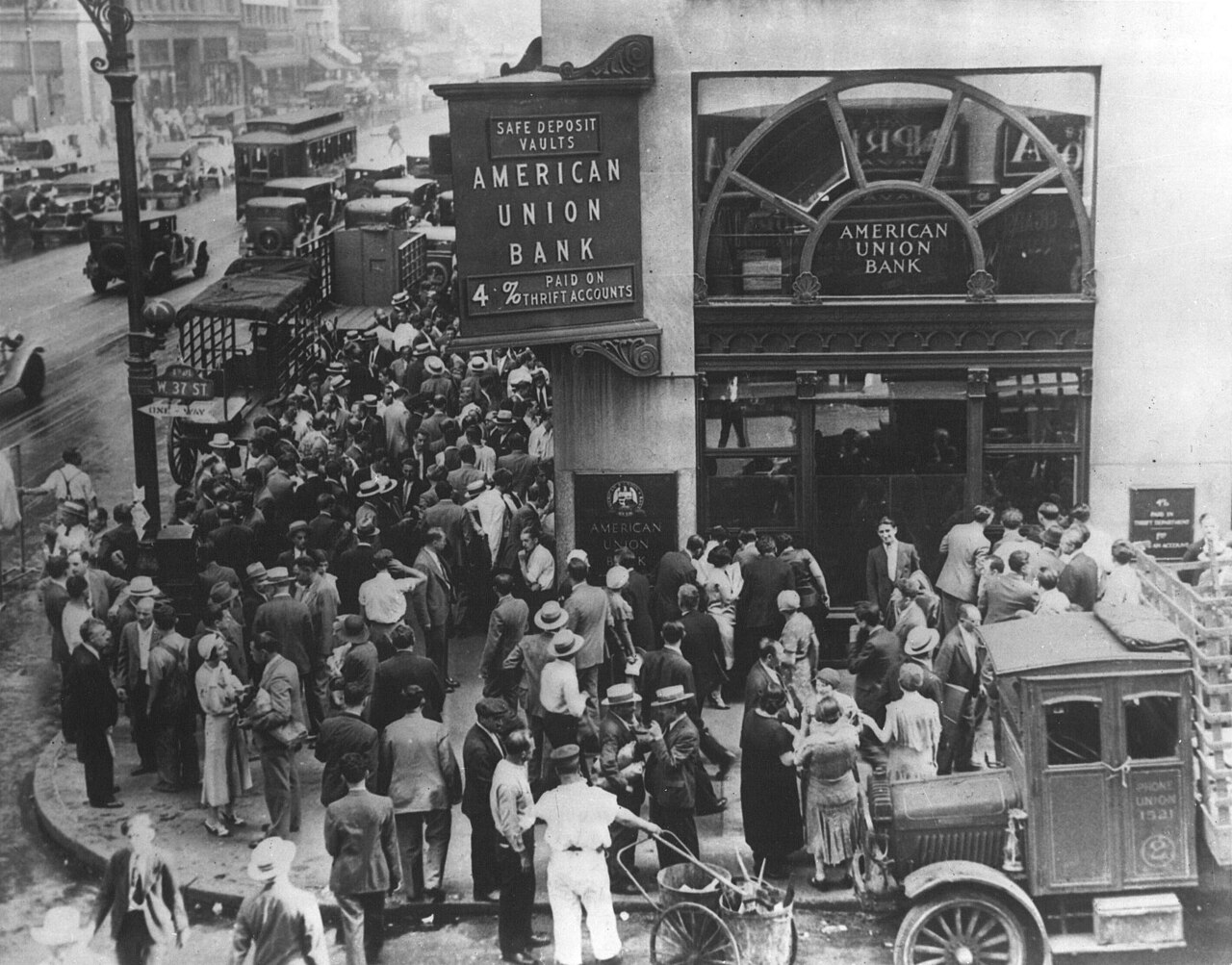
The dangerous misread in bank stress is to treat a run as a pure solvency story. It usually is not. The market prices a bank on capital and earnings; depositors run on confidence in immediate liquidity. The failure point arrives when those two clocks stop moving at the same speed.
SVB is still the cleanest case. The bank entered 2023 with a deposit base heavily outside the FDIC insurance boundary, a securities book carrying large unrealized losses, and weak operational preparation for emergency liquidity. Once management tried to realize part of the loss and refill capital, the market got a sharper fact pattern than the headline balance sheet had been showing.[1][2][3]
Priced vs new
Priced: banks can carry unrealized securities losses for long periods without failing, especially if they can hold assets to maturity and keep their deposits stable.[2]
New: once a bank with a heavily uninsured and concentrated funding base has to crystallize losses or explain them in public, the question changes from capital adequacy over time to cash survivability over hours.[1][3]
That is the real transmission chain. Duration losses do not kill the bank by themselves. They become lethal when they collide with runnable deposits and weak liquidity plumbing.
The mechanism in one chain
- Insurance boundary shapes run incentives. FDIC insurance generally protects up to $250,000 per depositor, per insured bank, per ownership category. Balances above that line have a much stronger reason to leave early when confidence breaks.[4]
- Duration losses shrink flexibility before they erase book capital. If a bank is sitting on a large held-to-maturity portfolio with market values far below carrying values, selling assets to meet withdrawals can force losses that had previously been parked outside the income statement.[1][2]
- A public capital raise can turn an abstract mark into a concrete signal. Once management sells securities, books the hit, and asks the market for fresh equity, uninsured depositors stop treating the loss as an accounting footnote and start treating it as a funding warning.[1]
- Operational liquidity readiness matters after sentiment flips. Vice Chair Barr's May 15, 2024 testimony was blunt on this point: banks under stress found it hard to monetize held-to-maturity securities through repo, and some were not adequately prepared to use the discount window at speed.[3]
- Digital coordination compresses the timetable. In the Federal Reserve's review, SVB's concentrated venture-capital network and social-media-amplified communication turned an ordinary liability mismatch into an unprecedented withdrawal tempo.[1]
Six numeric anchors that constrain the story
- Total deposits at year-end 2022: $173.1B.[2]
- Estimated uninsured exposure: SVB reported $151.5B of estimated uninsured deposits in U.S. offices and another $13.9B of foreign deposits not subject to U.S. deposit insurance; the Federal Reserve's review summarizes uninsured deposits as 94% of total deposits.[1][2]
- Held-to-maturity mark gap: HTM securities were carried at $91.3B amortized cost but had only $76.2B fair value at December 31, 2022, a gap of roughly $15.2B.[2]
- Losses already visible in equity: accumulated other comprehensive income was -$1.911B at year-end 2022, showing that the balance sheet was already absorbing rate damage on the available-for-sale side.[2]
- March 8 balance-sheet reset: management sold $21B of AFS securities, booked a $1.8B after-tax loss, planned to increase term borrowings by $15B to $30B, and sought to raise $2.25B of capital.[1]
- March 9 run speed: SVB lost over $40B of deposits in one day and expected to lose over $100B more the next day, roughly 85% of the bank's deposit base.[1]
Those numbers matter because they separate a vague "rates hurt banks" narrative from a specific run template. A bank can survive one of these variables. It gets fragile when it carries all of them at once.
Why unrealized losses were not the whole story
This is the point most postmortems flatten. Plenty of banks experienced rate-driven securities marks in 2022 and 2023. They did not all fail. The differentiator was funding structure.
If deposits are sticky, diversified, and mostly insured, management usually has time. It can shrink the balance sheet gradually, reprice deposits, add hedges, and let securities roll down. If deposits are large, concentrated, and mostly uninsured, time becomes the scarce asset. The same duration gap that looks manageable in a twelve-month asset-liability model can become fatal in a one-day funding model.[1][3]
That distinction is also why "capital ratios looked acceptable" was never a sufficient defense. Capital is a stock. A run is a flow. The market can debate the stock for weeks; depositors force the flow problem immediately.
Strongest counterweight
The strongest counterweight is that SVB was an extreme case, not a universal template. Barr's testimony made the same point indirectly: the lesson was not that all unrealized losses are terminal, but that some deposit types are more runnable than the framework had assumed and that liquidity readiness was weaker than regulators expected.[3]
That counterweight is real. It means investors should not screen banks by one metric alone. A large HTM discount without unstable funding is not the same thing as unstable funding without large HTM losses, and neither is automatically a failure setup.
Falsifier
This framework is wrong if banks with a similarly high uninsured-deposit share, similarly weak liquidity preparation, and similarly large duration marks can repeatedly absorb public balance-sheet shocks without meaningful deposit flight. In that world, the run mechanism is overstated and the real variable would sit elsewhere.
Watchlist
- Next quarterly 10-Q and 10-K securities footnotes: HTM amortized cost versus fair value, AOCI, and the size of any realized loss remain the cleanest first-pass read on whether rate damage is still mostly latent.[2]
- Quarterly deposit disclosures and earnings-call detail: uninsured-deposit mix, noninterest-bearing deposit share, and sector concentration matter more than generic deposit growth headlines.[1][2]
- Liquidity-readiness language from management and regulators: discount-window testing, collateral pre-positioning, and HTM monetization capacity were singled out by Barr as real stress points, so they deserve explicit monitoring rather than checklist treatment.[3]
- Any capital action taken under pressure: if a bank has to realize losses and raise equity in the same communication window, the market should assume the depositor clock has accelerated.[1]
Takeaway
The clean lesson from SVB is narrower than "duration risk is bad" and more useful than "bank runs are random." Runs become lethal when three conditions align: runnable uninsured deposits, a securities book with large marks that cannot be monetized cleanly, and weak operational access to emergency liquidity. When those conditions are absent, a rate shock can stay an earnings problem. When they align, it becomes a same-day funding problem.[1][2][3][4]
Sources
- Board of Governors of the Federal Reserve System, Review of the Federal Reserve's Supervision and Regulation of Silicon Valley Bank (April 28, 2023).
- SVB Financial Group, Annual Report on Form 10-K for the year ended December 31, 2022.
- Michael S. Barr, Oversight of Prudential Regulators: Ensuring the Safety, Soundness, Diversity, and Accountability of Depository Institutions (Federal Reserve testimony, May 15, 2024).
- FDIC, Deposit Insurance FAQs.