Priced is that the LIBOR transition is over. New, for anyone still reading old loan agreements, swaps, securitizations, or private-credit documents, is that the fallback spread keeps living inside contracts long after the benchmark crisis has passed. The useful interpretation is narrow: the spread was a transition bridge, not a current market price for bank credit, funding stress, or fair compensation on a fresh floating-rate deal.[3][4][5]
That distinction matters because a fixed spread can look more authoritative than it is. The numbers are precise: 11.448 basis points for one-month USD LIBOR, 26.161 basis points for three-month USD LIBOR, and 42.826 basis points for six-month USD LIBOR in ARRC hardwired loan fallback language.[4] Precision, however, should not be confused with liveness. Those figures solved a legal and operational problem: how to move contracts away from a dying bank-panel benchmark without renegotiating every instrument one by one.
The Mechanism
LIBOR embedded two things in one number. It was an interest-rate benchmark, and it carried a bank-credit and term-funding flavor because it came from unsecured interbank borrowing estimates. SOFR is deliberately different. The New York Fed defines the Secured Overnight Financing Rate as a broad measure of the cost of borrowing cash overnight collateralized by Treasury securities. It draws on tri-party repo, GCF Repo, and bilateral Treasury repo transactions cleared through FICC's delivery-versus-payment service, with special-collateral trades filtered out.[1]
That makes SOFR more robust as a transaction-based benchmark, but it also means plain SOFR is not economically identical to term USD LIBOR. The fallback spread was the shim. It tried to preserve continuity when a contract moved from a bank-credit-sensitive term rate to an overnight secured rate framework. The ARRC summary says the preferred methodology was based on the five-year historical median difference between USD LIBOR and SOFR, and that ARRC's recommended commercial cash-product spread adjustments would match the spread-adjustment values used in ISDA fallback documentation.[3]
The important word is historical. The spread was not designed to reset every day with bank funding conditions. It was fixed so that parties could know the replacement economics before the benchmark disappeared. The tradeoff was deliberate: certainty beat theoretical perfection.
Why the Fixed Spread Worked
The fallback spread did three practical jobs. First, it reduced litigation and amendment risk. ARRC's hardwired language created a replacement waterfall in which contracts could move to Term SOFR plus a fixed adjustment, or to Daily Simple SOFR plus an adjustment if a term rate was unavailable.[4] That let administrative agents, borrowers, lenders, and hedge counterparties know what switch would occur after LIBOR ceased or became non-representative.
Second, it made timing manageable. The March 2021 endgame announcements created the reference point for spread fixing; ARRC's documents describe how the FCA and ICE Benchmark Administration announcements triggered spread-adjustment fixing under the fallback framework.[4] Without that kind of common trigger, every borrower and lender would have had a fresh economic negotiation precisely when operational systems, valuation models, and hedge documentation were already being rewritten.
Third, it gave cash products and derivatives a common language. That did not make every instrument economically identical, but it reduced basis chaos. A loan fallback, a swap fallback, and a securitization fallback could still differ in conventions, compounding, payment timing, and legal language. The fixed spread at least prevented the transition from becoming a contract-by-contract argument over the historical gap between two different benchmarks.[3][4]
Where It Misleads
The spread becomes dangerous when users treat it as a live credit indicator. A one-month fallback adjustment of 11.448 bps does not mean banks are currently funding at SOFR plus 11.448 bps. A six-month adjustment of 42.826 bps does not mean six-month bank-credit risk is fairly priced at that level today.[4] It only tells you what historical median difference was chosen for fallback continuity.
The same boundary applies to new debt. If a borrower signs a new SOFR-based loan, the credit spread, original-issue discount, floor, call protection, and covenants are live market terms. The LIBOR fallback adjustment is not an argument that the new loan should mechanically add the old spread on top of SOFR. In a refinanced credit agreement, using the fallback spread as an anchor can quietly transfer value from one side to the other because the old number was built for conversion, not price discovery.
SOFR averages add another layer. The New York Fed publishes 30-, 90-, and 180-calendar-day compounded SOFR averages and a SOFR Index that began at 1.00000000 on April 2, 2018.[2] Those tools help contracts calculate interest over time, but they do not recreate LIBOR's unsecured term-bank component by themselves. They make overnight secured funding usable over longer periods. That is a calculation improvement, not a credit-risk oracle.
The Endgame
The benchmark transition now has a clean endpoint. The Bank of England, FCA, and Working Group on Sterling Risk-Free Reference Rates said the remaining synthetic LIBOR settings were published for the final time on September 30, 2024, after which all 35 LIBOR settings had permanently ceased. The same release framed the wider transition as moving markets away from a benchmark once referenced in an estimated $400 trillion of financial contracts.[5]
That finality is why old fallback mechanics deserve a second reading. During the transition, the key question was "does the contract survive the death of LIBOR?" In 2026, the better question is "what economic artifact did the contract inherit?" A fallback spread sitting inside a legacy instrument is not wrong just because it is stale. It is wrong only if the reader mistakes its purpose.
The clean mental model is this: SOFR is the new reference-rate base; the fallback spread is the historical conversion gasket; the borrower-specific margin is the live credit price. Blend those three together and the economics become muddy.
Counterweight
The strongest pushback is that a fixed fallback spread still has economic information. It was not pulled from thin air; it came from a historical median methodology, reflected broad consultation, and was chosen because market participants preferred operational certainty across a huge population of contracts.[3] For legacy instruments, that is valuable. A crude but agreed bridge can be better than a bespoke fight in every document.
That counterweight is right for legacy conversion and wrong for new underwriting. The spread's legitimacy comes from being an agreed transition convention. It does not become a standing theorem about the right relationship between secured overnight Treasury repo funding and unsecured term bank funding across every credit cycle.
Falsifier
The thesis would be too strict if new-issue markets, across multiple borrower types and rate environments, consistently priced SOFR loans as if the old fallback spread were the actual clearing premium and did so independently of covenant quality, lender balance-sheet scarcity, bank-credit stress, and hedge-market basis. In that case, the fallback spread would have become a de facto market convention rather than only a legacy bridge.
The more likely falsifier to watch is legal rather than macro. If courts, regulators, or major market-standard forms begin treating the fixed adjustment as the presumptive economics for new SOFR instruments, then its role has changed. Until then, it belongs in the transition toolkit, not the live-pricing toolkit.
Watchlist
- Legacy reset dates: on the first interest period after a fallback takes effect, check whether the agreement uses Term SOFR, Daily Simple SOFR, a compounded SOFR average, or another replacement convention.[2][4]
- Refinancing amendments: when a legacy loan is refinanced rather than merely converted, separate the old fallback adjustment from the new borrower margin; they answer different questions.[3][4]
- Hedge alignment: confirm whether the loan and derivative fallback mechanics use the same SOFR convention, timing, and spread adjustment, because mismatch can create basis exposure even when both documents say "SOFR."[3][4]
- Credit-sensitive-rate language: regulators have warned that credit-sensitive rates should not reappear as broad LIBOR successors, so any document that tries to replace SOFR with a bank-credit-sensitive benchmark needs extra scrutiny.[5]
The investable takeaway is not that fallback spreads are unfair. It is that they are old machinery doing a specific job. They made LIBOR contracts survivable. They do not tell you what bank funding stress is today, what a new borrower should pay tomorrow, or whether SOFR itself needs to carry a permanent credit add-on.
Sources
- Federal Reserve Bank of New York, "Secured Overnight Financing Rate Data" - SOFR definition, repo-market transaction inputs, filtering, and publication timing.
- Federal Reserve Bank of New York, "SOFR Averages and Index Data" - 30-, 90-, and 180-day compounded averages and SOFR Index mechanics.
- Alternative Reference Rates Committee, "Summary of the ARRC's Fallback Recommendations" (October 6, 2021) - historical median methodology, ISDA alignment, and rationale for fixed spread adjustments.
- Alternative Reference Rates Committee, "Supplemental Recommendations of Hardwired Fallback Language for LIBOR Syndicated and Bilateral Business Loans" (March 25, 2021) - fallback waterfalls, trigger context, and one-, three-, and six-month spread adjustments.
- Bank of England, FCA, and Working Group on Sterling Risk-Free Reference Rates, "The end of LIBOR" (October 1, 2024) - final synthetic LIBOR publication, all-settings cessation, $400 trillion transition context, and credit-sensitive-rate warning.
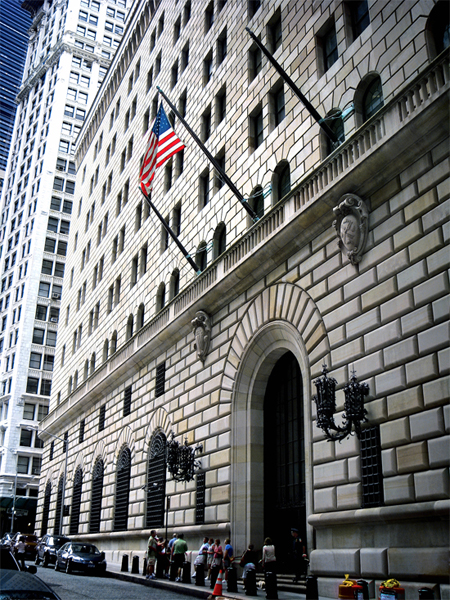
- Federal Reserve Bank of New York, "Building Photo Gallery" - image 17, the 33 Liberty Street entrance of the New York Fed building used as the article photograph.