Insurance brokers still deserve to trade like high-quality compounders. That part is already priced. The market has years of evidence that renewal books are sticky, acquisition engines stay active, and margins can hold high even when underwriting cycles wobble.[2][3][4][5]
The new question is narrower. As global commercial insurance rates fell 4% in the fourth quarter of 2025 and the U.S. composite went flat, the next performance gap moves away from easy premium inflation and toward business mix: excess casualty, reinsurance, advisory services, payroll and exposure growth, and acquisition integration.[1][2][3][4][5] If the old hard-market tailwind is cooling, the best brokers will still grow; they just will not all grow for the same reason.
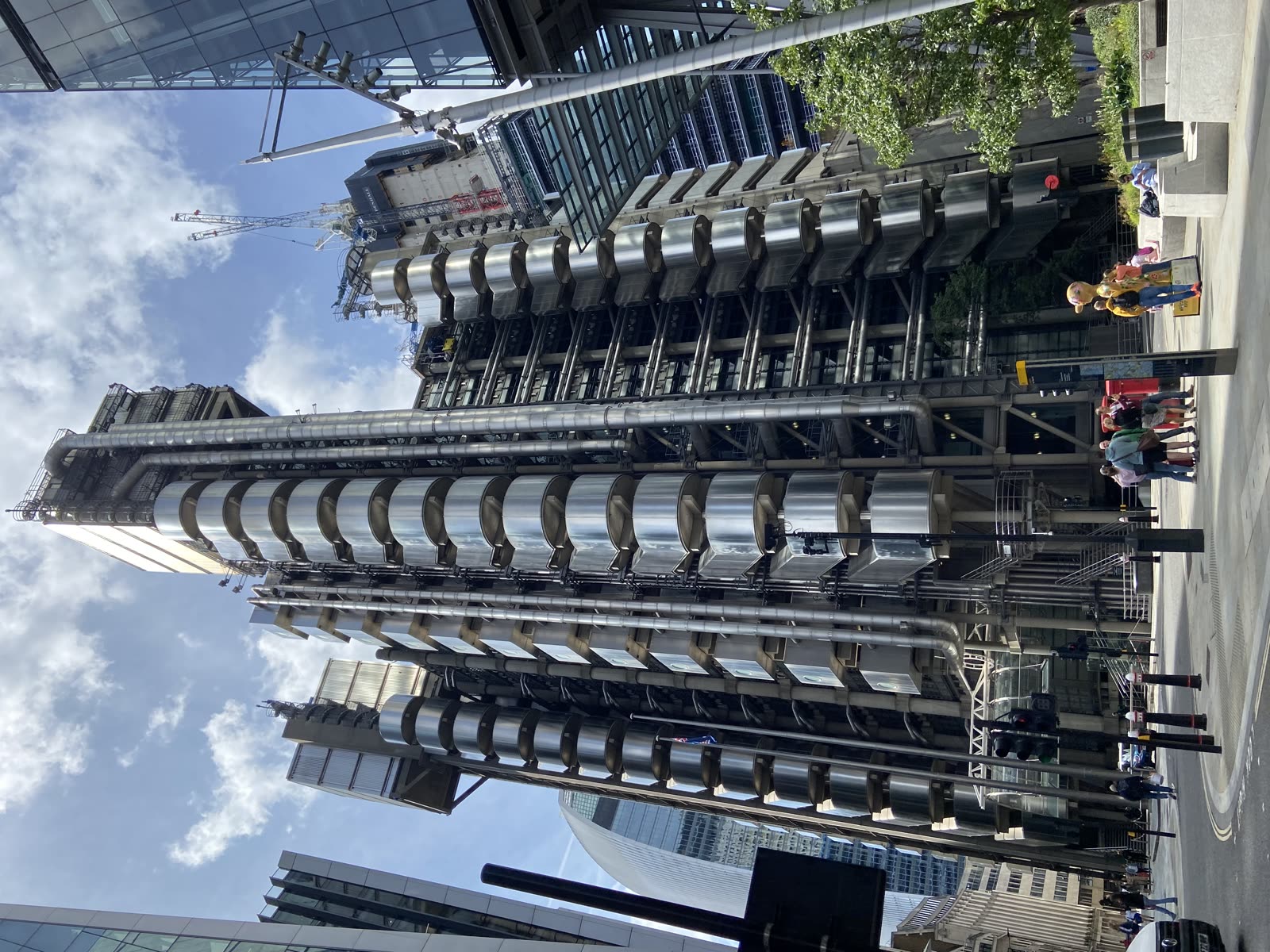
Image context: the cover uses a real photograph of the Lloyd's Building because the article is about specialty-market structure and placement power in a real insurance marketplace, not about generic "financial services" iconography.[9]
Why the handoff matters
During the hard market, broad premium inflation did a lot of work for everybody. Commission pools rose when clients renewed at higher rates, and brokers with scale could post clean top-line growth without needing every underlying exposure variable to cooperate. That backdrop is fading now. Marsh's latest Global Insurance Market Index shows global commercial insurance rates down 4% in Q4 2025, with property down 9%, financial and professional lines down 4%, and cyber down 7%.[1] The U.S. composite stopped falling, but it only held flat because casualty remained hot.[1]
That detail matters because casualty is not the same thing as a sector-wide rate tailwind. U.S. casualty rates still rose 9% in Q4 2025, largely because claims severity and large jury awards kept excess casualty capacity tight.[1] That favors brokers with strong specialty placement, wholesaling, reinsurance, and complicated advisory work. It does not automatically give the same lift to every plain-vanilla commercial book. The market is leaving the phase where a single sentence about rising insurance pricing explains enough.
The company numbers already show the split. Marsh reported full-year 2025 revenue of $27.0 billion, up 10% on a GAAP basis and 4% on an underlying basis; within Risk & Insurance Services, revenue was $17.3 billion, also up 4% underlying.[2] Aon posted 2025 organic revenue growth of 6%, a 32.4% adjusted operating margin, and $3.2 billion of free cash flow, but its Risk Capital adjusted operating margin slipped to 34.3% from 34.6%.[3] Gallagher finished 2025 with 21% revenue growth, 6% organic growth, 26% growth in adjusted EBITDAC, and 33 mergers representing more than $3.5 billion of estimated annualized revenue.[4] Brown & Brown's 2025 commissions and fees jumped to $5.763 billion from $4.705 billion after the Accession deal, yet full-year organic revenue growth was only 2.8%.[5]
That is the handoff in one paragraph. Headline growth can still look excellent. The reason underneath is getting more selective. The next winners are the brokers that can replace broad pricing tailwinds with specialty mix, exposure-linked growth, and disciplined deal execution.
Six numeric anchors
- The broad rate tailwind is cooler now: Marsh says global commercial insurance rates fell 4% in Q4 2025, while the U.S. composite was flat.[1]
- The remaining hot pocket is narrow, not universal: U.S. casualty rates still rose 9% in Q4 2025, while cyber fell 7% globally and financial/professional lines fell 4% globally.[1]
- Marsh is still compounding, but on a tighter base: full-year 2025 revenue reached $27.0 billion, up 10% GAAP and 4% underlying; Risk & Insurance Services revenue was $17.3 billion, also up 4% underlying.[2]
- Aon's quality remains obvious, but margin lift is less automatic inside broking: 2025 organic revenue growth was 6%, adjusted operating margin was 32.4%, free cash flow was $3.2 billion, and Risk Capital adjusted operating margin edged down to 34.3% from 34.6%.[3]
- Gallagher is still using M&A to keep the machine hot: 2025 revenue grew 21%, organic growth was 6%, adjusted EBITDAC grew 26%, and the firm completed 33 mergers representing more than $3.5 billion of estimated annualized revenue.[4]
- Brown & Brown shows why acquisition headlines need unpacking: 2025 commissions and fees rose to $5.763 billion from $4.705 billion, but full-year organic revenue growth was only 2.8% even before the first full integration test of Accession shows up in 2026 comparisons.[5]
Those numbers point to a cleaner conclusion than the usual "brokers are defensive" summary. The sector still has quality. The easy macro tailwind is no longer evenly distributed.
Strongest counterweight
The strongest pushback is that the sector may not need a new story at all. Clients still need advice, retention remains high, casualty is still firm in the U.S., and the large platforms keep adding specialty scale through acquisition.[1][3][4][5] If payrolls, insured values, wage bases, and asset values stay constructive enough, mid-single-digit organic growth can survive even without a broad pricing surge. In that branch, the premium stays deserved across more of the group than this article suggests.
That counterweight is real. This is not a short thesis on insurance brokers. It is a narrower claim that the next spread inside the group will come from mix and execution, not from one shared pricing escalator.
Falsifier
This framework is too selective if the next two quarters show brokers holding mid-single-digit organic growth even as broad commercial pricing stays soft, casualty remains firm enough to protect margins, and acquisition-heavy platforms integrate without visible drag to incremental profitability.[1][3][4][5] If that happens, the market will have been right to keep treating the group as a uniform quality compounder.
Watchlist
- 2026-04-27 after the close / 2026-04-28 8:00 a.m. EDT: Brown & Brown's first-quarter 2026 release and conference call are the next clean read on how much organic growth is left once Accession stops being just a headline acquisition and starts becoming a comparison base.[6]
- 2026-04-30 after the close / 5:15 p.m. ET: Gallagher's first-quarter 2026 release and call will show whether specialty mix and acquisition scale can keep organic growth and adjusted margins sturdy without a broad pricing lift.[4][8]
- 2026-05-01 7:00 a.m. CDT: Aon's Q1 2026 earnings conference call is the next test of whether high-quality broking and advisory platforms can keep converting 6%-type organic growth into margin and cash while the rate backdrop cools.[3][7]
Takeaway
Insurance brokers still have the right to trade like high-quality franchises. The part that changes in 2026 is what counts as proof. Broad premium inflation is no longer doing enough of the work on its own. The next spread belongs to firms with specialty casualty leverage, reinsurance and advisory depth, exposure-linked client growth, and acquisition integration that does more than make headline revenue look bigger.[1][2][3][4][5]
Sources
- Marsh, "Global commercial insurance rates fall 4% in Q4 2025, marking the sixth consecutive quarterly decrease" (February 4, 2026).
- Marsh, "Fourth Quarter Results, 2025" investor news release PDF (January 29, 2026).
- Aon plc, Annual Report on Form 10-K for the year ended December 31, 2025.
- Arthur J. Gallagher & Co., "Arthur J. Gallagher & Co. Announces Fourth Quarter and Full Year 2025 Financial Results" (January 29, 2026).
- Brown & Brown, Inc., "Brown & Brown, Inc. announces fourth quarter 2025 results, including total revenues of $1.6 billion, an increase of 35.7%; Organic Revenue decrease of 2.8%; diluted net income per share of $0.59; and Diluted Net Income Per Share - Adjusted of $0.93" (January 26, 2026).
- Brown & Brown, Inc., "Brown & Brown, Inc. announces 2026 first-quarter earnings release and conference call dates" (March 31, 2026).
- Aon Investor Relations, Events and Presentations page, including "Q1 2026 Aon plc Earnings Conference Call" for May 1, 2026.
- Arthur J. Gallagher & Co., "Arthur J. Gallagher & Co. Announces First Quarter 2026 Earnings Release And Conference Call Date" (April 9, 2026).
- Wikimedia Commons, "File:Lloyd's Building from St Mary Axe.jpg".