GE Aerospace's first quarter did not need to prove demand. Orders rose to $23.0 billion, adjusted revenue rose 29% to $11.6 billion, adjusted EPS rose 25% to $1.86, and free cash flow rose 14% to $1.7 billion.[1] The cleaner finance question now sits one layer lower in the mix.
Priced is that GE Aerospace has a large installed base, a young commercial fleet, and a services book that still throws off unusually resilient cash generation.[1][2] New is whether that services-heavy backlog can keep cushioning margins while the company ramps more original-equipment output, invests harder in durability and supplier capacity, and cuts its full-year departures assumption to flat to low-single-digit growth from the mid-single-digit range it carried before the recent Middle East disruption.[1][2] That is why this quarter reads less like an order story than a mix story.
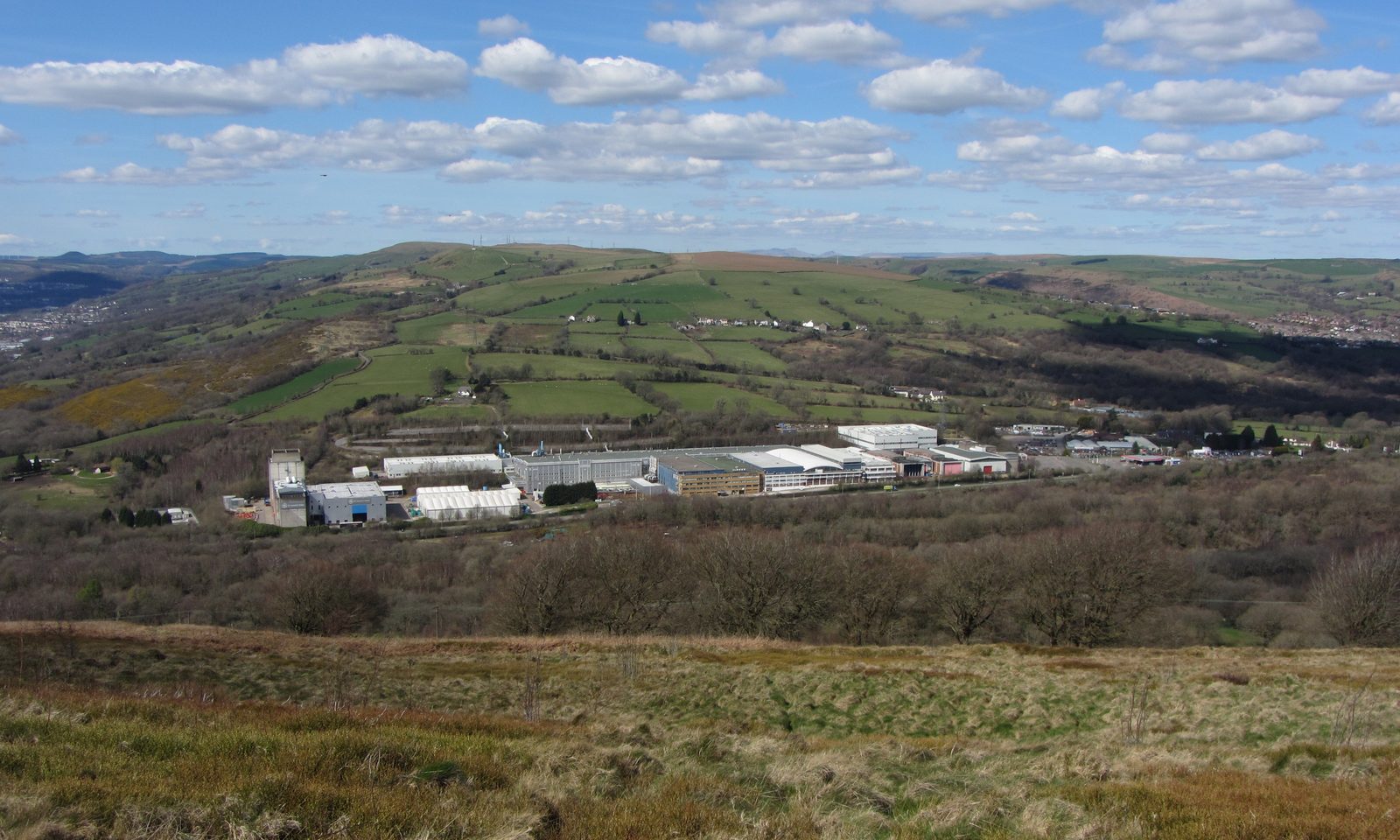
Image context: the cover uses a real photograph of GE Aviation's Nantgarw maintenance works in Wales. That is the right anchor because the quarter's quality still depends on overhaul throughput, induction timing, and parts availability. This is not mainly an abstract aerospace-growth piece. It is about how engines already flying turn into service revenue and margin.[2][5]
Priced vs new
The easy part of the GE Aerospace thesis is already visible. Commercial Engines & Services, or CES, produced $8.9 billion of first-quarter revenue, up 34%, while Defense & Propulsion Technologies added $3.2 billion, up 19%.[1] The company is not short of demand. It is not short of customers. It is not short of backlog.
What changed in this report is the shape of the next debate. CES operating profit still rose 23% to $2.4 billion, but CES margin fell 230 basis points to 26.4%.[1] Total company operating profit margin also fell 200 basis points to 21.8%.[1] Management was explicit about why: installed-engine growth, including more GE9X shipments, and continuing investment in capacity and durability pushed mix toward lower-margin equipment even as the services machine remained strong.[1][2]
That is the real split. Demand can stay excellent while margin quality still gets tested by mix.
Why services still own the quarter
The strongest part of the release was not the top-line order jump by itself. It was the evidence that services demand remains both large and unusually visible. In CES, services orders grew 49%, services revenue grew 39%, internal shop-visit revenue grew 35%, and spare-parts revenue grew more than 25%.[1][2] Those are not side statistics. They are the higher-quality part of the franchise.
Management also gave unusually concrete indicators that 2026 service demand is already largely spoken for. Commercial services backlog now stands at more than $170 billion, up nearly $30 billion since the end of 2024.[2] Since the beginning of March, spare-parts orders were up more than 30% year over year, and more than 95% of second-quarter spare-parts revenue was already in backlog entering Q2.[2] For internal shop visits, approximately two-thirds of the engines due for GE Aerospace's projected 2026 shop visits were already off-wing, either in shops or waiting for induction.[2]
That matters because it changes how investors should read the departures cut. GE Aerospace lowered its full-year departures assumption to flat to low-single-digit growth, with a low double-digit decline in the Middle East, yet held full-year guidance and said it is trending toward the high end of the range.[1][2] A business with weaker backlog visibility would have had to cut harder. GE did not, because the service pipeline is already physically forming in front of it.
Why the margin test is still open
The quarter was strong, but it did not remove the mix risk. Equipment revenue in CES grew 20%, helped by engine deliveries up 50%, including LEAP deliveries up 63%.[2] That is valuable growth, but it is not the same kind of growth as a spare-parts sale or a shop visit. Original equipment carries lower margins, requires more material flow, and arrives with more dependence on supplier readiness and customer mix.[1][2]
The transcript sharpened that tradeoff. GE said priority-supplier material input increased double digits sequentially and year over year again in the first quarter, and total engine deliveries rose 43%.[1][2] At the same time, the company is putting another $1 billion into U.S. manufacturing sites and supplier capacity, with nearly $200 million directed toward LEAP durability upgrades and $100 million earmarked for the external supplier base.[1][2] Those investments are constructive, but they also explain why investors should not expect immediate margin expansion from every additional engine shipped.
There is another pressure point inside spare parts. Management said spare-parts delinquency was up roughly 70% since the end of 2024 because demand still exceeds supply.[2] That is a double-edged fact. It supports revenue visibility because the queue is long, but it also shows that the constraint has not disappeared. GE Aerospace is monetizing scarcity, yet still working through it.
Six numeric anchors
- Headline quarter: orders were $23.0 billion; adjusted revenue was $11.6 billion, up 29%; adjusted EPS was $1.86, up 25%; free cash flow was $1.7 billion, up 14%.[1]
- CES scale: CES revenue reached $8.9 billion, up 34%, and CES operating profit reached $2.4 billion, up 23%.[1]
- Services strength: CES services revenue grew 39%; internal shop-visit revenue grew 35%; spare-parts revenue grew more than 25%.[1][2]
- Mix pressure: CES margin fell 230 basis points to 26.4%, while total company operating profit margin fell 200 basis points to 21.8%.[1]
- Backlog visibility: commercial services backlog is more than $170 billion, up nearly $30 billion since the end of 2024, and more than 95% of second-quarter spare-parts revenue was already in backlog entering Q2.[2]
- Guide still held: GE Aerospace kept its 2026 guide at $9.85 billion to $10.25 billion of operating profit, $7.10 to $7.40 of adjusted EPS, and $8.0 billion to $8.4 billion of free cash flow even after lowering departures assumptions.[1][2]
Taken together, these anchors point to one conclusion. The installed base is still doing the real de-risking. New-engine output matters, but the service backlog is what makes the 2026 guide believable.
Strongest counterweight
The strongest pushback to caution is that GE Aerospace may be closer to a cleaner margin re-expansion than this recap allows. If supplier input keeps improving, if LEAP turnaround times continue to shorten, and if a larger share of 2026 revenue lands in spares and shop work rather than fresh installs, then the current quarter's margin pressure will look more like a temporary growth mix effect than a durable ceiling.[2][4]
That case has real support. GE Aerospace still has the industry's largest commercial propulsion fleet, a large share of engines not yet through later-life service cycles, and a service book that keeps compounding as more contracted engines enter long-term service agreements.[2][3][4] In that light, the quarter's lower margin is not a broken signal. It is the cost of feeding a larger future annuity.
Falsifier
This cautious read is too tight if the next two quarters show three things together: services growth stays in the high-teens or better, spare-parts delinquency begins easing from current levels, and CES margin stabilizes even while OE output remains high.[2] If that combination appears, then the market should treat the current mix pressure as transitional rather than structural.
Watchlist
- Second-quarter services growth: management said it expects Q2 services growth in the high teens, with all shop visits for the quarter already off-line and spare-parts backlog largely spoken for.[2]
- CES margin behavior: the key question is whether CES can hold or rebuild margin after the first-quarter drop to 26.4% while equipment deliveries remain elevated.[1][2]
- Farnborough Air Show in July 2026: management explicitly pointed to Farnborough as the next major commercial-order checkpoint, especially for LEAP and GEnx programs.[2]
- Departures and Middle East disruption: the 2026 guide now assumes flat to low-single-digit departures growth rather than mid-single-digit growth, so any further traffic deterioration would test how much cushion the backlog really provides.[1][2]
Takeaway
GE Aerospace's first quarter was strong enough to narrow the finance question. Orders are not the problem. Demand is not the problem. The backlog is not the problem.
The question is mix. A huge services backlog is cushioning the franchise, while faster OE output and ongoing capacity investment are asking investors to tolerate lower margins in the short run. If services stay tight enough to hold the high end of guidance while that OE ramp continues, the stock keeps earning its premium. If the services cushion thins before equipment mix normalizes, the quarter will look strong in headline terms but less elegant underneath.
Sources
- GE Aerospace, "GE Aerospace Announces First Quarter 2026 Results" press release PDF (April 21, 2026).
- GE Aerospace, "Q1 2026 GE Aerospace Earnings Call" transcript PDF (April 21, 2026).
- GE Aerospace, "2026 1Q Form 10-Q" PDF (April 21, 2026).
- GE Aerospace, "GE Aerospace Releases 2025 Annual Report and 10-K" (January 29, 2026).
- Wikimedia Commons, "File:View over the GE Aviation aircraft engine maintenance works at Nantgarw - geograph.org.uk - 4416463.jpg".