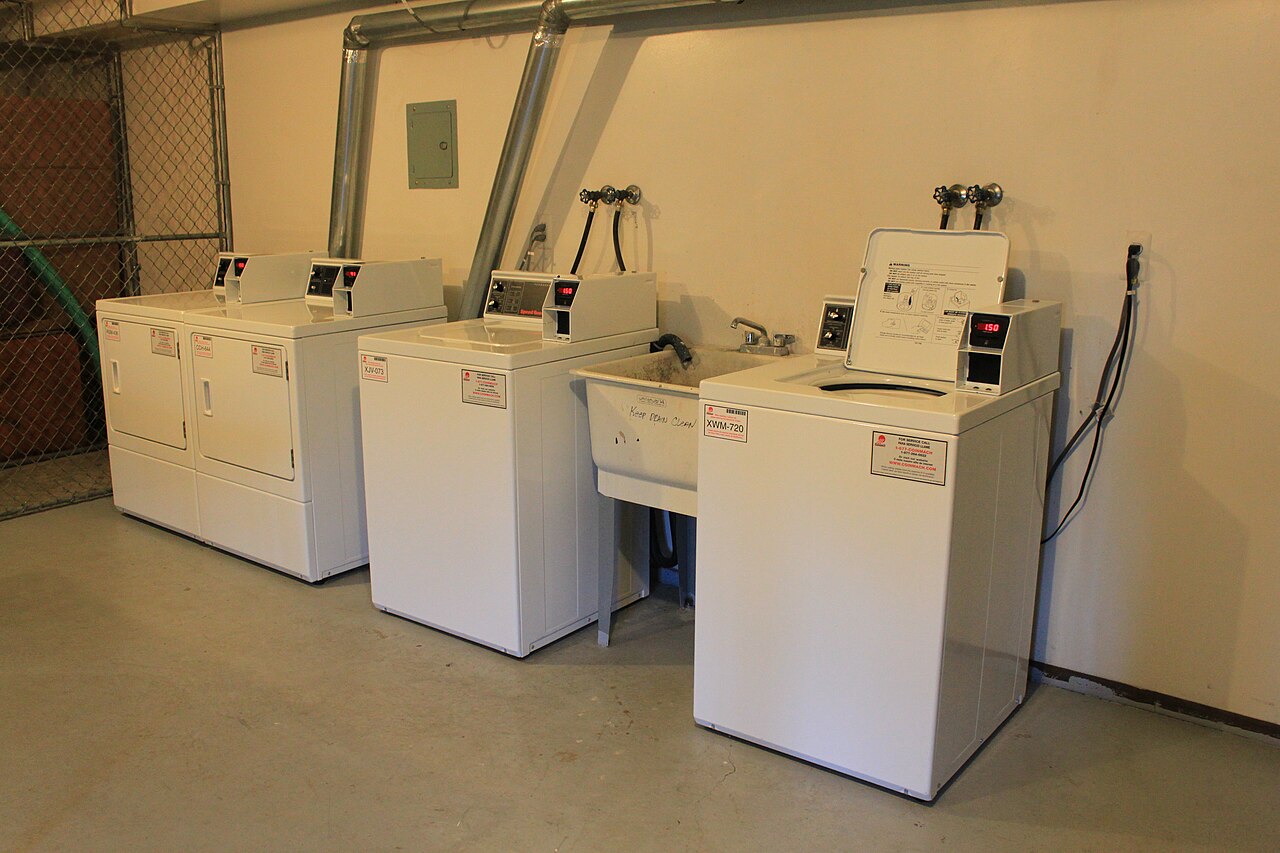
Priced: EVI Industries' familiar claim is a buy-and-build record that management says lifted annual revenue from about $36 million to nearly $435 million. New: its July agreement to buy Sudsies for headline consideration of $34.6 million makes the next proof less about acquired revenue than whether a commercial service system can travel into consumer garment care while inventory and debt already demand cash.[1][4][5]
The cautious thesis is that those capabilities are local until EVI proves otherwise. Commercial service density, a luxury-care route, and a founder's reputation can reinforce one another, but common ownership does not make them interchangeable.
Evidence cutoff: August 29, 2026. Market data use the August 28 close. The Sudsies agreements had not been reported as closed by the cutoff. Company projections, including expected accretion, are expectations rather than established results. This is an operating and capital-allocation analysis, not individualized investment advice.
The route matters more than the drum
EVI is not a washer manufacturer. Its subsidiaries design laundry rooms and plants, sell or lease equipment made by others, install those systems, stock parts, and send technicians back when machines need maintenance or replacement. Customers range from laundromats and hotels to hospitals, industrial plants, institutions, and government agencies.[1]
The commercial mechanism is short enough to write as a chain:
regional distributor -> installed equipment -> service call -> parts demand -> replacement lead
A large or competitively bid equipment project can carry a lower initial margin. EVI argues that the concession can still be worthwhile when it enlarges the installed base available for later service.[1] Buying a distributor therefore adds revenue on closing day; integration creates value only if a denser technician network responds faster, carries the right parts, completes more calls per day, and returns qualified replacement work to sales.
Management's rollout data show throughput, not yet the economics. The common field-service platform expanded from two business units completing about 1,000 appointments in July 2024 to 27 units completing more than 8,500 in June 2025; EVI also reported more than 425 service professionals.[3] That is a large activity gain. It becomes an operating advantage only if travel time, first-time fix rates, parts availability, pricing, and technician utilization improve enough to cover the central systems and integration staff.
This distinction matters in any consolidator. Acquisition count measures transactions. A shared operating system has to earn its way into profit and cash through ordinary work after the deal.
The March quarter exposed the leverage gap
The fiscal third quarter showed both sides of the model. Revenue rose 8% to $101.1 million and gross margin reached a record 32.5%, but operating income was essentially flat at $2.3 million.[1][2] Better gross economics did not become operating leverage because selling, general, and administrative costs rose with integration, modernization, and the larger enterprise.
Cash carried the same warning. From June 30, 2025 to March 31, 2026, net inventory increased from $66.1 million to $80.2 million. Nine-month operating cash flow fell to $7.2 million from $11.3 million a year earlier, while revolver borrowings reached $60 million.[1]
Management offered a meaningful counterweight, but it is narrower than saying the whole build was contracted. About 65% of equipment inventory across four operating regions—excluding the master-distributor operations—was allocated to confirmed contracts. EVI separately attributed inventory growth partly to manufacturer price increases, tariffs, and purchases ahead of anticipated pricing actions and customer deliveries.[2]
Commercial laundry equipment does not become revenue merely by reaching a warehouse. Customer sites must be ready, machines delivered, and installation obligations satisfied.[1] Fiscal fourth-quarter deliveries could therefore turn stock into receivables and cash; delay could leave the same inventory absorbing capital. Confirmed orders reduce demand risk, not the timing risk around site readiness, labor, installation, and acceptance.
The March balance sheet is thus a baseline rather than a verdict. Fiscal-2026 results can reveal whether equipment converted after quarter-end, but they cannot show how a transaction agreed in July or a buyback announced later that month was funded.
Sudsies changes the unit of account
Sudsies is small beside EVI's commercial platform, but its economics differ enough to alter the mix. For the twelve months ended June 30, 2026, EVI said the South Florida garment-care operator generated $21.7 million of revenue, $4.7 million of operating income, and $5.7 million of EBITDA.[4] The first two figures imply a 21.7% operating margin. EVI's GAAP operating margin for the nine months ended March was about 3.1%, calculated from its filing.[1]
That comparison is directional, not like-for-like. The periods differ, the operating models differ, and Sudsies has not yet passed through EVI's financing, purchase accounting, or public-company cost structure. It nevertheless shows why the acquired mix could matter even before national expansion.
The transaction filing makes the transfer question unusually literal. Four agreements specify aggregate consideration of $34.624778 million before working-capital and other adjustments: roughly $34.0 million in cash and $0.6 million in stock-equivalent consideration. Dividing the headline price by Sudsies' disclosed EBITDA gives about 6.1 times.[4][5]
One of those agreements allocates about $7.1 million—roughly one-fifth of the total—to the founders' personal goodwill.[5] That does not mean the value vanishes after closing. It does mean customer trust, reputation, and relationships are explicitly part of what EVI is paying for. Retaining them while changing ownership is central to the underwriting.
What can transfer is narrower than the shared word laundry suggests. EVI brings acquisition experience, equipment knowledge, procurement relationships, local-business autonomy, and common dispatch and data systems. Sudsies brings a luxury-care brand, digitally driven customer acquisition, garment expertise, and a dedicated pickup-and-delivery fleet concentrated in South Florida.[4]
A commercial technician travels to a fixed machine and restores uptime. A garment-care route moves individually tracked items through pickup, cleaning, quality control, and return. Its density comes from customers and stops per route, not from commercial machines already installed nearby. A national distributor map may help with facilities, procurement, or acquisitions; it does not by itself reproduce Miami route density or founder goodwill.
The strongest counterweight is that EVI is not buying a turnaround. Sudsies arrived with positive disclosed operating income, an established fleet, and its own logistics and digital systems.[4] Those assets may teach the parent more about consumer data and recurring route behavior than its equipment business naturally provides. Management expects the acquisition to be accretive in the fiscal year ending June 30, 2027, although accretion alone would not prove that the model scales outside its home market.[4]
Three claims on the same dollar
The July 28 repurchase authorization sharpens the sequencing problem. EVI may buy up to $10 million of shares, but the program has no expiration date and requires no purchase.[6] At the August 28 close of $14.35 and using the 12.87 million shares outstanding reported in May, full use would cover roughly 697,000 shares, or about 5.4% of that count, before fees and price changes.[1][6][7]
That is meaningful optionality, not a commitment. The same balance sheet entered the summer with commercial-project inventory and $60 million of floating-rate revolver borrowings, then agreed to pay almost all of the Sudsies headline consideration in cash.[1][5] A repurchase can be sensible if the shares are unusually cheap and operations are converting cash. It is harder to defend if working capital or debt funds the confidence signal.
The choice is not simply “buyback or growth.” It is sequence and hurdle rate: deliver equipment, collect cash, close and integrate Sudsies, then compare a repurchase with the return on the next acquisition. A roll-up earns capital-allocation credibility when it can wait on either option.
The falsifier
The thesis here is narrow: owning a national commercial-laundry network does not, by itself, make Sudsies' consumer route economics transferable. It would be falsified if, by June 30, 2027, EVI shows consumer growth beyond the acquired South Florida footprint while preserving something close to Sudsies' pre-deal operating margin and without working capital or net borrowing rising faster than the acquired operation's profit. That combination would show that EVI's logistics, data, and acquisition disciplines travel across the boundary.
If EVI does not disclose enough consumer-level data to test those conditions, the thesis remains untested rather than confirmed. Revenue growth alone would not settle it.
What to watch next
- September 1, 2026 outside date: the July 17 agreements anticipated closing within 30–45 days, and three operating-company transactions permit termination if they have not closed by September 1. Watch the closing filing for adjustments and final cash and share consideration.[5]
- Fiscal-2026 results and Form 10-K: reconcile March inventory with fourth-quarter deliveries, year-end operating cash flow, and revolver borrowings. Because the year ended June 30, this is the pre-Sudsies, pre-buyback baseline—not evidence of their funding.[1][2]
- Quarter ending September 30, 2026: the subsequent filing should reveal the acquisition funding, initial consolidation, debt movement, and whether EVI used the repurchase authorization.[5][6]
- Year ending June 30, 2027: test management's accretion expectation and look for consumer revenue, margin, retention, route-density, or market-expansion evidence that can separate a successful Miami asset from a transferable platform.[4]
EVI's first decade of buy-and-build showed that a regional distributor could become a national commercial platform. Sudsies asks a more demanding question: whether the systems built around fixed machines can preserve founder goodwill and compound a consumer route where every garment moves.
Sources
- EVI Industries, Form 10-Q for the quarter ended March 31, 2026 — business model, quarterly results, inventory, operating cash flow, borrowings, liquidity, revenue recognition, and shares outstanding.
- EVI Industries, "EVI Industries Reports Record Third Quarter Results" (May 11, 2026) — gross-margin and adjusted-EBITDA disclosures, working-capital explanation, business-unit scale, and management commentary.
- EVI Industries, "EVI Industries Reports Record Fiscal 2025 Results" (September 11, 2025) — field-service rollout, appointment volume, technician count, ERP deployment, and buy-and-build operating strategy.
- EVI Industries, "EVI Industries to Expand Into Consumer Garment Care Services Industry With Agreement to Acquire Sudsies, Inc." (July 20, 2026) — transaction rationale, standalone Sudsies financials, operating model, closing conditions, and fiscal-2027 accretion expectation.
- EVI Industries, Form 8-K filed July 23, 2026 (agreements dated July 17) — four Sudsies transaction agreements, consideration components, expected closing window, outside date, and correction to a prior growth-rate disclosure.
- EVI Industries, "EVI Industries Announces Share Repurchase Program" (July 28, 2026) — $10 million authorization, discretion, absence of an expiration date, and capital-allocation conditions.
- Stock Analysis, "EVI Industries Stock Price History" — August 28, 2026 closing price and trading record.
- Dwight Burdette via Wikimedia Commons, "Cash card-operated Speed Queen commercial washers and dryers" (photographed September 21, 2011) — source page for the real photograph used as the hero image.