Eaton still looks like the kind of industrial compounder that earns a premium. In 2025, sales rose to a record $27.4 billion, adjusted earnings per share rose to $12.07, free cash flow reached $3.6 billion, and the company entered 2026 with Electrical and Aerospace backlog still expanding.[1][2] Priced is that Eaton sits in the right end-markets: data center power, utility equipment, commercial electrification, and aerospace. New is narrower. At about $425.55 per share on 2026-05-01, the stock is already pricing in more than simple exposure to good themes. It is pricing in clean backlog conversion, sustained order quality after a hot data-center cycle, and a Mobility separation that improves the mix without introducing a new execution discount.[1][3][5]
The company itself is helping set that bar. Eaton's fourth-quarter release did not just show a strong finish to 2025; it paired that finish with a 2026 setup that still asks investors to pay up. Full-year 2026 adjusted EPS guidance of $13.00 to $13.50, expected organic growth of 7% to 9%, and expected segment margins of 24.6% to 25.0% are the kind of numbers that justify a premium only if the electrical surge keeps translating into revenue and profit with very little slippage.[1]
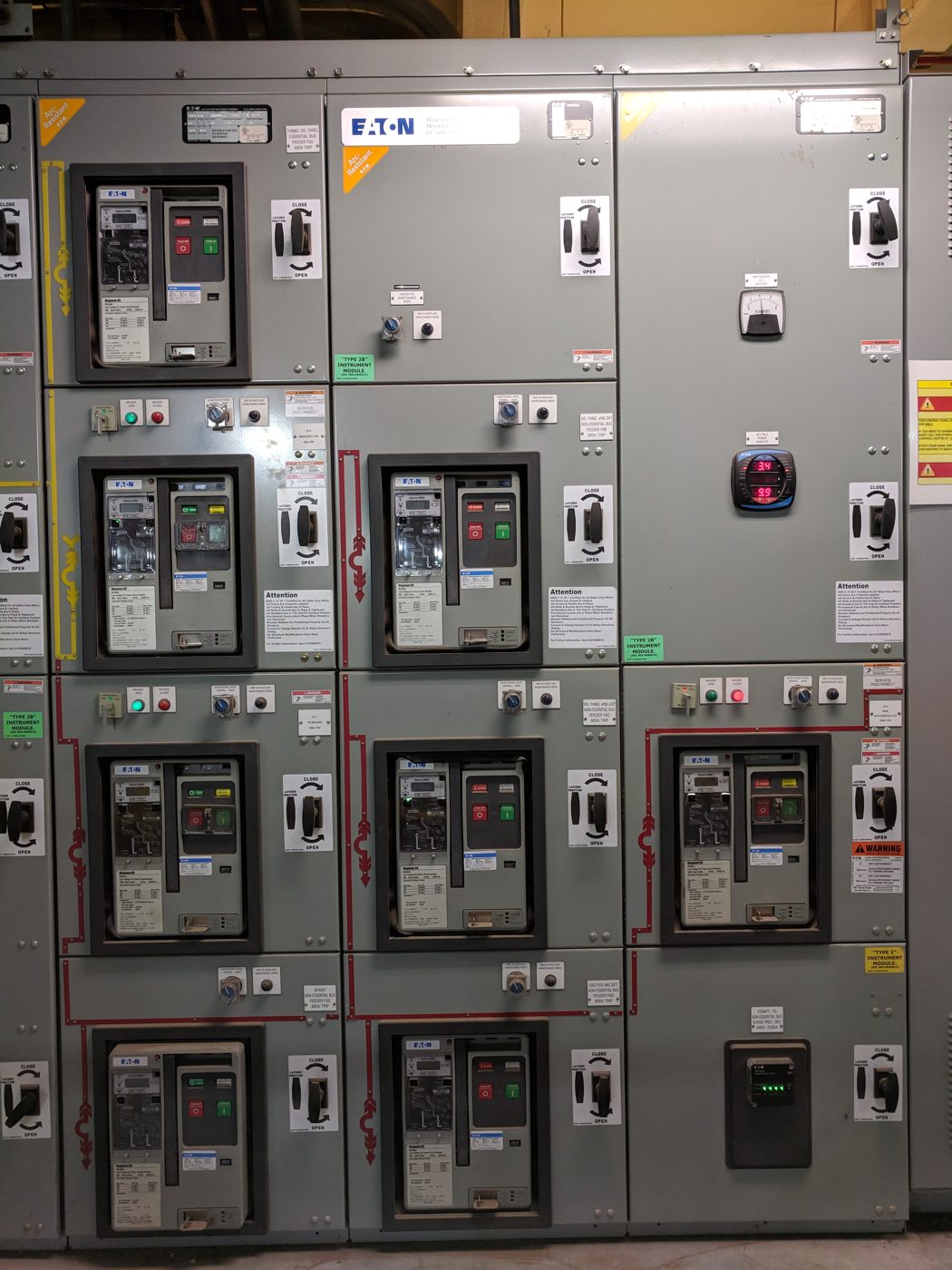
Image context: the cover uses a real Wikimedia Commons photograph of Eaton switchgear in service, not a symbolic grid graphic. That is the right visual language for this article because the investment case lives inside actual electrical equipment orders, factory throughput, and project timing.[6]
Why the premium is real
The strongest part of Eaton's case is that the growth is not coming from one weak segment dragged upward by narrative. It is concentrated in the better businesses. The 2025 annual report shows Electrical Americas net sales of $13.276 billion and operating profit of $3.972 billion, with 29.9% operating margin.[2] Backlog at year-end was $13.246 billion, up 31% from the prior year, while organic customer orders were up 16% and book-to-bill stayed at 1.2.[2] The annual report states directly that the organic sales increase in 2025 was driven by strength in data center end-markets.[2]
The second electrical lane stayed healthy too. Electrical Global generated $6.815 billion of sales in 2025 with 19.4% operating margin, while year-end backlog rose to $2.034 billion, up 19% from 2024.[2] The report again ties the growth to concrete end-markets rather than vague enthusiasm: data center, machine OEM, residential, and GEIS strength all helped, even as industrial demand stayed softer.[2]
That is why the quality case is not hard to defend. The fourth-quarter release showed Electrical Americas sales up 21% year over year to $3.5 billion, Electrical Global sales up 10% to $1.7 billion, and Aerospace sales up 14% to $1.1 billion.[1] Eaton is not trying to prove that it has found one lucky pocket of demand. It is showing a portfolio where the high-quality businesses are already the ones doing the lifting.
What the stock is already assuming
The problem is valuation, not business quality. At roughly $425.55 per share, Eaton trades at about 35.3x 2025 adjusted EPS and about 32.1x the midpoint of 2026 adjusted EPS guidance.[1][5] Those are not impossible multiples for an industrial name with unusually good end-market exposure and rising margins. They are, however, multiples that assume more than "electrification is good."
What they assume, first, is conversion speed. Eaton finished 2025 with Electrical backlog up 29% overall, including 31% in Electrical Americas and 19% in Electrical Global.[1][2] If that backlog turns into revenue efficiently, the premium can hold. If project timing slips, customers stretch schedules, or component and labor constraints slow delivery, the market will start distinguishing between booked enthusiasm and realized earnings.
Second, the multiple assumes that data-center demand remains broad enough to support margins rather than just headline order growth. Eaton's own disclosures repeatedly identify data centers as a driver in Electrical Americas and Electrical Global.[1][2] That is bullish, but it also means the stock is more exposed to one especially celebrated capex lane than a casual "diversified industrial" label would suggest.
What the Mobility separation changes
The January 2026 spin-off announcement is a genuine strategic positive, but it is also another proof point the market will test. Management's stated goal is clear: sharpen the company around higher growth, higher margin Electrical and Aerospace businesses, make the separation immediately accretive to Eaton's organic growth and operating margin, and complete the spin by the end of the first quarter of 2027 on a tax-free basis for U.S. shareholders, subject to approvals.[3]
That can make the post-spin company better. The Vehicle and eMobility businesses were already the least impressive lines in the 2025 annual report: Vehicle sales fell 10% to $2.505 billion with 16.7% margin, while eMobility sales fell 7% to $565 million and remained barely profitable.[2] Removing those pieces should make Eaton's remaining mix look cleaner, more margin-rich, and more aligned with secular electrical and aerospace demand.
But investors should be precise about what that means. A better mix is not the same thing as a cheaper stock. If the separation works smoothly, it likely deserves some multiple support. If the market has already capitalized that cleaner mix before the spin mechanics, Form 10 process, and stand-up costs are fully visible, the upside from "portfolio improvement" can be smaller than the headline logic suggests.[3]
Six numeric anchors
- 2025 sales reached $27.4 billion, up 10%, with 8% organic growth.[1]
- 2025 adjusted EPS reached $12.07, while free cash flow reached $3.6 billion.[1]
- Fourth-quarter 2025 sales reached $7.1 billion and segment margin reached 24.9%.[1]
- Electrical Americas backlog ended 2025 at $13.246 billion, up 31%, with 16% organic order growth and 1.2 book-to-bill.[2]
- Electrical Global backlog ended 2025 at $2.034 billion, up 19%, while Aerospace backlog reached $4.316 billion, up 16%.[2]
- At about $425.55 per share on 2026-05-01, Eaton trades at about 35.3x trailing adjusted EPS and about 32.1x the midpoint of 2026 adjusted EPS guidance.[1][5]
Those anchors describe a very good company. They also describe a stock that already expects the very good company to keep looking easy.
Strongest counterweight
The strongest pushback is that this article may still be too stingy. Eaton's 2025 and late-2025 numbers are exactly what investors say they want from a premium industrial: rising orders, backlog visibility, high electrical margins, Aerospace support, and a management team explicitly narrowing the portfolio toward higher-growth, higher-margin businesses.[1][2][3] If the right way to value Eaton is as a power-management platform sitting inside data-center buildouts, grid hardening, reindustrialization, and aerospace aftermarket demand all at once, then a mid-30s adjusted multiple may be expensive only in the way great assets often look expensive.
That case is credible. It is also why the burden of proof is now so specific. Eaton no longer needs to prove it is pointed at the right markets. It needs to prove that the timing, conversion, and portfolio-shaping details will stay as clean as the narrative.
Falsifier
This cautious framing is wrong if Eaton's 2026-05-05 first-quarter report shows that orders and backlog are still compounding, segment margins land at or above the top of guidance, and management either raises 2026 adjusted EPS or narrows guidance toward the upper end while keeping the Mobility separation on track.[1][3][4] If that happens, today's premium will look less like overpayment and more like investors paying correctly for rare visibility.
Watchlist
- 2026-05-05 first-quarter 2026 earnings: the next hard read on backlog conversion, margin delivery, and whether 2026 guidance already needs to move.[4]
- Electrical Americas and Electrical Global order growth: if data-center strength stays broad and book-to-bill remains above 1.0, the premium case keeps its core support.[1][2]
- Mobility spin execution milestones: the planned Form 10 process, separation costs, and management commentary matter because the spin is expected to be completed by the end of Q1 2027.[3]
- Whether cleaner mix turns into cleaner cash conversion: Eaton already has record sales and free cash flow; the next question is whether backlog quality keeps translating into realized earnings without more working-capital drag.[1][2]
Takeaway
Eaton still deserves a premium. The electrical franchises are large, profitable, and backed by real backlog. Aerospace is adding support rather than noise. The Mobility separation should improve the mix instead of diluting it.[1][2][3] The narrower finance question is what kind of premium the stock still deserves at roughly 35x trailing adjusted earnings.[1][5] At this price, investors are no longer paying for the right story alone. They are paying for fast conversion, durable order quality, and clean strategic execution. Those are higher standards, and Eaton now has to keep meeting them quarter by quarter.
Sources
- Eaton, "Eaton Reports Record Fourth Quarter 2025 Results, with Accelerating Orders and Continued Backlog Growth, and Issues Guidance on 2026 Outlook" (February 3, 2026) - full-year 2025 results, fourth-quarter segment data, backlog growth, and 2026 guidance.
- Eaton, 2025 Annual Report - 2025 segment sales, margins, backlog, customer-order growth, and end-market commentary across Electrical Americas, Electrical Global, Aerospace, Vehicle, and eMobility.
- Eaton, "Eaton announces plan to spin off its Mobility Group" (January 26, 2026) - rationale, accretion claims, and expected end-Q1 2027 timing for the planned separation.
- Eaton, "Eaton to announce first quarter 2026 earnings on May 5, 2026" (April 21, 2026) - next results date and conference-call timing.
- Google Finance, "Eaton Corporation PLC (NYSE: ETN) Stock Price & News," accessed 2026-05-03 - share price reference used for the valuation multiples in this article.
- Wikimedia Commons, "File:RG&EStation5PowerHouseEatonMagnumDSLowVoltageSwitchgear.jpg" - source page for the Eaton switchgear photograph used as the article image.