A contractor can price work to leave an $80,000 margin and still need $20,000 of outside cash when the government pays the progress bill. The gap appears when retainage, a portion withheld pending better performance, exceeds the margin built into that work.[1]
The financing question starts before the last inspection. A crew must be paid while its work is turning into an approved estimate, and an approved estimate may still turn into less cash than expected. A reliable customer and a profitable price do not, by themselves, settle that timing problem.
Sources checked on 17 October 2026. This is a hypothetical U.S. federal fixed-price construction scenario using the cited clauses. The executed contract, including applicable agency supplements or deviations, determines the actual terms. These figures are assumptions, not a reported project's results.
The payment that leaves the job short
Suppose a contractor obtains approval for a progress estimate covering $1 million of conforming work on a larger project. The cash costs allocated to that slice of work total $920,000, payable before any retained money returns. The difference is the margin above those costs, before financing and tax. Assume no advance payment, no other deductions and no bond-premium reimbursement in this estimate.
Now suppose the project has fallen behind schedule and the contracting officer determines that progress is unsatisfactory. The work included in the estimate meets the contract's quality requirements, but the project's pace does not. Under the standard federal rule, the officer can retain up to 10% of the approved estimated amount, with the decision made case by case.[1]
At that maximum, the contractor receives $900,000. Subtract the costs coming due and the job needs the outside cash identified above. That calculation isolates the payment gap after the progress payment arrives; the earlier need to fund work before billing may be larger.
Retainage has not automatically destroyed the margin. It has delayed cash that the contractor expected to use. If the money is eventually released without extra costs, the original economics survive before financing charges. If the delay requires borrowing, interest takes part of the margin. If catching up requires overtime or corrective work, those costs take another part. The financing problem can become a profitability problem, but they begin as different problems.
Better performance changes the branch
The strongest counterweight is that this withholding is conditional. Federal policy says funds should not be withheld without cause and allows the retained amount to be reconsidered as performance improves or other safeguards become available.[1]
The standard payment clause makes the distinction explicit: satisfactory progress calls for full payment for the period. In the hypothetical full-payment branch, the same work and costs produce a cash surplus equal to the original margin instead of a funding gap.[2]
This is why applying a blanket retention percentage to every federal job can mislead a cash forecast. The important input is the contracting officer's performance assessment and the contract's payment terms. A percentage copied from a previous project can obscure both a legitimate release opportunity and a developing delay.
The retainage-driven cash-shortfall thesis fails if the full progress payment, or enough released retainage, arrives before the assumed bills fall due. It also disappears if costs due before release do not exceed the cash received. A performance concern alone does not establish the size or timing of a cash deficit.
Substantial completion can release cash in stages
There is a middle branch between continuing to withhold and closing the entire contract. At substantial completion, the standard clause permits the government to keep an amount adequate for its protection and requires release of the balance. Completed and accepted buildings or other contract divisions with separately stated prices can also be paid without percentage retention.[2]
For the cash forecast, that means the release schedule may follow identifiable parts of the job. A separately priced building that has been accepted can matter more than a broad estimate that the overall development is nearly finished. The useful question is which work has crossed the contractual payment threshold.
The downside branch is that a nearly finished site still leaves the contractor funding the wait. Prompt-payment interest does not ordinarily accrue on amounts properly retained under the contract. Release approval has its own payment timetable, so an inspection milestone and a bank receipt should remain separate forecast events.[3]
Administrative completion matters too. GSA's supplemental clause calls for separate requests for progress payments, retainage and final payments. It also conditions final payment on required closeout material, including warranties, as-built drawings and operating manuals, together with a release of claims that can reserve specifically identified claims.[4]
The implication is financial: closing a documentation gap may bring cash forward without changing the building's physical completion. A forecast that puts all remaining receipts on the day the last trade leaves can miss that dependency.
The subcontractor is a separate cash calculation
The prime contractor cannot simply assume the government's withholding passes through unchanged to every supplier. The prompt-payment clause permits negotiated subcontract retainage, but subcontract terms and payment obligations still govern. It also bars requesting government payment for amounts the prime intends to retain until the subcontractor is entitled to them.[3]
Our example therefore assumes the stated costs actually fall due before release. If valid subcontract terms shift those outflows, the funding requirement changes. Stretching a payment without a contractual basis is not an equivalent financing assumption.
What to watch next
- At the next progress-payment review: compare the officer's performance finding, the approved estimate and the amount actually authorized. This determines which cash branch applies.[1][2]
- At substantial completion or acceptance of a separately priced division: identify the amount still needed for government protection and obtain the corresponding release decision. Physical progress matters when it changes payment entitlement.[2]
- When release is approved and closeout documents are submitted: put the contractual payment due date into the cash forecast and track any outstanding deliverables. For GSA work under the cited supplement, use the appropriate separate payment request.[3][4]
Sources
- Federal Acquisition Regulation, 32.103, “Progress payments under construction contracts” — case-by-case retainage, the ceiling and adjustment as performance changes.
- Federal Acquisition Regulation, 52.232-5, “Payments under Fixed-Price Construction Contracts,” paragraphs (b), (e), (g) and (h) — progress estimates, satisfactory performance, release and final-payment conditions.
- Federal Acquisition Regulation, 52.232-27, “Prompt Payment for Construction Contracts,” paragraphs (a), (c), (d) and (h) — payment timing, retained amounts and subcontractor entitlements.
- General Services Administration Acquisition Manual, 552.232-5, “Payments under Fixed-Price Construction” — separate requests and contractual closeout documents.
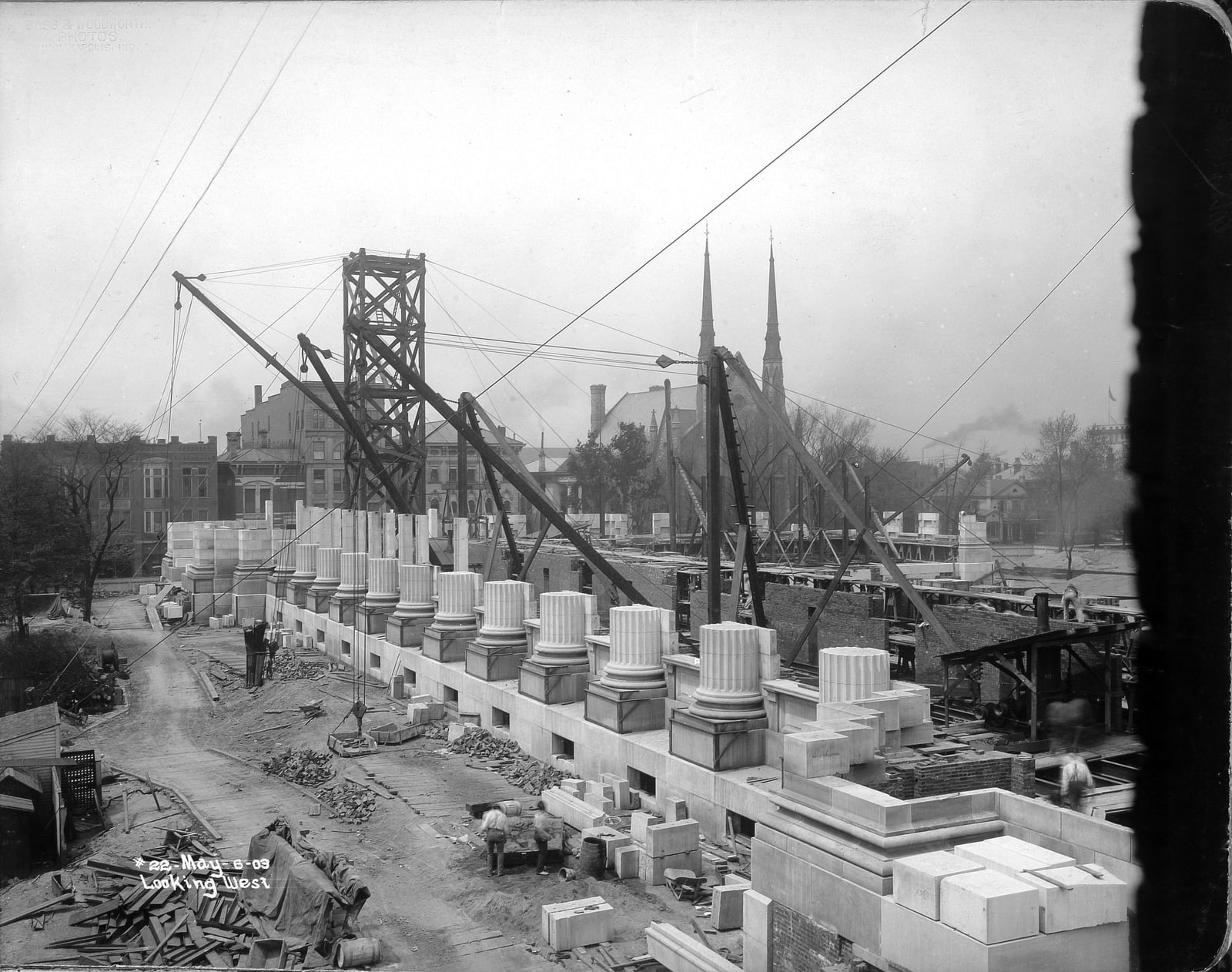
- U.S. District Court, Southern District of Indiana, “Courthouse Construction Images” — archival photograph number 22, looking west, May 6, 1903.