Gold is already priced as a strategic reserve asset, not just a jewelry cycle or a retail fear trade. The new part is that official demand has survived record prices; the hard part is that gold still has to compete with real yields, liquidity needs, and the fact that a bar in a vault pays no coupon.
The market's lazy version says "central banks are buying gold, therefore the dollar is finished." The cleaner version is narrower and more investable: reserve managers are adding a non-liability asset because sanctions risk, fiscal pressure, inflation anxiety, and geopolitical fragmentation have made diversification more valuable. That creates a floor under demand, but it does not make price insensitive forever.
The Mechanism
Gold's reserve bid works through three channels.
First, official-sector buying removes metal from the price-sensitive pool. World Gold Council data show central banks bought about 244 tonnes on a net basis in the first quarter of 2026, up 3% from a year earlier and 17% from the previous quarter.[1] The April update kept the pattern alive: reported central banks bought 19 tonnes net, with Poland adding 14 tonnes and China adding 8 tonnes in the month.[2] That is not a speculative ETF flow that can reverse on a bad payroll print. It is slower institutional allocation.
Second, private investment has joined the same direction. Total first-quarter gold demand, including OTC, reached 1,231 tonnes, up 2% year over year, while the value of quarterly demand jumped 74% to $193 billion.[1] Gold-backed ETFs added 62 tonnes in Q1. Bar and coin demand reached 474 tonnes, up 42% year over year.[1] The mix matters: jewelry volumes were down 23%, so the demand story is no longer led by adornment. It is led by investors and official institutions.
Third, valuation effects have made gold look larger inside the reserve system. The ECB's June 2026 report says gold's share of total official foreign reserves reached 27% at the end of 2025, above U.S. Treasuries at 22% and the euro at 15%.[3] That headline is powerful, but the ECB's own caveat is the point: using end-2023 gold prices, U.S. Treasuries would still be larger at 26%, while gold and the euro would each sit around 16%.[3] Gold has gained rank because reserve managers bought it and because the price rose. Investors should not confuse those two sources of return.
What Is Priced
The market has mostly priced the obvious narrative: central banks want more diversification. The World Gold Council's 2025 survey found 95% of central-bank respondents expected global official gold reserves to rise over the following 12 months, and 43% expected their own institution's holdings to increase.[5] That is a strong demand signal, but it is no longer hidden.
The less-priced part is the distinction between allocation and replacement. IMF COFER data still tracks the foreign-exchange reserve system by currency, with 147 reporting entities and total foreign-exchange reserves around $13.0 trillion in the latest highlighted 2025Q3 update.[4] COFER is not a gold table; that is exactly why it is useful here. Gold is gaining as a reserve asset, but the operating system of global reserves still runs through currencies, payments, bills, deposits, and sovereign bonds.
That makes gold a hedge against confidence shocks, not a full substitute for dollar liquidity. A central bank can hold gold against geopolitical tail risk. It cannot use gold as cleanly as Treasury bills for day-to-day intervention, collateralized dollar funding, or short-dated liquidity management. The ECB underlines the same limitation: gold is volatile, does not remunerate holders, carries physical storage costs, and has inelastic supply.[3]
The Counterweight
The strongest counterweight is real yield. FRED's Cleveland Fed series put the U.S. 10-year real interest rate at about 1.89% for June 2026, up from 1.63% in May and 1.59% in April.[6] That is a direct opportunity-cost problem. Gold can rally with high real yields if the reserve-insurance bid is strong enough, but the hurdle is higher when investors can earn a positive real return in Treasuries.
The second counterweight is that central banks also sell. The Q1 WGC report notes a visible rise in reported sales, including Turkey and Russia, even though net demand stayed positive.[1] April data showed Russia selling 6 tonnes while Turkey's position was roughly flat after March reserve-management operations.[2] That does not break the long-term bid; it clarifies its nature. Official gold is a reserve tool, and reserve tools get used when foreign-exchange or domestic-liquidity pressure bites.
The third counterweight is price itself. At record or near-record prices, jewelry demand weakens, recycling responds, and tactical investors can become less patient. WGC reported Q1 supply at 1,231 tonnes, up 2% year over year, with recycled gold up 5%.[1] Supply is not elastic like Treasury issuance, but it is not frozen either. Higher prices pull some metal back into the market.
The Trade Read
The bullish case is not "buy gold because central banks are buying." That is too blunt. The bullish case is that central-bank buying changes the downside distribution. When official buyers are pursuing reserve diversification rather than quarterly performance, dips can meet steadier demand than a normal commodity would.
The bearish case is not "gold yields nothing." That has always been true. The bearish case is that the market has already capitalized a large part of the strategic-bid story while real yields are rising and some official holders are showing that gold can be mobilized for liquidity. If the next move is a calmer geopolitical tape plus higher real yields, the marginal ETF buyer may become more important than the central bank buyer.
My base case sits between those poles. Gold deserves a higher strategic allocation premium than it carried before the reserve-fragmentation cycle began. But it should not trade as if every tonne of official demand is permanent and every dollar reserve asset is being abandoned. The smarter read is a barbell: gold is becoming more important as insurance, while Treasuries and dollars remain the working capital of the reserve system.
Falsifier
The thesis fails if official buying stops cushioning the market while real yields stay high. Concretely: monthly central-bank data would need to turn into repeated net sales, ETF inflows would need to reverse into persistent outflows, and U.S. real yields would need to remain near or above the current June level without gold holding its range. Under that setup, the reserve-bid story would still be true structurally, but over-owned tactically.
The opposite falsifier would be a clean bullish confirmation: continued net official buying, no forced selling from reserve-stressed countries, renewed ETF accumulation, and falling real yields. In that branch, the market would be repricing both the strategic floor and the opportunity-cost ceiling at once.
Watchlist
- WGC monthly central-bank updates: Poland, China, Turkey, Russia, and Uzbekistan are the cleanest tells for whether the official bid is broadening or becoming more two-way.[1][2]
- U.S. real yields: a sustained move below the recent June reading would lower gold's opportunity cost; a move higher would test whether the reserve bid is enough.[6]
- ETF tonnage: Q1 inflows helped confirm investor demand; reversal would leave official buyers carrying more of the price burden.[1]
- Reserve-share framing: watch whether ECB-style valuation adjustments keep reminding investors that gold's reserve share rose partly because price already moved.[3]
The practical conclusion is disciplined. Gold's reserve bid is real, measurable, and stronger than a retail sentiment story. It is also not magic. The metal is winning a larger role as geopolitical insurance, but the price still has to clear the old tests: real rates, liquidity stress, investor flows, and the willingness of central banks to buy when gold is expensive rather than only when it is politically useful.
Sources
- World Gold Council, Gold Demand Trends: Q1 2026 - Q1 demand, ETF flows, bar and coin demand, jewelry demand, supply, price, and central-bank net purchases.
- World Gold Council, "Central bank gold statistics: Central banks resume net buying in April" (June 3, 2026) - April 2026 reported central-bank buying and selling by country.
- European Central Bank, The international role of the euro, June 2026 - gold's share of total official reserves, valuation-effect adjustment, and reserve-asset limitations.
- International Monetary Fund, Currency Composition of Official Foreign Exchange Reserves (COFER) - reserve-currency dataset scope, reporter count, and latest highlighted reserve total.
- World Gold Council, Central Bank Gold Reserves Survey 2025 - reserve-manager expectations for global and own-institution gold holdings.
- Federal Reserve Bank of St. Louis FRED, "10-Year Real Interest Rate" - Cleveland Fed real-rate series and June 2026 observation.
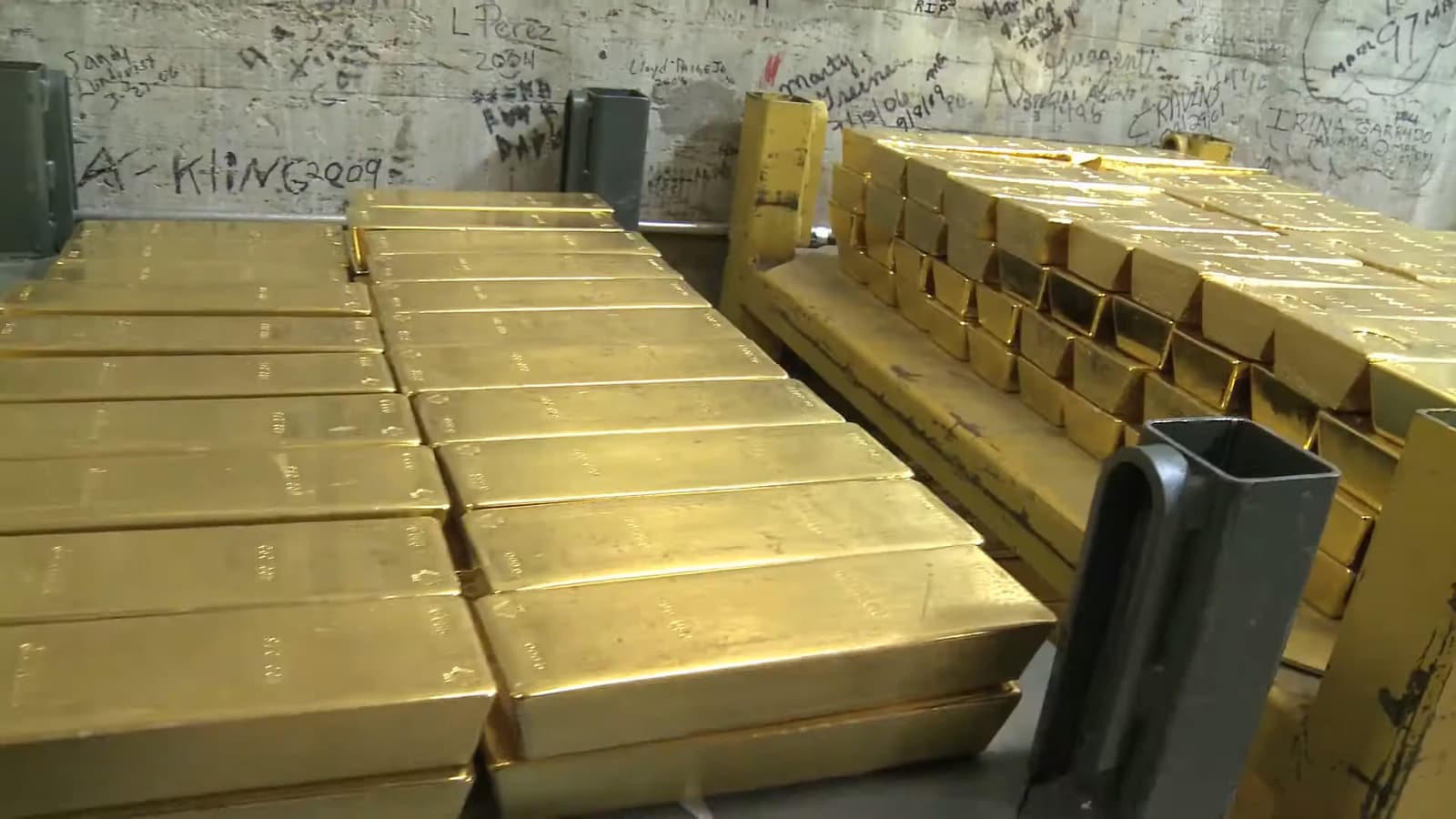
- Wikimedia Commons, "File:West Point gold.jpg" - U.S. Mint photograph of gold bars in storage at the West Point Mint, 2011.