ADP's third quarter was a real beat. Revenue rose 7% to $5.9 billion, adjusted EBIT rose 10% to $1.8 billion, adjusted EBIT margin expanded 80 basis points to 30.2%, and adjusted diluted EPS rose 10% to $3.37.[1][2] Management also raised full-year guidance for revenue growth, adjusted EBIT margin expansion, and adjusted diluted EPS growth.[1][2] The market did not need another reminder that ADP is a high-quality payroll-and-HCM franchise.
The more useful finance question sits one layer below the headline. Priced is that ADP has sticky clients, long relationships, disciplined execution, and a client-funds engine that turns payroll scale into incremental earnings.[1][3] New is that this quarter offered evidence of better core operating leverage at the same time that client-funds carry remained unusually helpful. Employer Services margin rose, retention improved, and U.S. pays per control turned positive, but interest on funds held for clients also rose 14% to $404 million on average client funds balances of $48.3 billion and a 3.3% yield.[1][2] That makes this less a simple beat story than a durability story.
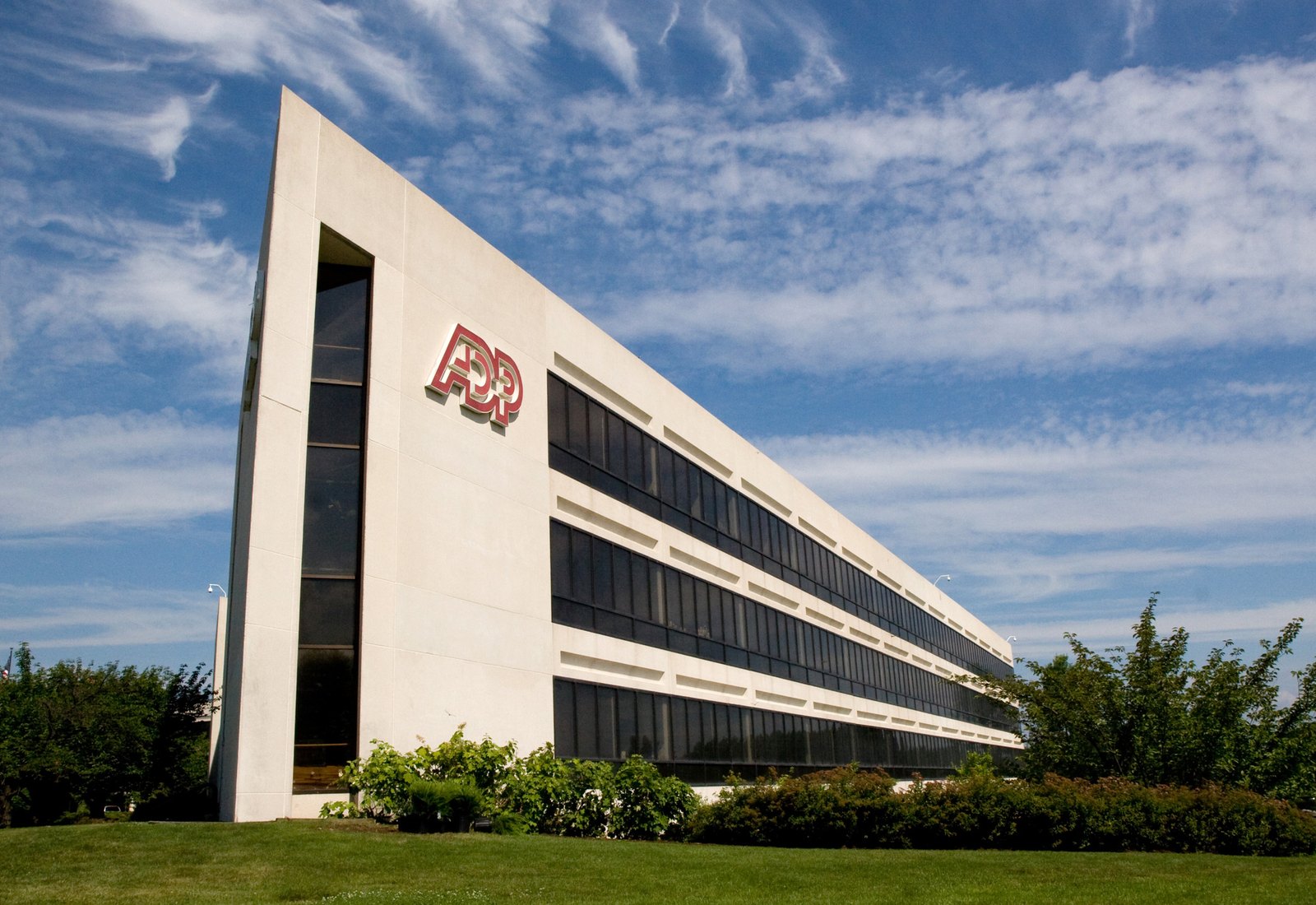
Image context: the cover uses a real photograph of ADP headquarters in Roseland, New Jersey. That is the right visual anchor because this quarter's strength runs through an actual service-and-payroll operating system with retention, implementation, funding, and compliance mechanics, not through a generic software metaphor.[3][4]
Priced vs new
The easy part of the ADP thesis is still intact. The annual report says Employer Services retention in fiscal 2025 was 92.1%, and based on fiscal 2025 retention levels ADP estimates average client life at roughly 13 years in Employer Services and 6 years in PEO.[3] That is why ADP keeps earning the benefit of the doubt. The installed client base is large, relationships are long, and payroll remains mission-critical.
What changed in this report is that the quarter showed improvement in the core engine without fully escaping the pull of rates-driven carry. Employer Services revenue rose 7% reported and 5% on an organic constant-currency basis, U.S. pays per control rose 1%, and Employer Services margin rose 130 basis points to 41.1%.[1][2] The deck also says Employer Services retention and overall client satisfaction reached new record highs for a third quarter.[2] Those are real operating signals, not cosmetic ones.
Still, ADP's own slide language keeps the hierarchy visible. Management said the Employer Services margin increase was driven by operational productivity improvements and client funds interest revenue growth.[2] That wording matters. It does not say the margin lift came from software mix alone or from cleaner labor demand alone. It says the quarter improved through two gears at once: better execution and a still-favorable funding backdrop.
Why the core quarter really did improve
There is enough inside the release to say the quarter was not just a rate gift. Full-company revenue growth of 7% was matched by 7% revenue growth in both Employer Services and PEO Services, while PEO revenue excluding zero-margin benefits pass-throughs rose 5% and average worksite employees rose 2% to about 762,000.[1] Those are not breakout-growth numbers, but they do describe an HCM platform still finding demand in a slower employment environment.
The better signal is how guidance moved. ADP raised full-year revenue growth to 6% to 7% from roughly 6%, raised adjusted EBIT margin expansion to 70 to 80 basis points from 50 to 70 basis points, and raised adjusted diluted EPS growth to 10% to 11% from 9% to 10%.[1][2] In Employer Services, it improved the client-retention outlook from a decline of 30 to 10 basis points to a range of down 20 basis points to flat, and it moved the U.S. pays-per-control outlook from roughly flat to about 1% growth.[1][2] That is a meaningful shift because it points to slightly better underlying volume and client behavior, not just to treasury arithmetic.
The annual report helps explain why that matters. ADP's 2025 10-K says Employer Services grew in fiscal 2025 through new business started from bookings, strong client retention, pricing, interest on funds held for clients, the WorkForce Software acquisition, and 1% growth in pays per control.[3] In other words, this company compounds when several modest levers line up together. Q3 looks stronger because more of those levers were aligned at once.
Why client-funds carry still matters so much
Even so, the client-funds engine still does more of the work than the headline beat alone suggests. Interest on funds held for clients rose 14% to $404 million in the quarter, faster than total revenue growth, while average client funds balances rose 9% to $48.3 billion and average yield rose 10 basis points to 3.3%.[1] That is a high-quality earnings stream because it rides on balances already embedded in the payroll machine.
The bigger clue is in the updated full-year outlook. ADP now expects $1.340 billion to $1.350 billion of client-funds interest revenue and $1.300 billion to $1.310 billion of net contribution from the client-funds extended investment strategy.[1][2] In January, those ranges were $1.310 billion to $1.330 billion and $1.270 billion to $1.290 billion, respectively.[1][2] The raise is not trivial. It says the carry layer is still widening, not merely holding flat.
This is where investors should keep their discipline. Client-funds interest is not fake. It is part of ADP's business model, and the annual report is explicit that moving client funds is a core operational function, not an incidental side business.[3] But the quarter also makes clear that a payroll company can show better fundamentals and still have a disproportionate share of incremental earnings come from balances and reinvestment yields. That is the boundary line.
Why PEO keeps the recap honest
PEO is the reminder that not every growth lane had the same quality. PEO revenue rose 7%, and revenue excluding zero-margin pass-throughs rose 5%, but PEO margin fell 120 basis points to 13.0%.[1][2] Management attributed that decline mainly to zero-margin pass-through growth, higher SUI costs, and higher selling expenses.[2]
That matters because it stops the whole quarter from being read as uniform operating leverage. ADP improved at the consolidated level, and Employer Services looked better, but one important segment still absorbed cost pressure. The quarter therefore argues for a narrower conclusion: ADP is executing well enough to raise the year, yet the cleanest margin help still comes from Employer Services productivity plus client-funds carry rather than from broad, all-segment operating expansion.
Six numeric anchors
- Headline quarter: revenue rose to $5.9 billion, adjusted EBIT rose to $1.8 billion, adjusted EBIT margin reached 30.2%, and adjusted diluted EPS reached $3.37.[1][2]
- Employer Services quality: Employer Services revenue rose 7%, U.S. pays per control rose 1%, and Employer Services margin rose to 41.1%, up 130 basis points.[1][2]
- Carry layer: interest on funds held for clients rose 14% to $404 million on average client funds balances of $48.3 billion and a 3.3% yield.[1]
- PEO reality check: PEO revenue rose 7%, revenue ex zero-margin pass-throughs rose 5%, average worksite employees reached about 762,000, and PEO margin fell to 13.0%.[1][2]
- Guide raise: full-year revenue growth moved to 6% to 7%, adjusted EBIT margin expansion to 70 to 80 basis points, and adjusted diluted EPS growth to 10% to 11%.[1][2]
- Long-duration base: fiscal 2025 Employer Services retention was 92.1%, and ADP estimates average client life at about 13 years in Employer Services and 6 years in PEO.[3]
Taken together, those anchors say the same thing. The core business improved enough to justify a better year, but the carry layer still explains a meaningful share of why the quarter felt stronger than the employment backdrop alone would imply.
Strongest counterweight
The best pushback is that this recap may still understate how much of the quarter belonged to the core franchise. Record third-quarter retention and client satisfaction, a better pays-per-control outlook, stable bookings guidance, and productivity-led Employer Services margin expansion all point to a business that may be getting operationally cleaner at the same time that rates remain supportive.[2][3] If that is right, then client-funds carry is not masking weakness. It is simply amplifying a franchise that was already improving.
That argument has real weight. ADP's annual report describes a business that has kept compounding through retention, pricing, bookings conversion, and payroll scale for years, and the quarter does not break that pattern.[3] The cautious point is narrower: until investors see another quarter where core metrics keep improving without another meaningful lift in client-funds economics, the market should resist treating all of the EPS raise as equally durable.
Falsifier
This cautious framing is too tight if the next reporting window shows that ADP can keep its improved earnings profile even without another richer carry step. Concretely, if U.S. pays per control remains positive, Employer Services retention stays near current record territory, PEO revenue ex pass-throughs holds mid-single-digit growth, and full-year EPS power holds even if client-funds yield stops moving up, then the core engine is doing more of the work than this article allows.[1][2][3]
Watchlist
- U.S. pays per control: the guide moved from roughly flat to about 1% growth, so the next quarter needs to prove that payroll volume really did turn from stable to mildly positive.[1][2]
- Employer Services retention: management improved the outlook to down 20 basis points to flat; if retention holds near fiscal 2025 levels, the revenue base gets more durable.[1][2][3]
- Client-funds balances and yield: ADP's updated carry outlook assumes about 6% growth in average client funds balances and a portfolio yield around 3.4%.[1][2]
- PEO margin repair: after falling to 13.0%, PEO needs to show that higher SUI costs and selling expenses are not becoming the persistent offset to Employer Services strength.[1][2]
Takeaway
ADP's third quarter was better than a routine beat. The company showed stronger retention, better volume signals, and enough operating discipline to raise the year. That part is real.
The cleaner finance read is that two things improved at once: core execution and client-funds carry. Investors should welcome both while keeping them separate. If the next quarter shows that the operating engine can hold this trajectory without needing another meaningful boost from balances and yield, the market can treat Q3 as a more durable step-up. If not, then this quarter will still look good, but more of the beat will belong to the funding layer than to a newly steeper growth curve.
Sources
- ADP, ADP Reports Third Quarter Fiscal 2026 Results earnings release PDF (April 29, 2026).
- ADP, ADP Earnings Call & Webcast: Q3 Fiscal 2026 presentation PDF (April 29, 2026).
- Automatic Data Processing, Inc., Annual Report 2025 / Form 10-K courtesy PDF (fiscal year ended June 30, 2025).
- Wikimedia Commons, "File:ADP Headquarters.jpg".