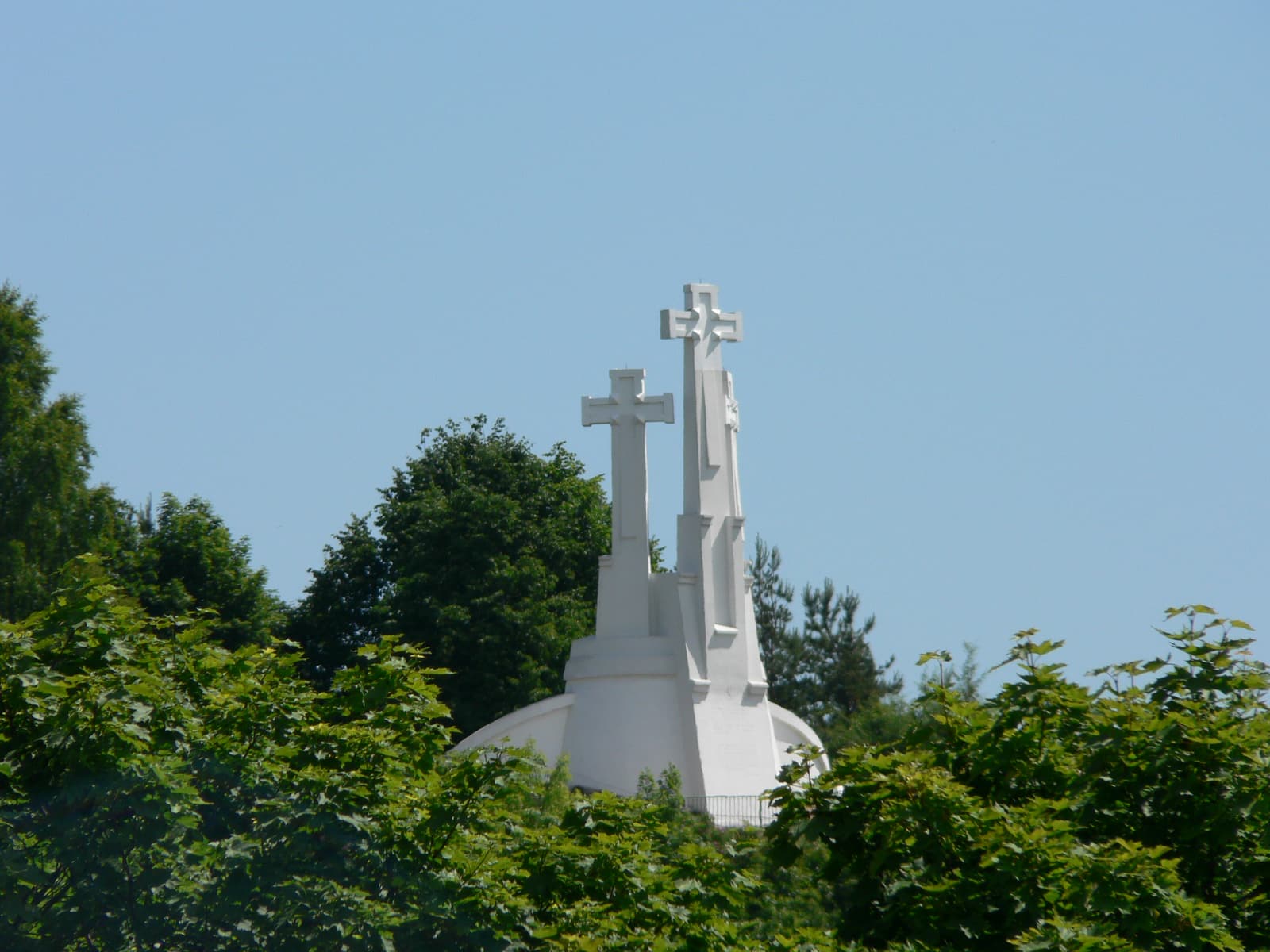
Vilnius is easy to flatten into an Old Town day: church, lane, square, another church, one more lane. The local correction is shorter and more physical. Enter through Bernardine Garden, climb to Three Crosses Hill while the light still holds, then come back down through the same green pocket instead of treating the summit as a stand-alone photo errand.[1][2][3][4][5][6]
That ritual works because the two anchors solve different parts of the city. The Hill of Three Crosses gives you the reset in scale. Go Vilnius describes vast panoramas over the Old Town, with Bernardine Garden and the Vilnelė right at the foot of the hill, and notes that the monument itself stands 12 metres tall.[1] Discover Vilnius makes the practical part clearer: it is one of the city's best viewpoints, locals use it for walks and runs, it is free, and there are two distinct ways up, one steeper and one gentler.[3] Bernardine Garden gives you the landing. The official Go Vilnius page places the garden between the river and the monastery, calls it a 15th-century historic park, sets current opening hours at 07:00-22:00, and keeps entry free.[2]
The city-specific texture comes from how quickly monumentality dissolves once you descend. Walkable Vilnius describes the garden as a small central green room rich in marked plants, a musical fountain, chess tables, and an oak tree measuring 1.5 metres in diameter near a bridge.[4] Its matching Three Crosses page describes the hilltop as a place of silence and peace, and adds that another perspective is only 800 steps away across the Vilnelė toward Gediminas Hill.[5] That proximity matters even if you do not take the extra hill. Vilnius is not asking for a heroic climb here; it is asking you to notice how compressed its ridge, river, and garden geography really is.
Image context: the cover uses a real 2005 Wikimedia Commons photograph of the white Three Crosses monument. It is useful precisely because it is plain. The article's argument is not that the hill is visually overwhelming, but that one clear landmark can organize the entire descent that follows.[7]
Why dusk is the right hinge
This route is stronger at the edge of evening than in the middle of the day. Discover Vilnius explicitly calls the hill a perfect photo spot at golden hour, while also noting that it is always open as a public park.[3] Go Vilnius adds another evening cue: the crosses are sometimes illuminated in different colours after dark for commemorative moments.[1] The summit therefore works best when the city is still readable in daylight but already starting to separate into lit surfaces and darker tree lines.
The garden makes that timing practical instead of romantic. Because Bernardine Garden stays open until 22:00, you can let the hill be the brief high point and keep the rest of the outing on a calmer, flatter register.[2] The descent matters more than the peak. You leave the panoramic city behind, re-enter the tree cover, pass water level again, and let Vilnius return to human scale by the time you are back among paths, benches, and fountain noise.[2][4]
There is also a current-city reason to trust this approach. A 2026 Go Vilnius event page for an international community celebration still treats Bernardine Garden as an active public room, with doors open 13:00-22:00 and the recommended entrance from Maironio street 1.[6] That does not mean you should time your visit to an event. It means the garden remains a live civic edge, not just a heritage backdrop, and the Maironio side is still a practical way in.
8 local moves that make the ritual land
- Start in the garden, not at the top. Bernardine Garden does the crucial first job of lowering the city's noise before the climb begins.[2][4]
- Use the Maironio side as your Old Town approach edge. The current Go Vilnius event programme still treats Maironio street 1 as a natural entrance point into the garden.[6]
- Choose your ascent style deliberately. Discover Vilnius notes two routes up: a steeper stair line from Kalnų Park and a gentler approach if you follow the river and cross Pilies tiltas first.[3]
- If you are tired, take the gentler route and save your attention for the top. The point is not to prove anything on the stairs; it is to arrive with enough calm left to read the city.[3]
- At the summit, look down at the garden and river as much as out across the skyline. Go Vilnius is explicit that Bernardine Garden and the Vilnelė sit right below the hill, and that vertical relationship is the whole logic of the route.[1]
- Do not leave the area the moment you finish the climb. The descent through Bernardine Garden is not a backup plan; it is the second half of the ritual.[2][4]
- Use one concrete pause in the garden. The musical fountain, the bridge-side oak, or the chess-table zone are better stopping points than trying to prolong the summit indefinitely.[4]
- If the garden is hosting an evening programme, keep walking anyway. The best version of this route uses the civic energy as atmosphere, not as a reason to stop moving.[6]
Non-local trapline: 4 common mistakes and the better alternative
Mistake 1: treating Three Crosses Hill like a midday checklist stop
Better move: aim for the late-day light. The hill's golden-hour reputation and the possibility of seeing the monument begin to read against evening light make the ritual much cleaner after the day has softened.[1][3]
Mistake 2: taking the steep stairs simply because they are the first thing you see
Better move: decide what kind of ascent you want. If you are fresh and the light is slipping, the stairs are efficient. If you want the better overall sequence, use the gentler riverside approach first.[3]
Mistake 3: climbing up, taking one panorama photo, and immediately calling a ride away
Better move: come back down through Bernardine Garden while it is still open until 22:00. The point is to let Vilnius contract from skyline to pathway.[2][4]
Mistake 4: assuming the garden is only decorative dead space between major sights
Better move: treat it as an active city room. The current 2026 event programme, official hours, free entry, and local-guide attention to fountains, chess tables, and planted paths all say the same thing: this park is meant to be used, not merely crossed.[2][4][6]
Concrete go details
- Best window: the late-afternoon to dusk band, with the hill taken in daylight and the garden used on the way down before its 22:00 close.[1][2][3]
- Expected spend: free for both the hill and the garden.[2][3]
- Access logic: enter from the Old Town side through Bernardine Garden; the current civic-programme cue is Maironio street 1, while the official garden address is B. Radvilaitės g. 8A.[2][6]
- Ascent choice: steeper stairs from Kalnų Park if you want the direct version, or the gentler river-and-bridge line via Pilies tiltas if you want the cleaner ritual build-up.[3]
- Where to slow down: keep the summit pause short, then take your longer stop lower down by the fountain, bridge, or oak inside Bernardine Garden.[1][4]
- Route cue:
Bernardine Garden -> hill approach -> Three Crosses summit -> same-side descent -> fountain / bridge / oak pause -> Old Town re-entry.[2][3][4] - Numeric anchors worth remembering: 12 metres, 15th century, 07:00-22:00, 1.5 metres, 800 steps, 13:00-22:00, Maironio street 1, B. Radvilaitės g. 8A.[1][2][4][5][6]
Vilnius does not need a large itinerary to explain itself. One white monument, one short climb, one garden descent, and a river at the bottom are enough to turn the city from postcard accumulation into a sequence with weight.
Sources
- Go Vilnius, "The Hill of Three Crosses" (official page describing the Old Town panorama, the garden and river at the foot of the hill, the monument's
12-metreheight, and its evening illumination use). - Go Vilnius, "Bernardine Garden" (official page describing the garden as a
15th-centuryhistoric park beside the river, with current07:00-22:00hours, free entry, and addressB. Radvilaitės g. 8A). - Discover Vilnius, "Three Crosses Hill" (local guide covering the hill's golden-hour appeal, free access, two ascent options, and the gentler route via the river and Pilies tiltas).
- Walkable Vilnius, "The Bernardine Gardens" (local guide describing the park's planted paths, musical fountain, chess tables, and the oldest oak in Vilnius at
1.5 mdiameter near a bridge). - Walkable Vilnius, "The Hill of Three Crosses" (local guide describing the hill's silence, the descent across the Vilnelė, and the nearby
800 stepsrelation to Gediminas Hill). - Go Vilnius, "Event programme" (current 2026 event page showing Bernardine Garden in live civic use, with doors open
13:00-22:00and entrance recommended fromMaironio street 1). - Wikimedia Commons, "File:Vilnius Three Crosses.jpg" (documentary cover photograph source, uploaded in 2005 by Wojsyl).