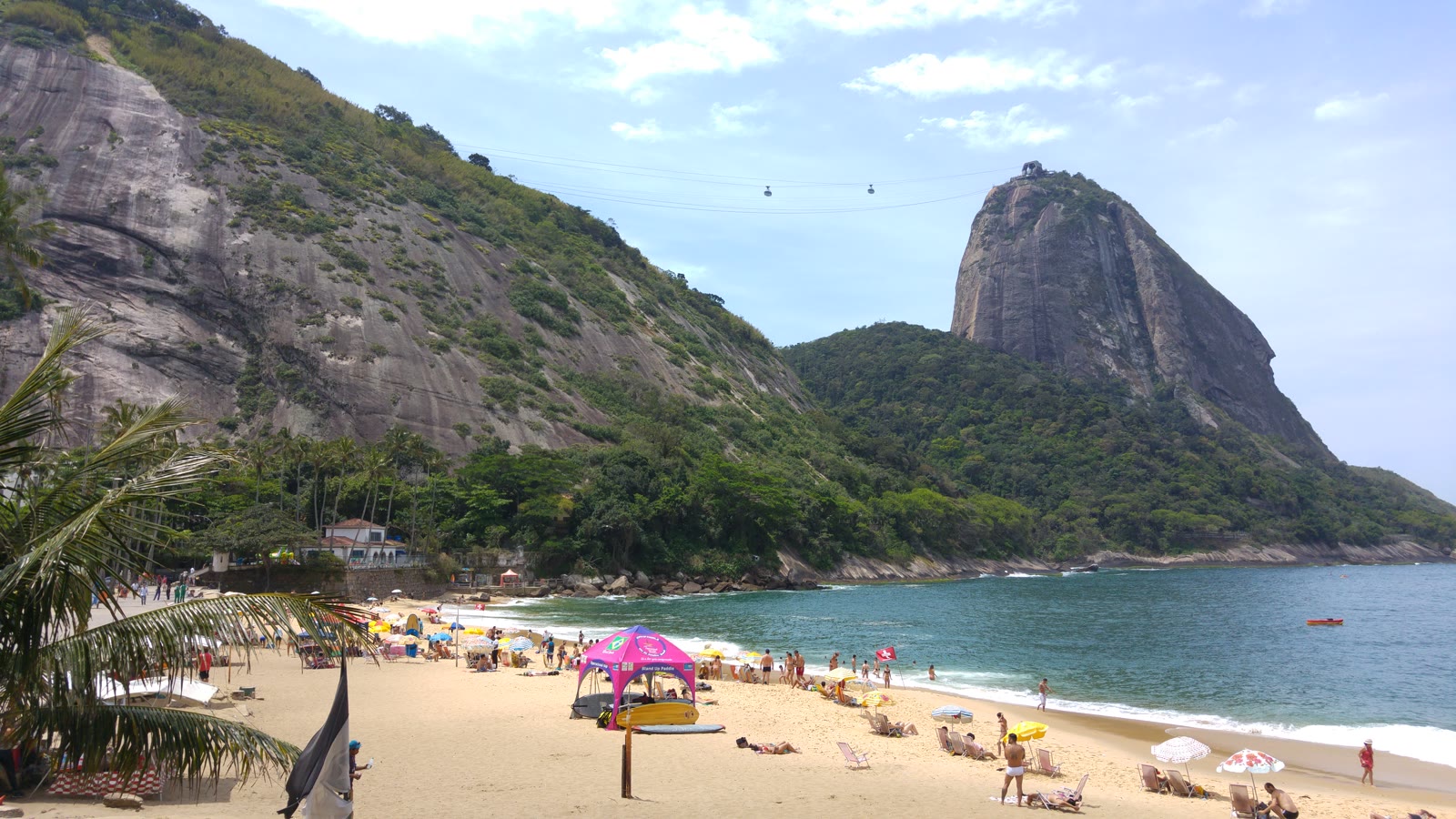
Rio has bigger beach theater than Praia Vermelha, and it has higher viewpoints than Morro da Urca. The useful move is that these two anchors fit together unusually well. Keep the scope tight: use Praia Vermelha as the threshold, then take the Pista Cláudio Coutinho approach into the Morro da Urca trail before sunset.[1][4][6]
That sequence works because the geography is compact and the timing is legible. Praia Vermelha is a small, sheltered beach in Urca, not an all-day oceanfront sprawl.[1] Morro da Urca rises only to the first hill in the Sugarloaf complex, around 220 meters up, which means you get the harbor-and-cove payoff without turning the outing into a full tourist escalation.[2] In late March, sunset in Rio is around 17:52, while the trail access gate used by hikers operates daily from 9:00 to 17:00.[4][10] That tells you what this outing is and what it is not. It is a late-afternoon climb with margin, not a last-minute scramble for golden hour.
There is also a neighborhood texture here that keeps the place from flattening into postcard logic. Praia Vermelha is still treated as a maintained local edge, not scenery alone: in April 2025, students and professional divers organized a cleanup there, a small but useful reminder that this cove is part of lived Rio stewardship rather than only an image surface.[7] The neighborhood habit matters because it changes how you use the place. You arrive lighter, move sooner, and keep the outing compact.
Anchor 1: Praia Vermelha should be a short threshold, not a whole beach day
The official Riotur description gets the mood right by understatement: this is a quiet, small beach in Urca.[1] The local access guide makes the practical version clearer. If you are coming from elsewhere in the city, the most useful bus lines are 107, 511, and 512 along Avenida Pasteur; the ride is about 20 minutes from Copacabana and about 35-45 minutes from Centro depending on traffic.[5] On weekdays those buses run roughly every 10-15 minutes.[5]
That matters because the most common mistake here is to arrive with Copacabana habits. Praia Vermelha is better read as a staging room. Use 15-25 minutes on the sand or seawall to let the cove settle the city noise out of your body, then move toward the right-hand edge of the beach where the paved Pista Cláudio Coutinho begins.[5][8] If you turn the beach into a full static stop first, the climb becomes an afterthought and the outing loses its shape.
Driving is the other trap. The same local guide says free curb parking can fill very early, private lots often charge R$40-60 a day, and the Bondinho parking can run around R$60-70 in busy periods.[5] For a short late-afternoon run, bus or app drop-off is cleaner than treating Urca like a casual parking district.
Anchor 2: Morro da Urca is the right stopping point
The trail guide published by the Praia Vermelha local site calls the route easy, gives the trail itself as about 1 km, and estimates 20-40 minutes to the top depending on pace.[6] The Bondinho help-center article is more conservative: it says the trail-access gate at the end of the route works daily from 9:00 to 17:00 and gives an average trail time of 40-60 minutes.[4] Read those numbers together as an operating rule rather than a contradiction. Fast walkers may clear the ascent in half an hour, but your planning margin should respect the longer official estimate.
This is why Morro da Urca is the right place to stop. It already gives you the first cable-car station, the high read back over Praia Vermelha and Botafogo Bay, and the sense that the city has shifted from beach scale to harbor scale.[2][6] The Bondinho park itself runs daily from 08:30 to 21:00, with last boarding at 19:30.[3] If you have energy and want to pay for more height, the system exists. But for a first compact visit, Morro da Urca is enough.
The descent logic is where non-locals get sloppy. Bondinho's own support page says hikers who start from the trail have specific ticket products sold exclusively at the Morro da Urca totem, including a descent-only ticket at R$60 adult or R$30 half-price.[4] It also warns that after the access gate closes, there is no free cable-car descent for hikers.[4] In other words, decide before you drift. Either walk down on your own legs with daylight still intact, or buy the proper descent product while the operating window is still clean.
8 local moves that make the outing work
First, treat Praia Vermelha as the opening room and Morro da Urca as the finish. The order matters because the cove settles you before the climb starts.[1][6]
Second, avoid driving unless you are arriving unusually early. For a short afternoon visit, the bus-and-app lane is cleaner than gambling on Urca parking prices and street supply.[5]
Third, use the right-hand edge of Praia Vermelha as your navigation cue. If you are not entering through Pista Cláudio Coutinho, you are starting the sequence wrong.[5][6]
Fourth, do not plan from the shortest trail estimate alone. The local guide's 20-40 minutes and the official support article's 40-60 minutes together imply one safe move: start the trail with real buffer, not with wishful math.[4][6]
Fifth, on a late-March day with sunset around 17:52, aim to be at the beach around 15:30-16:00 and on the trail by roughly 16:00-16:15 if you want an unhurried top-out.[4][10]
Sixth, keep shoes honest. The route is easy by Rio standards, but it still uses dirt steps and a steady incline through Atlantic-forest cover.[6]
Seventh, make the descent decision at the top, not after the gate logic turns against you. The hiker tickets are sold at the Morro da Urca totem; after closure, improvisation gets more expensive and less elegant.[4]
Eighth, stop at Morro da Urca unless you have a deliberate reason to continue. The first hill already gives the view, the facilities, and the city read that this route is built for.[2][6][9]
Non-local trapline: 4 common mistakes and the cleaner alternative
Mistake 1: treating Praia Vermelha like a full beach day before you even look at the trail
Better move: give the cove a short first act, then use it as a handoff into the climb.[1][6]
Mistake 2: turning up near 17:00 and assuming sunset will solve the timing
Better move: respect the 9:00-17:00 trail-gate window and the longer official ascent estimate.[4][10]
Mistake 3: assuming the whole point is to continue all the way to Sugarloaf
Better move: stop at Morro da Urca first. It is a complete outing on its own and keeps the route compact.[2][6]
Mistake 4: deciding about the cable-car descent only after the operating window has tightened
Better move: if you want the ride down, buy the hiker descent ticket at the Morro da Urca totem while the park is still operating normally.[3][4]
Concrete go details
- Best window: on late-March days, beach arrival around 15:30-16:00, trail start around 16:00-16:15, sunset around 17:52.[4][10]
- Expected spend: R$0 if you walk up and down; R$60 adult / R$30 half-price if you hike up and buy the descent-only hiker ticket from Morro da Urca.[4]
- Queue reality: no reservation for the beach or trail; the real constraints are the 17:00 trail-access cutoff and the Bondinho 19:30 last boarding.[3][4]
- Where to stand or sit: short sit-down low at Praia Vermelha first, longer stop high at Morro da Urca second.[1][2][8]
- Navigation cue: Avenida Pasteur -> Praia Vermelha -> right edge of the beach -> Pista Cláudio Coutinho -> signed Morro da Urca trail gate.[5][6]
- Numeric anchors worth keeping: 107 / 511 / 512 bus lines, about 20 minutes from Copacabana, about 35-45 minutes from Centro, trail gate 9:00-17:00, park 08:30-21:00, last boarding 19:30, and late-March sunset around 17:52.[3][4][5][10]
Rio does not always need a grand plan. Sometimes it only needs one small cove, one shaded approach, and one hill that knows when to stop.
Sources
- Riotur, "Vermelha Beach" (official description of Praia Vermelha as a quiet, small beach in Urca).
- Riotur, "Morro da Urca" (official overview of the first hill in the Sugarloaf complex and its approximate 220-meter height).
- Parque Bondinho Pão de Açúcar, official homepage (daily hours 08:30-21:00; last boarding 19:30).
- Parque Bondinho Help Center, "Acesso ao Parque Bondinho pela trilha do Morro da Urca" (updated 2026-02-03; trail-access gate 9:00-17:00 daily, 40-60 minute estimate, hiker ticket rules, and descent pricing).
- Praia Vermelha local guide, "Como Chegar à Praia Vermelha" (published 2025-05-19; updated 2026-03-19; bus lines 107/511/512, travel times, and parking-price guidance).
- Praia Vermelha local guide, "Trilha do Morro da Urca pela Praia Vermelha" (published 2025-11-06; updated 2025-12-07; 1 km trail description, easy-grade framing, and 20-40 minute ascent estimate).
- Diário do Rio, "Alunos do Colégio pH e mergulhadores profissionais se unem em limpeza da Praia Vermelha, na Urca" (2025-04-25; recent neighborhood cleanup and stewardship signal).
- Google Maps search, "Praia Vermelha Rio de Janeiro" (community listing used for current crowding and on-the-ground behavior checks).
- Google Maps search, "Pista Claudio Coutinho Rio de Janeiro" (community listing used for trail-entry behavior and summit-flow checks).
- Time and Date, "Sunrise and sunset times in Rio de Janeiro, March 2026" (March 31 sunset reference used for the late-afternoon timing window).
- Wikimedia Commons, "File:Praia Vermelha 01.jpg" (documentary photograph used for the cover image).