Porto's postcard mistake is easy to describe. Visitors look at the Dom Luis I bridge, the cathedral ridge, and the lit riverfront, then assume the best move is to stand in one exposed lookout until the city turns fully dark. The cleaner seasonal version is shorter and more local in its mechanics. Start on the upper side around Batalha, take the Guindais funicular down in the late-light shoulder, and let Ribeira be the landing instead of the whole evening.[1][4][5]
That route works because the funicular is not a novelty prop. STCP's current page frames it as a functioning piece of urban mobility with two stations, one at Batalha and one at Ribeira, a steep line that drops 61.2 meters over 281.1 meters of track, and summer operating hours that now run from 08:00 to 22:00 Sunday-Thursday and 08:00 to 24:00 Friday-Saturday.[1] The point is not to admire the mechanism for its own sake. The point is to use it to remove the hill at exactly the moment when Porto's upper city is losing the afternoon and Ribeira has not yet hardened into a dinner-and-drinks bottleneck.
The lower anchor is just as specific. Visit Porto's Ribeira entry calls Praça da Ribeira one of the city's oldest squares, dates its current shape to 1389, and treats 30 minutes as a normal visit length.[4] That timing is more useful than it first appears. It tells you Ribeira works best as a short, high-yield room: enough time to absorb the waterfront and arcades, not so much time that the square turns into dead standing.
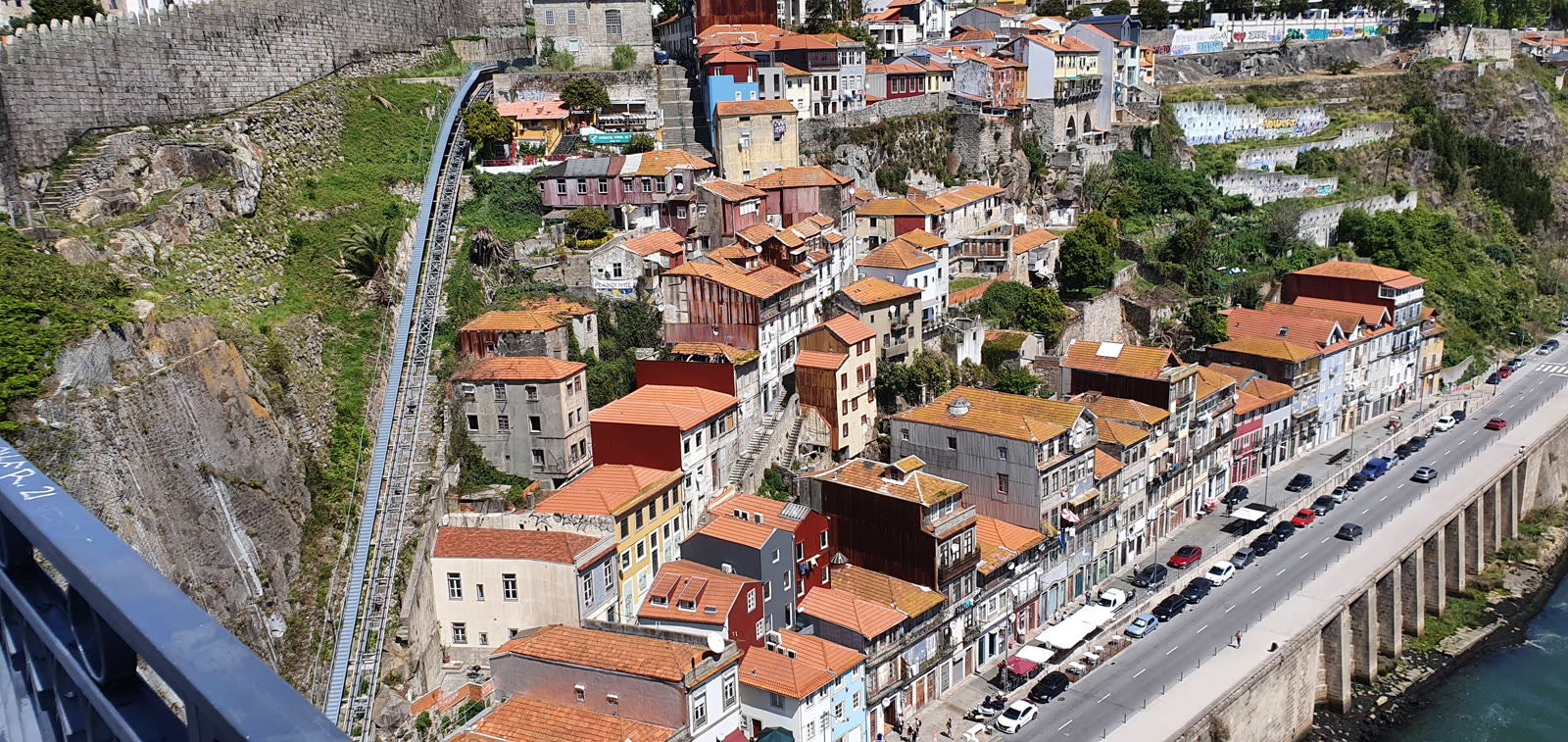
Image context: the cover uses a real documentary photograph of the Guindais line sliding down beside Porto's old walls. That is the right cue because this article depends on one visible relationship: upper-city masonry, the sudden drop, and the riverfront waiting below.[9]
Why the late-light shoulder is better than treating Ribeira as the whole plan
The late-light shoulder gives both anchors the job they are best at. Up top, the city is still legible as slope and wall rather than nightlife backdrop. Down below, Ribeira is still a riverfront room rather than a packed holding area for menus, selfies, and bridge traffic. If you do the descent too early, the move feels like transport. If you do it too late, you inherit all the lower-city congestion and lose the pleasure of arrival.[1][4][8]
The official operating facts reinforce that reading. The Guindais line runs automatically with two vehicles, each with a maximum capacity of 25 people and a comfort load of 15, and the route page lists enough bus lines around the stations that the funicular behaves like a real connector inside the network rather than a sealed tourist capsule.[1] STCP's own maintenance notice sharpens the local signal: the operator said more than 460,000 trips had already been recorded that year, including about 100,000 users tied to the Porto. card and Andante subscription base.[6] That matters because it shows the line still sits inside normal city use. It is not only a heritage ride for outsiders.
Community behavior points the same way. In a Porto discussion about how to spend a day well, a local route suggestion runs downhill from Se toward the bridge and then recommends the funicular as the clean link into Ribeira.[7] Google Maps review activity shows the current version of that same pattern in real time: people are still using the line as a hill-solver and timing tool, which is exactly why the late-light shoulder matters more than a generic "anytime" recommendation.[8]
Use the descent to edit the city, not to collect one more ride
The Guindais funicular is strongest when you board from the upper station. That sounds minor, but it changes the whole feel of the stop. A downhill run lets the city open outward. You start in stone and gradient, then come out at Rua da Ribeira Negra with the river already close. The ride stops being a queue for a view and becomes a mechanical release.[1]
This is also where the spring-to-autumn window matters. From April through October, Sunday-to-Thursday service reaches 22:00, and Friday-Saturday service stretches to 24:00.[1] That gives you room to board after the workday and before full night. In practice, the sweet spot is usually the band roughly 45-75 minutes before sunset through about 20 minutes after, when the upper city is softening, the riverfront is bright but not fully compressed, and the descent still feels like an arrival rather than a rescue. That timing is an operating inference from the published summer hours, the official Ribeira dwell guidance, and current crowd surfaces.[1][4][8]
The lower square then works better if you respect its scale. Visit Porto's 30-minute average is a clue, not a command.[4] Ribeira is one of those places that gets worse when you try to extract a whole evening from it. The right move is to let the square and riverfront settle, take one short waterside drift, and then leave before the waterfront becomes pure volume.
8 local moves that materially improve this Porto stop
- Board from Batalha, not from the river. The route is strongest as a descent because the hill disappears in one motion and Ribeira arrives as payoff rather than climb target.[1]
- Use the late-light shoulder from April to October. The official summer timetable gives you a real window: 08:00-22:00 on Sunday-Thursday and 08:00-24:00 on Friday-Saturday.[1]
- Treat the fare and validation rules as part of the system, not friction. The official tariff table lists EUR4 for adults and EUR2 for children aged 4-12, while the reopening notice says holders of a
Porto.card and monthly Andante subscriptions can travel free when properly validated.[2][3] - Keep the funicular phase short and functional. This is a 281.1-meter route with a 61.2-meter drop, not a scenic excursion you need to stretch into an event.[1]
- Use Ribeira as a landing, not a camp. The official tourism entry's 30-minute average is a good discipline for first-time visitors.[4]
- If the square centerline is clogged, move laterally instead of deeper in. The riverfront works better when you use the edge as a drift space rather than fighting for the middle. That is an operating read from current community-review patterns.[8]
- Remember the line is built for a real slope. The maximum gradient reaches 36.1%, which is exactly why the descent changes the outing's energy more than a normal short walk would.[1]
- Keep the network in reserve for the exit. The station page lists multiple bus connections around the line, so you do not need to turn Ribeira into a stay-until-exhaustion plan.[1]
Non-local trapline: 4 common mistakes and the better alternative
Mistake 1: treating the bridge view as the whole evening
Better alternative: use the upper city for the setup and the funicular for the release. The city reads more clearly when the descent, not the railing, is the hinge.[1][7]
Mistake 2: riding up from Ribeira at peak time because the river feels like the obvious start
Better alternative: start above and drop down. The downhill motion gives you the payoff in the right order.[1]
Mistake 3: assuming Ribeira deserves indefinite dwell just because it is photogenic
Better alternative: cap the first visit around the official 30-minute scale, then move on while the place still feels like a square rather than a holding pen.[4][8]
Mistake 4: treating the funicular as a quaint museum object instead of current transport
Better alternative: read it as live city infrastructure. The operator's own maintenance note makes clear that the line carries large everyday volumes, including resident-linked use.[6]
Concrete go details
- Best window: from April to October, aim for roughly 45-75 minutes before sunset through about 20 minutes after, with weekdays usually cleaner than Saturday for first-timers.[1][4][8]
- Expected spend: EUR4 adult, EUR2 child (4-12); free for eligible
Porto.card and monthly Andante holders with validation.[2][3] - Queue and reservation reality: no reservations; the real constraint is that there are only 2 vehicles with a maximum of 25 passengers each and a comfort load of 15, so the late-light band can tighten fast.[1]
- Where to stand or sit: board from the upper station, then do your real pause after arrival below rather than clustering inside the car or at the square's busiest centerline.
- Navigation cue:
Batalha upper station -> Guindais descent -> Rua da Ribeira Negra -> Praça da Ribeira -> short riverfront drift -> exit before full-night compression. - Numeric anchors worth keeping: 08:00, 22:00, 24:00, 61.2 m, 281.1 m, 36.1%, 2 vehicles, 25 people, 15 people, EUR4, EUR2, 1389, 30 minutes, 460,000, 100,000.[1][2][4][6]
Porto has many places where visitors try to out-stare the skyline. This one works because it gives the hill a job. Use the late-light descent, let Ribeira land quickly, and leave before the city turns from riverfront into queue.
Sources
- STCP Servicos, "Funicular dos Guindais" - official route page with summer/winter hours, exceptions, station names, bus links, slope, elevation change, route length, and vehicle capacities.
- STCP Servicos, "Tabela de Precos / Regulamento" for the Guindais funicular - official tariff table with current single-trip fares.
- STCP Servicos, "Ja pode voltar a viajar no Funicular dos Guindais" - official reopening notice with the 18 April 2024 restart, free travel for eligible
Porto.card and monthly Andante holders, and the EUR4 / EUR2 public fares. - Visit Porto, "Praca da Ribeira" - official tourism entry describing the square's historic fabric, 1389 date anchor, and a typical 30-minute visit length.
- Visit Porto, Accessible Porto Guide 2025 - official city guide with Ribeira context and riverfront orientation for walking the lower city.
- STCP Servicos, "Funicular dos Guindais fecha para obras de manutencao" - official maintenance notice stating that more than 460,000 trips had already been recorded that year, including about 100,000
Porto.card and Andante users. - r/porto, "Anyone have any recommendations on a day in Porto?" - local-community route advice linking Se, the bridge, and the funicular into Ribeira.
- Google Maps search, "Funicular dos Guindais Porto" - current community-review surface for timing and crowd behavior.
- Wikimedia Commons, "File:Funicular dos Guindais-Muralhas fernandinas do Porto.jpg" - documentary photograph source for the cover image.