Do Tsuboya before you shop Tsuboya.
The good version of this Naha walk is only two anchors: Tsuboya Yachimun Street and the Naha City Tsuboya Pottery Museum. Everything else, from shopfronts to Fenu-kama, works as evidence along the same 400-meter craft street. Okinawa Story describes the lane as Ryukyu-limestone paving lined by roughly 20 pottery workshops, direct-sale shops, and galleries; the Tsuboya story begins about 300 years ago, when the Ryukyu royal government gathered scattered kilns into this district [1]. If you treat that as a souvenir block, you miss the useful object. The street itself is a working display case for weight, clay, smoke history, and everyday tableware.
Use the street in one of two windows: 10:30 to 12:00 if you want quiet shop attention, or 15:30 to 17:15 if you want softer light and a clean handoff to dinner on Kokusai-dori. Avoid the dead-hot middle of the day unless you are only cutting through. The street association puts the approach at 10 to 15 minutes on foot from Yui Rail Makishi Station, about 10 minutes from Kokusai-dori's Mutsumi Bridge, 5 minutes from Makishi Public Market, and 1 minute from the Tsuboya bus stop; it also warns that the street is one-way and awkward by car, so public transport and walking are the better mechanics [2]. That is the first local move: do not make a rental car find the front door of a narrow pottery lane.
Start at the museum, even if you think you came to buy. Okinawa Story's museum listing gives the practical frame: 10:00 to 18:00, last entry at 17:30, closed Mondays, with year-end closure from December 28 to January 4 [3]. NAHANAVI lists the regular adult admission as 350 yen, with university students and younger visitors free, and treats the museum as the course opener before the kiln lane [7]. That order matters. Thirty or forty minutes with the clay, glaze, vessel forms, and postwar context will make the shops less decorative. You will recognize why a heavy cup feels intentional instead of clumsy.
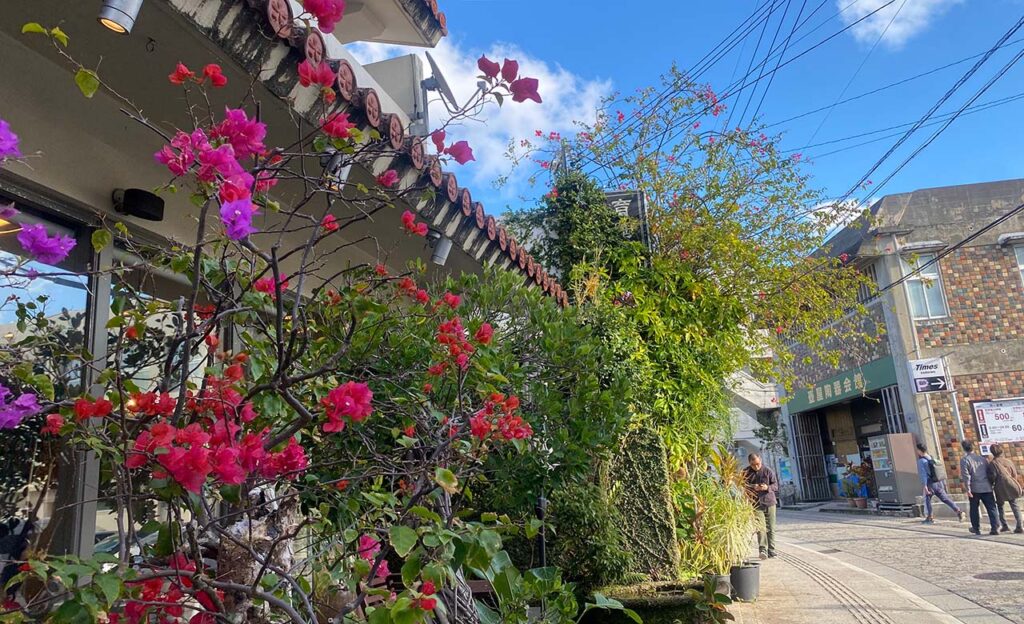
The second move is to walk the whole 400 meters once without buying. UMUI's recent local guide repeats the 400-meter scale, notes the Makishi approach at about 8 minutes, and flags that the street itself has no parking; it also uses the kind of close street photography that shows the real condition, with tile eaves, plants, shopfronts, pavement, wires, and pedestrians sharing the frame [5]. That is the right visual grammar. Tsuboya is not a polished craft mall. It is a neighborhood street that happens to carry an unusually dense ceramic memory.
Keep your bag small and your elbows quiet. Many shops are compact, with shelves that punish careless backpacks. Hold a tote in front of you, ask before photographing interiors, and do not lift stacked bowls as if you are inspecting fruit. If you want a piece, name its job first: rice bowl, tea cup, small plate, chopstick rest, one everyday thing you can hand-carry. The Tsuboya Pottery Cooperative's account of the craft helps explain why this restraint works. Tsuboya ware divides broadly into glazed joyaki and unglazed arayaki, with daily-use bowls, plates, jars, cups, and large vessels shaped by local clay, wood-fired history, glaze traditions, wheel work, hand-forming, carving, inlay, and slip techniques [4]. The purchase should feel like choosing a tool, not capturing a district.
The third move is to let Fenu-kama stay part of the street, not a separate conquest. NAHANAVI describes it as an Okinawa prefectural intangible cultural property and the only remaining climbing kiln on Yachimun Street, now preserved rather than used [7]. That detail changes the walk. Tsuboya's heavier past is not hidden behind a museum wall; it sits close enough to the shops that you can read the modern lane against the older kiln system. The cooperative history adds the reason this matters: after Naha recovered from war, increasing housing made wood-kiln smoke a serious problem, so many makers moved from wood firing toward gas or kerosene kilns, while some wood-firing work shifted toward Yomitan [4]. The calm shopping street still carries an urban compromise.
Fourth move: buy late, and keep the budget honest. A no-purchase route costs 350 yen if you enter the museum and 0 yen if you only walk the public lane. If you want a making experience, do not improvise it at the end of the walk. NAHANAVI's course lists Ikutouen Yachimun Dojo experiences from 3,300 yen, with roughly 30 to 90 minutes for vessel work and 60 to 90 minutes for shisa work, both requiring reservation and later pickup or delivery [7]. That is a different outing. For this route, the better first-timer move is one durable small object, bought after you have seen several shops, wrapped well, and carried by hand.
The fifth move is to use community evidence without outsourcing taste to it. Jalan's Japanese review surface repeats the useful basics: people enjoy walking shop by shop, the back lane has a rougher local feel, and the pottery stores make the street more than a photo stop [6]. Read that as a pacing clue, not as an order to buy more. The street association's own feed for the 2025 Yachimun Street Festival described shopping rules, a 2,000 yen purchase threshold across shops for festival lottery participation, a 14:00 guided walk, and a next festival planned for the first Saturday and Sunday of November 2026 [8]. Festival Tsuboya is lively; ordinary Tsuboya is easier for choosing one thing well.
The trapline is predictable. Mistake one: arriving Monday and discovering the museum rhythm is broken. Better: check the museum calendar first and make the museum the opener [3]. Mistake two: driving straight in because the map says the street is central. Better: Makishi Station, Makishi Public Market, or the Tsuboya bus stop, then walk [2][5]. Mistake three: treating the street as a photo lane and leaving before touching the craft history. Better: museum, full slow pass, then one shop decision [3][4]. Mistake four: booking a workshop mentally but not actually reserving time. Better: choose either a 75 to 100 minute street-and-museum visit or a longer craft session with reservation, pickup, and packing handled [7].
Concrete go details: budget 75 to 100 minutes for the street and museum, more if you are a serious buyer. Start from Makishi Station or Makishi Public Market, enter through the Heiwa-dori side, and let the ceramic signs and stone paving pull you east rather than hopping between pins. Stand outside the museum first, then inside the first gallery, then at the street edge near the preserved kiln before deciding where to buy. No queue is normally needed for the street or museum; reservations matter only if you add a hands-on workshop. Bring water, a slim bag, and room for one wrapped piece. Card acceptance varies by shop, so carry enough yen for a small purchase without assuming every counter works like a department store.
Tsuboya works because it keeps pottery heavy in the middle of a tourist city. The street is close to Kokusai-dori, but its logic is slower than Kokusai-dori. It asks you to feel weight, glaze, shelf spacing, kiln memory, and neighborhood scale before you decide what belongs in your suitcase. That is the local move: leave with one object you understand better than you did an hour earlier.
Sources
- Okinawa Story, "Tsuboya Yachimun Street" - official Okinawa tourism page on the 400-meter Ryukyu-limestone street, roughly 20 pottery workshops and galleries, royal-kiln history, and access notes.
- Tsuboya Yachimun Street Association, "Tsuboya Yachimun Street" - official street-association access page used for Makishi, Kokusai-dori, market, bus-stop, and one-way-street details.
- Okinawa Story, "Naha City Tsuboya Pottery Museum" - Okinawa tourism listing for museum hours, last entry, Monday and year-end closures, admission, address, and access basics.
- Tsuboya Pottery Cooperative, "About Tsuboya Pottery" - cooperative history and technique page on joyaki, arayaki, glazes, forming methods, the 1682 kiln consolidation, postwar recovery, and kiln-smoke pressures.
- UMUI Clip, "Tsuboya Yachimun Street Walking Guide" - recent local Okinawa guide used for the 400-meter scale, Makishi access, no-parking note, street texture, and the real photographic lead image.
- Jalan, "Tsuboya Yachimun Street" - Japanese review/community page used for visitor reports on shop-by-shop walking, back-lane texture, pottery-store browsing, and street-atmosphere cues.
- NAHANAVI, "Enjoy Tsuboya Ware on Yachimun Street" - Naha City Tourism Association model course used for museum admission, Fenu-kama context, workshop time, pricing, reservation, pickup, and citizen-recommendation signals.
- Tsuboya Yachimun Street Association, "Daily Tsuboya" - official street-association feed used for the 2025 Yachimun Street Festival details and November 2026 festival timing signal.