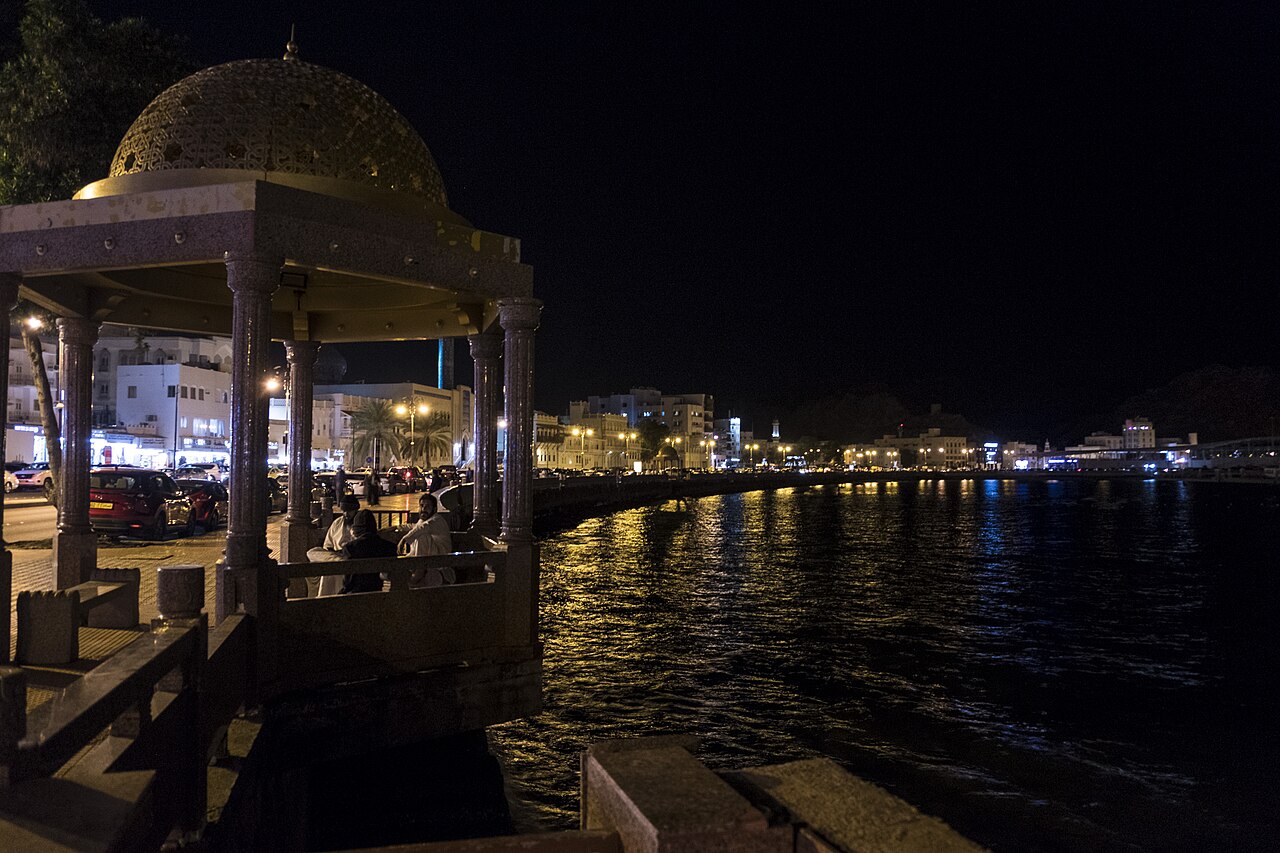
Muscat is easy to misread if you only move by car between big monuments. The city sits long and low between water and rock, and the distances make first-time visitors behave as if every stop has to be consumed in a separate taxi hop. Muttrah corrects that. For one evening, keep the plan narrow: Muttrah Corniche first, Muttrah Souq second, then back to the waterfront before the night turns into shopping fatigue.[1][2][3]
This is a night-room route, not a full Muscat itinerary. The official tourism page for Muttrah Fort places the fort above the historic district, looking over the corniche and old harbour, with the souq and corniche listed as nearby anchors.[1] That geography is the reason the walk works. You are not chasing a skyline. You are letting a harbour town show its parts in order: water, lamps, white buildings, hill fort, covered market, then water again.
The strongest window is 17:30 to 20:30. Oman Spirit's current Muttrah Souq guide gives the practical schedule: the souq generally runs on a split day, roughly 9:00-13:00 and 16:00-22:00, with evening after 17:00 as the more atmospheric time because heat drops, more local families are out, and the covered lanes brighten into their proper rhythm.[2] That timing also keeps the corniche from feeling like a hot exposed errand. Arrive while the sky is still holding color; leave after the lamps have done their work.
Image context: the cover is a real Wikimedia Commons photograph of Muttrah Corniche at night, taken in 2020. It is used because the article depends on a recognisable waterfront curve, not a generic Oman desert image or a generated travel mood board.[7]
Anchor 1: let the corniche be the measuring line
Start outside, not in the market. If you enter the souq first, Muttrah becomes a buying problem too quickly. Walk the corniche for 20 to 30 minutes before you shop. Stand where the harbour, the lamps, the road, and Muttrah Fort all sit in one frame. The fort is not just background decoration; Experience Oman dates its original Portuguese construction to the 1580s, with later rebuilding under the Al Ya'arubah rulers between 1624 and 1742.[1] That is the city-specific texture worth carrying into the route. Muttrah's night mood is not only pretty water. It is a trading harbour with defensive architecture still watching the curve.
The local move is to keep the waterfront short. Do not try to turn the corniche into a heroic end-to-end promenade. The better version is a controlled loop: arrive near the souq entrance, walk along the harbour until the fort and water settle into view, then return to the main gate. Local and traveller surfaces keep pairing the same two anchors because they belong together: the corniche gives orientation, and the souq gives street-level pressure.[2][3][4]
Spend expectation is simple. The corniche costs OMR 0. Muttrah Fort, if you add it before the night-room route, is a paid stop: Experience Oman lists non-resident adult entry at OMR 3 and opening hours from 8:00 to 23:00.[1] For this article's core evening, the fort is a visual anchor rather than a required climb. If you do climb it, do that first, then come down to the waterfront before the souq gets busy.
Parking is the first trap. A recent r/Oman visitor thread mentions Muttrah Corniche and Souq as standard Muscat stops, but another practical thread about Muttrah parking points to the real friction: driving yourself into the old district can turn a calm evening into a curb-hunt.[4][5] The better alternative is to arrive by taxi or ride-hailing app, set the pin near Muttrah Souq or Muttrah Corniche, and make the rest pedestrian. If you have a rental car, park once and stop moving it.
Anchor 2: enter the souq softly
When you cross into Muttrah Souq, use the waterfront entrance as your reset point. Oman Spirit describes the souq as a rectangular covered market just behind the corniche, with a prominent white arched gate and a central lane that branches into smaller passages.[2] That gate is your navigation cue. If you get turned around, do not keep burrowing inward while checking a phone map that cannot read the alleys. Drift back toward the wider lane, then toward the waterfront.
The second local move is cash discipline. Cards may work in many shops, but Oman Spirit notes that cash is preferred and can make bargaining easier; bring Omani rials in small denominations rather than forcing every conversation into a card terminal or a large-note problem.[2] The expected souvenir spend for a light pass is OMR 2-10 for small incense, dates, spices, or a modest keepsake. Anything involving silver, khanjars, or old-looking objects deserves more patience and comparison than a first loop usually gives.
Bargaining should be calm. The non-local mistake is to perform haggling as theater: exaggerated walkaways, comic lowballing, sudden reversals. Oman Spirit's practical advice is better: decide what you are willing to pay, ask directly for the best price, and only negotiate seriously when you actually intend to buy.[2] ZigZag on Earth adds the useful reality check that the souq is used by locals as well as visitors, sells household goods alongside frankincense, perfume oils, garments, spices, and tourist-facing items, and gets busier at night.[3] That mix is the point. Treat the place like a living market, not a stage set built for your souvenir story.
The third move is to smell before you buy. Frankincense and bakhoor are the obvious Omani thread, but the quality range is wide. Ask to smell different grades, buy small, and remember that a burner or resin you can actually use is better than a decorative object you do not understand.[2] The fourth move is to leave the narrow lanes before you are irritated. A 45- to 70-minute souq pass is enough for a first evening. After that, return to the corniche air.
The visitor mistakes that weaken Muttrah
The first mistake is arriving at midday. The souq's split schedule makes the middle of the day the weakest version of the route, and the covered lanes still hold heat.[2] Better alternative: use late afternoon for arrival, dusk for the corniche, and early evening for the souq.
The second mistake is making Muttrah only a shopping stop. If you enter, buy, exit, and leave, you miss why the market sits where it does. Better alternative: read the harbour first. The souq makes more sense after you have seen the water and fort that explain its old commercial logic.[1][2]
The third mistake is trying to append all of old Muscat to the same hour. Al Alam Palace, museums, forts, the corniche, the souq, and dinner can all look close on a map, but Muscat punishes overpacking. Better alternative: hold this route to two anchors and one optional fort view. The night works because it is narrow.
The fourth mistake is treating local etiquette as vague politeness. A recent r/Oman reply to a first-time visitor gives the plain rule: Oman is tourist-friendly, but visitors should respect local culture and religion and dress decently.[4] In Muttrah, that means modest clothing, patient browsing, no aggressive photography of shopkeepers or families, and no turning bargaining into a contest.
The compact go sheet
Best time window: 17:30-20:30, with the souq usually strongest after 17:00 and generally open in the evening until around 22:00.[2]
Navigation cue: set your drop-off for Muttrah Souq or Muttrah Corniche, find the waterfront gate, and use the harbour side as your reset point if the lanes start looping.[2][6]
Expected spend: OMR 0 for the corniche walk; OMR 2-10 for small souq purchases; OMR 3 for non-resident adult entry if you add Muttrah Fort.[1][2]
Queue and reservation reality: no reservation is needed for the route itself. The real bottlenecks are parking, heat, and your own tendency to overpack the evening.[2][5][6]
Where to stand: on the corniche before entering the souq, where the harbour curve and fort are both visible; inside the souq, stay near the main spine until you have your bearings.[1][2]
Muttrah does not need a grand plan. Give it one curve of water, one market gate, small rials, soft bargaining, and enough time to return outside. Muscat feels more coherent when the evening is allowed to stay this small.
Sources
- Experience Oman, "Muttrah Fort" (official tourism page; fort history, harbour and corniche context, opening hours, entry fees, and nearby attractions).
- Oman Spirit, "Muttrah Souq: Muscat's Ancient Market Guide" (updated April 15, 2026; local guide to souq hours, layout, bargaining, cash/card norms, frankincense, and corniche pairing).
- ZigZag on Earth, "Muttrah Corniche and Souq (Muscat, Oman)" (local-experience guide noting the corniche/souq pairing, local shoppers, evening crowding, and market goods).
- r/Oman, "Visit in Muscat" (published 2026; local community reply recommending Muttrah Corniche and Souq and emphasizing decent dress and respect for local culture).
- r/Oman, "How easy is it to park in Mutrah, Muscat?" (local community discussion on tourist movement and parking friction around Muttrah).
- Google Maps search, "Muttrah Souq Muscat" (current community-review and place-status surface; accessed May 31, 2026).
- Wikimedia Commons, "File:Muttrah Corniche by night 01.jpg" (real photographic cover image source).