Melbourne gives first-time visitors too many ways to make the centre feel smaller than it is: rush Swanston Street, photograph Flinders Street Station, cut through a laneway, then pay for a tram ride that was already free. The cleaner move is to treat the CBD as a slow public room. As of 2026-04-20, Transport Victoria still says trams are free inside the Free Tram Zone, including the City Circle Tram route, and that a myki is not needed when the whole trip stays inside that zone; it also warns that tapping on inside the zone can charge a two-hour fare.[1] That single rule changes the city. The useful question is no longer "how many sights can I cover?", but "where can I let the loop change pace before I choose the next block?"
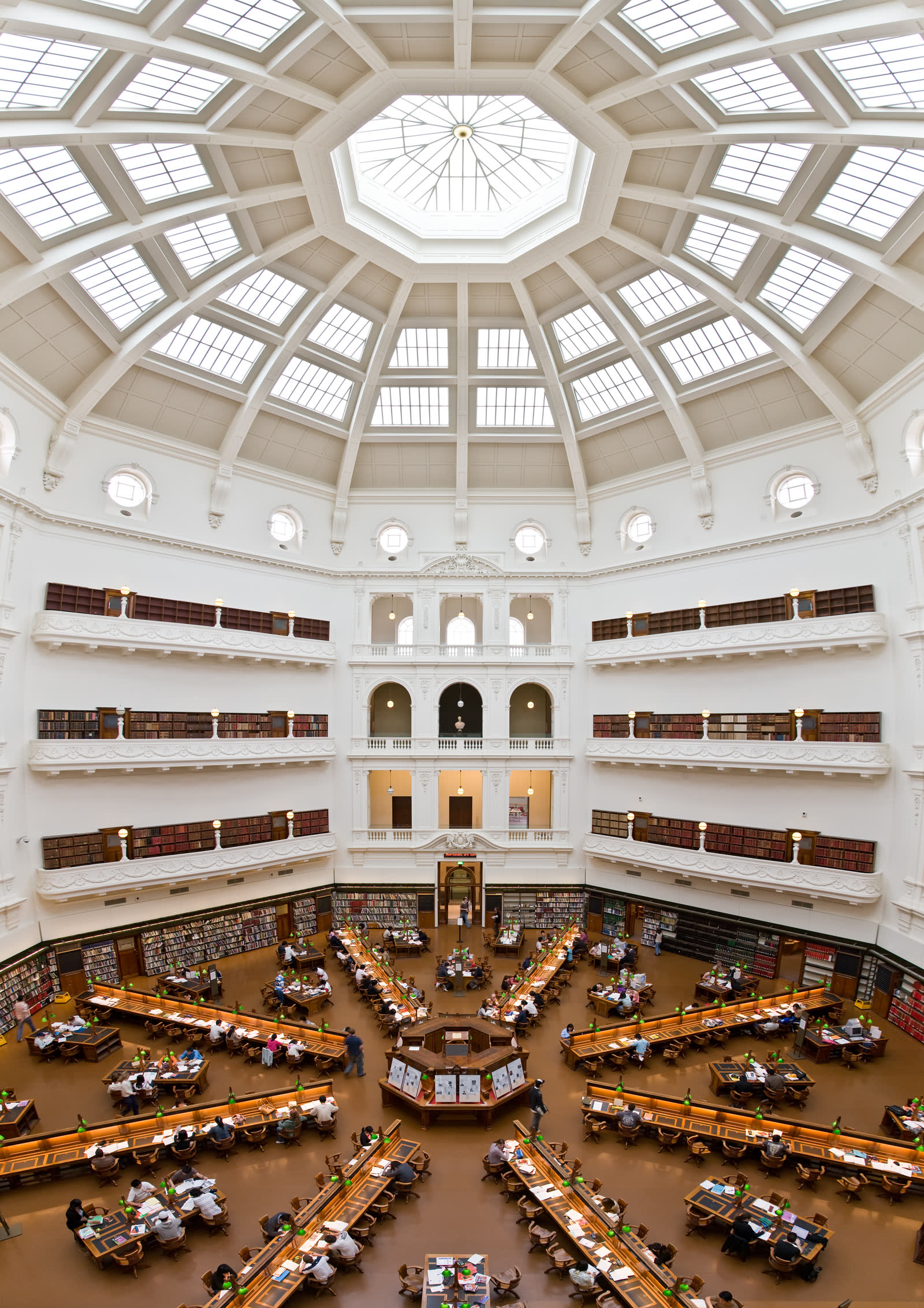
Use two anchors only. The first is Route 35, the City Circle (Free Tourist Tram), not as a full sightseeing obligation but as a weatherproof way to read the CBD's edge: La Trobe Street, Spring Street, Flinders Street, Docklands, then back toward the library side of town.[2] The second is State Library Victoria, at 328 Swanston Street, open 10am-6pm daily in its public-facing guidance, with Melbourne Central opposite and ten tram routes reaching the entrances on Swanston and La Trobe streets.[3] Inside it, the La Trobe Reading Room is the real pause: opened in 1913, six storeys high, built for 320 readers and 32,000 books, quiet enough that the green lamps and original chairs do more for your nervous system than another coffee queue.[4]
This route works especially well in rain, heat, or the hour when the CBD starts pushing everyone toward transactions. Local and city-facing signals line up. Time Out Melbourne's August 2025 note on the library's global beauty ranking describes the front lawn as one of the city's beloved public hangouts and points back to the six-storey dome as the room that keeps pulling visitors in.[6] OnlyMelbourne's visitor-facing Free Tram Zone guide adds the practical local layer: the free zone is marked at stops, drivers announce approaching boundaries, and visitors only need myki logic when they leave the CBD/Docklands zone.[7] The current Google Maps place surface for State Library Victoria supplies the other live cue: this is still treated as a central city place people actively visit, review, and navigate to, not a frozen heritage object.[8] The local habit is not complicated. Ride a free central tram when the streets are too loud, step off near the library, and let the reading room reset the city.
Image context: the cover uses a documentary photograph from Wikimedia Commons, not a diagram or generated visual. It suits the piece because the dome is the practical endpoint: a recognisable public interior where the CBD's tram noise turns into a civic hush.[9]
The street microcosm
Start with the tram, but do not fetishize the full loop. The City Circle is useful because it gives the CBD a perimeter you can feel in your body: the office edge along La Trobe, the ceremonial edge near Spring Street, the river-facing edge around Flinders Street, the rebuilt Docklands edge before the line folds back.[2] If you are already inside the Free Tram Zone, the local move is to board without touching on, keep the ride short, and use the tram as a moving threshold rather than as a museum ride.[1] Ten or fifteen minutes is enough. The aim is to find the city changing material under the wheels, then leave before the commentary becomes the point.
The best working window is 10:30am-11:30am or 4:00pm-5:20pm. The first window lands after the library doors have opened but before the central lunch churn fills Swanston Street; the second gives you the late-afternoon turn without betting the whole outing on the edge of the 6pm closing time.[3][4] In wet weather, board whichever City Circle stop is convenient, then make the State Library the exit. In bright weather, do the reverse: take the lawn first, then ride one short side of the loop when the streets get too glare-heavy.
State Library Victoria matters because it is not just a pretty shelter. The institution dates to 1854, opened as the Melbourne Public Library in 1856, and has remained on the same two-acre allotment while the site absorbed and shed exhibition buildings, museum functions, gallery histories, and public-record responsibilities.[5] The front lawn used to be fenced; the fence was gone by 1939, helping turn the Swanston Street frontage into the public hangout people now treat as obvious.[5][6] That detail changes how you should visit. The lawn is not a waiting area. It is part of the building's civic machinery.
8 local moves that make it work
- Do not touch on if the whole tram ride stays inside the Free Tram Zone. Transport Victoria is explicit: a myki is not needed for trips wholly inside the zone, and accidental touch-on can cost a two-hour fare.[1]
- Use Route 35 as a short reset, not a completion badge. One side of the loop is enough if it gets you from crowd pressure to the library edge.[2]
- Check the official route page or PTV planner before relying on late service. Generic search summaries blur route-specific hours; the official route page is the better starting point for same-day timing.[2]
- Enter the library from Swanston Street when you want the full civic reveal. The address, public-transport directions, and current place surface all make that the cleanest arrival, with Melbourne Central directly opposite.[3][8]
- Go up before you go down. The La Trobe Reading Room is strongest from the elevated gallery first; then take the floor if you want to sit.[4]
- Treat the dome as a quiet room. It is still a reading space, with study desks, catalogue PCs nearby, and a culture of low volume.[4]
- Use the lawn only when it is doing actual work for you. In good weather, sit there for ten minutes and read the Swanston Street flow; in rain, skip the performance and go inside.[5][6][8]
- Keep the route free unless you knowingly leave the zone. The visitor mistake is drifting toward Carlton, the Royal Exhibition Building, or the gardens as if the same no-myki rule still applies. Once a trip starts or ends outside the zone, normal myki rules return.[1]
Non-local trapline
The first trap is treating the City Circle as a tourist obligation. Better move: take one leg, then step off when the city has changed texture. If you sit through the whole thing while tired, the tram becomes a moving waiting room instead of a tool.[2]
The second trap is tapping on out of big-city habit. Better move: read the stop signage, keep the ride inside the Free Tram Zone, and leave the myki alone unless you are crossing the boundary.[1]
The third trap is arriving at the library at midday expecting silence, an empty dome selfie, and a desk under the best light. Better move: use 10:30am for the clearest interior start or 4:00pm for a softer late-day pass, then keep a hard eye on 6pm.[3][4]
The fourth trap is stopping at the lawn and calling the library done. Better move: go inside, climb or lift to the upper vantage point when open, look down into the octagon, then decide whether you want a desk, the galleries, or the exit back to Swanston Street.[4]
Concrete go details
- Best time window: 10:30am-11:30am for a clean start, or 4:00pm-5:20pm for a late-afternoon rain-hour pause before the 6pm close.[3][4]
- Expected spend: $0 if the tram ride stays inside the Free Tram Zone and the visit stays with the public library spaces.[1][3][4]
- Queue and reservation reality: no booking layer is needed for this basic visit; the only capacity pressure is ordinary crowding around the lawn, dome vantage points, and study desks.[3][4][6]
- Where to sit or stand: stand by the tram door for a short hop, then use the La Trobe gallery for the first view and the reading-room floor only if you are ready to be quiet.[1][4]
- Navigation cue:
City Circle / Free Tram Zone -> La Trobe or Swanston edge -> State Library Victoria -> La Trobe Reading Room gallery -> lawn or Melbourne Central exit.[1][2][3][4] - Numeric anchors worth keeping: Route 35, Free Tram Zone, 10am-6pm, 328 Swanston Street, ten tram routes, 1913, six storeys, 320 readers, 32,000 books, 1854, 1856, two acres, 1939.[1][2][3][4][5]
Melbourne's centre rewards this kind of small discipline. Spend nothing, ride less than you could, enter one public building properly, and the CBD stops being a list of nearby attractions. It becomes a set of thresholds: tram step, wet pavement, Swanston lawn, dome gallery, reading desk, street again.
Sources
- Transport Victoria, "Cheaper travel with myki" - Free Tram Zone rule, City Circle inclusion, myki/touch-on warning, and outside-zone boundary rule.
- Transport Victoria, "35 City Circle (Free Tourist Tram)" - official route page for the City Circle tram.
- State Library Victoria, "Visit" and "Getting here" - opening hours, address, public-transport access, and Melbourne Central orientation.
- State Library Victoria, "La Trobe Reading Room" - 1913 opening, six-storey room, 320-reader and 32,000-book capacity, quiet-space description, and access notes.
- State Library Victoria, "The history of our building" - 1854 founding, 1856 opening, two-acre site, people's-university framing, and lawn/fence history.
- Time Out Melbourne, "This historic Melbourne library has just ranked among the ten most beautiful in the world" (August 2025) - recent local-publication confirmation of the lawn and dome as live visitor draws.
- OnlyMelbourne, "Free Tram Zone" - local visitor guide to the CBD/Docklands free-tram boundary, stop signage, driver announcements, and myki boundary caution.
- Google Maps search, "State Library Victoria" - current place, navigation, and community-review surface for the library as an active central Melbourne stop.
- Wikimedia Commons, "File:State Library of Victoria La Trobe Reading room 5th floor view.jpg" - documentary photograph used for the cover image.