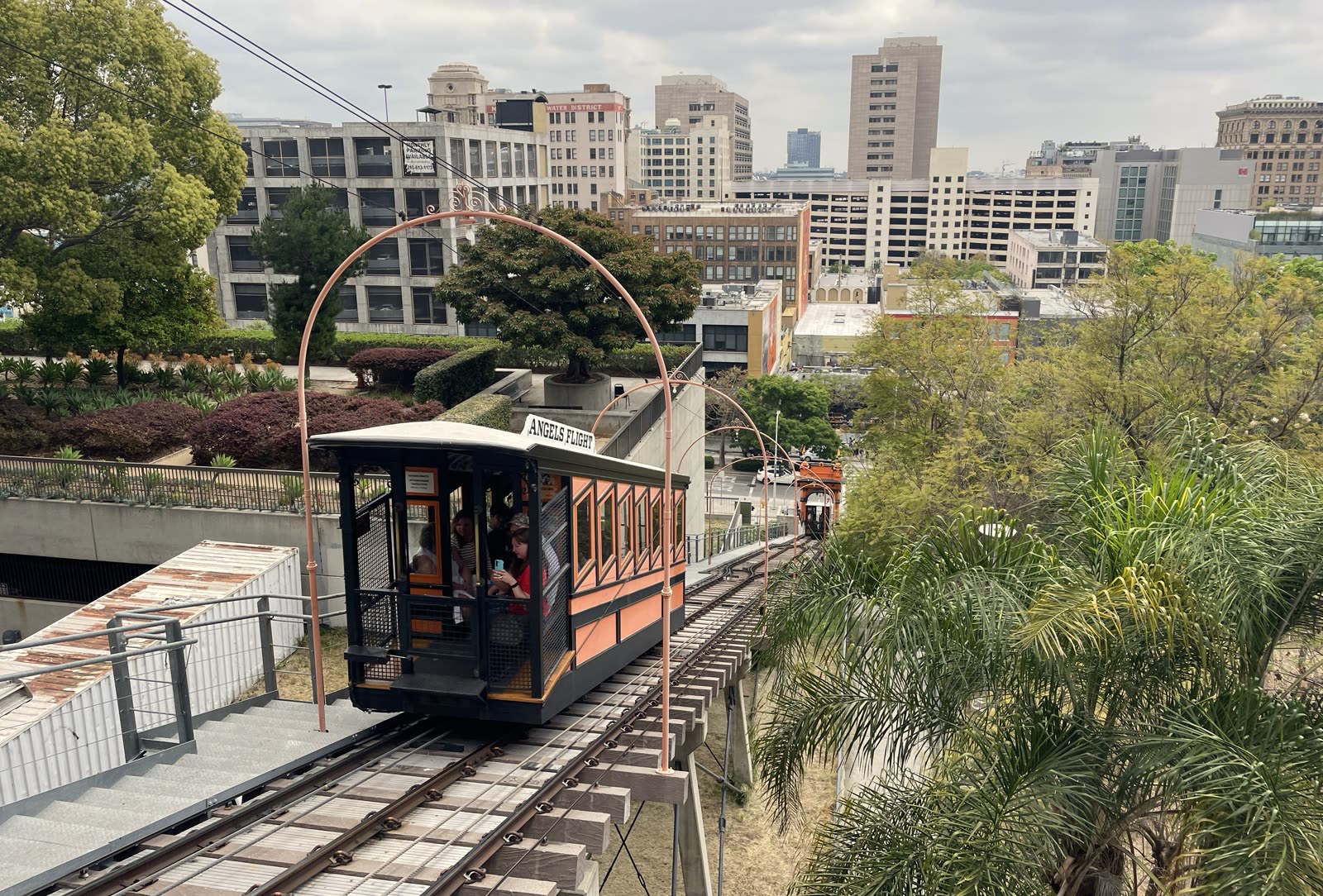
Downtown Los Angeles gets overplanned. People either treat Bunker Hill as a museum district to clear in a rush or they use Angels Flight as a one-minute novelty and go straight back down. The better move is narrower: work the short vertical seam between the Hill Street lower station and California Plaza's upper terraces as one urban room.[1][2][3]
The scale is tiny. The railway covers only 298 feet and one block, but it still solves a real topographic problem and carries the older Bunker Hill logic inside a downtown that was largely rebuilt around it.[1][3][4] That mix is what makes the route useful. You get a mechanical lift, a level change, and a quieter plateau without committing to a whole DTLA itinerary.
Image context: the cover image shows Angels Flight in present-day service, the exact lower-to-upper seam this route uses to climb into California Plaza.
Why this seam works better than a random DTLA add-on
Angels Flight opened in 1901, ran at its original alignment until 1969, and was reassembled near Grand Central Market in 1996 after decades in storage.[3][4] The present ride still performs the same basic city function: it gets you off the Historic Core slope and onto the Bunker Hill shelf quickly enough that you notice the change in pace.
That upper shelf matters more than first-timers expect. Grand Performances' venue guide describes California Plaza as a two-level setting with Upper and Lower Plaza zones, 350 amphitheater seats, benches across the balcony, and second-floor access by stairs, elevator, or ramp.[2] In practical terms, that means the top station empties into a place you can actually use, not just photograph.
The best version is early evening on a non-event night
The railway runs seven days a week from 6:45 a.m. to 10:00 p.m.[1] That makes timing flexible, but the route is not equally good at every hour. The most readable version is the after-work shoulder, when the light softens and the plaza still behaves like public space instead of event infrastructure. Los Angeles guides that still cover the ride tend to frame it as a practical upward link from Hill Street, not a static photo op, which is the right starting mentality for this seam.[5][6]
Event nights change the math. Grand Performances uses California Plaza as a large outdoor venue with 7,000-person capacity, and some event-parking operations begin 60 minutes before listed show times.[2] On those nights, either arrive well before the one-hour pre-show fill begins or pick another day. A quiet vertical seam and a concert crowd are two different products.
8 local moves that materially improve the route
First, start at the 351 S Hill Street lower station across from Grand Central Market, not at the top.[1][3] The uphill version is stronger because the mechanical lift becomes the opening reveal and California Plaza becomes the release.
Second, pay with a Metro TAP card if you are already moving through the rail system. The one-way fare drops to $0.75 instead of $1.50, which is the cleanest way to keep this route in "small urban move" territory instead of turning it into a novelty purchase.[1]
Third, ride up once and linger upstairs first. Local Los Angeles guides treat the useful version of Angels Flight as an uphill transfer into Bunker Hill, not as a stand-alone trick, and that is the sequence to preserve here.[5][6]
Fourth, hold your longest pause on the Upper Plaza benches or balcony edge, not at the lower loading zone. The bottom station is for boarding; the top station is where the route actually becomes a room.[2]
Fifth, if Grand Performances or another plaza event is scheduled, use the venue's own circulation clues to predict how the night will feel. Once the upper and lower plaza start filling for a show, California Plaza stops acting like a casual overlook and starts acting like audience infrastructure.[2]
Sixth, keep the first pass compact. One ride, one upper-plaza loop, one decision point. If the plaza feels good, extend; if it feels crowded or over-programmed, descend and keep moving. The route works because it is tight, not because it is long.
Seventh, read the old/new city overlap while you move. Angels Flight is one of the few DTLA pieces that still records the original Bunker Hill steepness instead of hiding it inside garages, escalators, and office lobbies.[4]
Eighth, use Google Maps as the last operational check before you commit. Same-day status, entrance friction, and whether the place feels actively in use are the variables most likely to change the texture of a very short route.[7][8]
Non-local trapline: 4 common misses and the cleaner alternative
Mistake 1: riding up and immediately riding back down because it is "too short"
Better alternative: treat California Plaza as the actual second anchor. The railway is the transfer between rooms, not the whole experience.[2][6]
Mistake 2: showing up on a concert night expecting a quiet overlook
Better alternative: go on a non-event evening, or beat the 60-minute pre-show swell and accept that the plaza is functioning as a venue that night.[2]
Mistake 3: paying full fare out of habit
Better alternative: use stored value on TAP and keep the one-way ride at $0.75 if you are already in Metro mode.[1]
Mistake 4: starting from the top because Grand Avenue museums feel more "important"
Better alternative: start on Hill Street so the elevation change is legible and the upper plaza lands like a release instead of an exit.[1][3]
Concrete go details
- Best window: a non-event weekday in the late afternoon or early evening, when Angels Flight is lit, the slope is still legible, and California Plaza has not yet turned into event infrastructure.[1][2]
- Expected spend: $0.75 one way with TAP, $1.50 standard fare, or $3.00 for the souvenir round-trip ticket.[1]
- Queue and reservation reality: no reservations; the real variables are operational pauses, same-day crowd friction, and whether an upper-plaza event is starting.[1][2][7][8]
- Where to stand: ride up, then shift to the Upper Plaza balcony benches before drifting toward Grand Avenue. Do not spend your whole dwell in the lower loading pen.[2]
- Navigation cue:
351 S Hill Street lower station -> Angels Flight -> California Plaza / 350 S Grand Ave -> upper-plaza loop -> decide on Grand Avenue continuation or descent.[1][2][3] - Numeric anchors worth keeping: 298 feet, 1901, 1969, 1996, 6:45 a.m.-10:00 p.m., $0.75 TAP, $1.50 regular fare, 7,000 capacity, 350 amphitheater seats.[1][2][3][4]
Los Angeles often rewards people who accept incomplete systems and read them closely. This is one block of rail, one plaza, and one altitude change, but it turns a generic downtown crossing into a tiny lesson in how the city still exposes its older terrain.
Sources
- Angels Flight Railway, "Operations" (official hours, station locations, fares, and TAP discount details).
- Grand Performances, "Venue Info" (California Plaza address, Angels Flight access, seating layout, accessibility, and event-night capacity details).
- Discover Los Angeles, "Angels Flight: The Story of an L.A. Icon" (published 2025-11-21; one-block 298-foot climb, current station locations, and route history).
- LA Conservancy, "Angels Flight" (landmark history, 1901 opening, 1969 dismantling, 1996 reassembly, and Bunker Hill context).
- Time Out Los Angeles, "Angels Flight" (local guide recommending Hill Street boarding, TAP use, and current-use framing).
- Secret Los Angeles, "Los Angeles' Angels Flight Is 'The World's Shortest Railway'" (published last month; recent local listing with current hours, fare, and upper/lower entrance details).
- Google Maps search, "Angels Flight Railway Los Angeles" (same-day operational status and community-review surface).
- Google Maps search, "California Plaza Los Angeles" (same-day plaza-status and community-review surface).
- Wikimedia Commons, "File: Standseilbahn Angels Flight in Los Angeles.jpg" (documentary photograph used for the cover image).