Do not make your first Lagos Blue Line ride a grand transport conquest. Make it a short ritual: enter at Marina, ride to National Theatre, step out with a plan, and let the city appear from rail height before you decide whether to continue west.
That small segment is enough. LAMATA's current Blue Line schedule page reads the active passenger spine as Marina, National Theatre, Iganmu, Alaba, and Mile 2, with Marina to National Theatre shown as a matter of minutes on the downline timetable [2]. In June 2026, LAMATA also announced a service expansion to 94 daily trips, a 6:00 a.m. Monday-to-Saturday start, continued 9:30 p.m. closing, and improved Sunday service [1]. Those numbers are not an invitation to drift. They are the reason the local move is to plan like a rail passenger, not improvise like a road passenger.
The best first-timer window is 10:30 a.m. to 3:00 p.m. on a normal weekday or Saturday if your aim is to learn the system calmly. If you want late light on the elevated approach, use 4:00 to 5:30 p.m., but only with your ride away from National Theatre already decided. A recent practical guide makes the right warning: do not read first and last train times as the moment you can arrive at the station entrance; add time for card loading, security or crowd control, the correct platform, and any gate queue [7]. The Blue Line can remove a hard middle section of Lagos traffic; it does not solve the first and last mile for you.
Start with payment discipline. LAMATA says regulated public transport rides in Lagos State are paid with the Cowry Card, and its warning is blunt: load through POS, the linked wallet, or a designated Touch and Pay collecting account, and do not transfer to a personal account under any guise [4]. For a visitor, the move is to treat the Cowry setup as part of the visit, not a small errand. Arrive 15 minutes before the train you want, load more than one ride's worth, keep the card or app ready after entry, and do not make the turnstile the place where you learn the system.
Budget modestly but with buffer. Old rider accounts mention discounted 2023 fares in the hundreds of naira during the launch period [7][8], but that is not a 2026 fare promise. The practical range is to hold NGN 3,000 to NGN 5,000 for card/app buffer and short onward movement, then obey the posted fare at the station. The spend problem is usually not the rail fare. It is the cost of being stranded, reloading in a rush, or needing a last-minute vehicle after you exit.
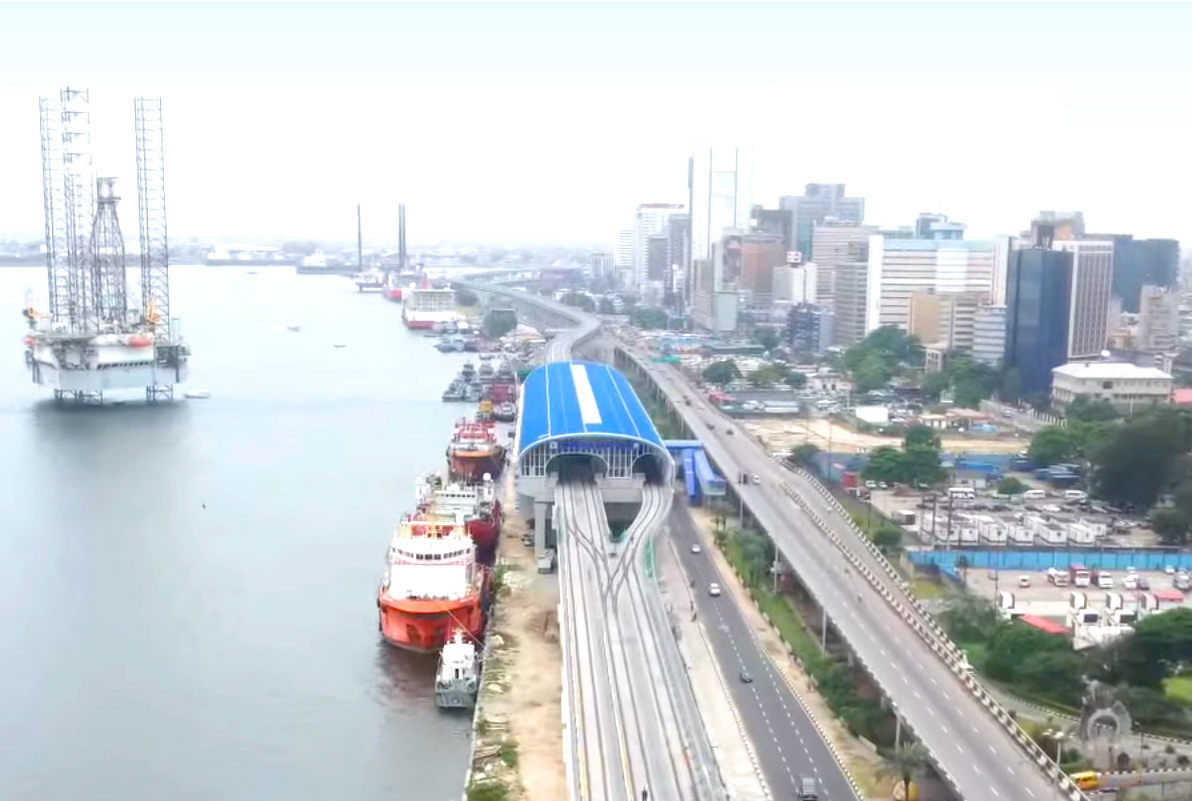
Marina is the decision point. Do not drive there casually and hope the station will behave like a mall with an obvious door, obvious parking, and an obvious pickup lane. Better: arrive by e-hailing, BRT or a short controlled drop-off, then look for the station as infrastructure rather than as a standalone attraction. The navigation cue is water and elevation. Marina Station sits where Lagos Island, roads, and the waterfront squeeze together; the photograph of the station catches exactly why the approach feels different from a bus stop [10].
On board, take the ride seriously by keeping it ordinary. Let commuters exit before you board. Do not block the doors for video. If seats are open, choose a window; if not, stand clear and look out between station announcements. From Marina toward National Theatre, the city drops below the carriage: road traffic, rooflines, water, and the scale of Lagos Island become visible without the usual roadside negotiation. One early rider noticed the absence of potholes, sudden braking, and conductor shouting precisely because those are normal street expectations being suspended by the train [8]. That is the point of doing the short segment first: the difference is clearest before it becomes routine.
Get off at National Theatre even if you are tempted to stay on. The current official rail overview still frames the Blue Line as part of a larger 27 km Okokomaiko-to-Marina project, integrated with BRT, water transport, pedestrian access, and other transport corridors [3]. But the traveler's useful line is the one operating in front of you. Marina to National Theatre gives you a complete first lesson: ticketing, platform behavior, elevated movement, one landmark exit, and a return option.
The landmark matters. The National Theatre's own history page describes the Iganmu complex as a 23,000-square-meter, 31-meter-tall architectural landmark inspired by Bulgaria's Palace of Culture and Sports, formally opened in the mid-1970s and used for FESTAC '77 [5]. In 2025, after renovation, it was commissioned and rededicated as the Wole Soyinka Centre for Culture and the Creative Arts [5][6]. That means the stop is not only a rail stop. It is Lagos connecting a new daily-mobility system to an older cultural object with a long memory.
Use that as your pacing rule: 20 minutes outside the station and theatre edge is better than a rushed full-line return. Stand where the theatre's white bowl-like mass gives you orientation. Decide whether you are returning by train, meeting a car, or walking only within a very small planned radius. Do not wander out of curiosity if you have no local companion or exit plan. The article's local trapline is simple because Lagos punishes vague transitions more than short rides.
The common visitor mistakes are predictable. Mistake one is treating the Blue Line as a sightseeing toy and stacking the whole Mile 2 return onto a loose afternoon before learning station pairs, gate timing, and the exit side [7]. The better move is one station pair first, then expand. Mistake two is assuming cash, a personal bank transfer, or "someone at the gate said so" can replace Cowry; LAMATA says it cannot [4]. Mistake three is arriving at Marina too close to departure; an early local rider praised the punctuality, which is good for the system and bad for late visitors [8]. Mistake four is exiting late without a pickup or onward route; the rail ride may be orderly, but the street edge still needs Lagos judgment [7].
The local community read on the Blue Line has never been only "nice train." A Nairaland thread around Marina Station's construction photos quickly moved from admiration to design criticism, safety worries, politics, and value-for-money arguments [9]. That mix is useful context. Lagos residents read transit through daily stakes: crowding, security, access, public money, and whether the project actually changes movement. If you ride with that in mind, the short Marina-to-National-Theatre segment stops being a novelty and becomes a city lesson.
The clean version is this: arrive with Cowry ready, use the official schedule, ride outside the hardest commute crush, exit at National Theatre, orient by the Wole Soyinka Centre, and keep the return plan visible. Do not overfill the day. Six minutes can be enough when the city is usually read through traffic. The Blue Line's strongest travel value is not that it lets you say you took a Lagos train. It is that, for a few elevated minutes, Lagos lets you see the road from outside the road.
Sources
- LAMATA, "Lagos Blue Line Expands Service to 94 Daily Trips, Starts Earlier at 6:00 AM" - official June 2026 service-expansion notice.
- LAMATA, "Blue Line - Train Schedule" - official current Blue Line timetable and station sequence.
- LAMATA, "Train Services" - official Lagos Rail Mass Transit overview and Blue Line project context.
- LAMATA, "Use Authorized Bank Account to Pay for Transport Services" - official Cowry Card and payment warning.
- National Theatre, "Our Story" - official history of the National Theatre/Wole Soyinka Centre site, design, renovation, and FESTAC context.
- National Assembly Library Trust Fund, "President Tinubu Commissions Renovated National Theatre renamed after Prof. Wole Soyinka" - October 2025 commissioning report.
- MomentBook, "Lagos Blue Line and Cowry Card guide: schedule, stations, payment," 2026 - recent practical guide to current schedule reading, station pairs, Cowry use, and first/last-mile caution.
- Adeola Osas Jacob-Osagie, "The Lagos Blue Line Rail is Finally Here: My Experience on the Train," Medium, 2023 - local first-ride account with station sequence and passenger observations.
- Nairaland Travel Forum, "Pictures Of The Marina Train Station For The Lagos Blue Rail Line" - Nigerian community discussion around Marina Station construction photos and local reactions.
- FrankvEck, "Marina-station-lagos.jpg," Wikimedia Commons - real photographic source for the article image.