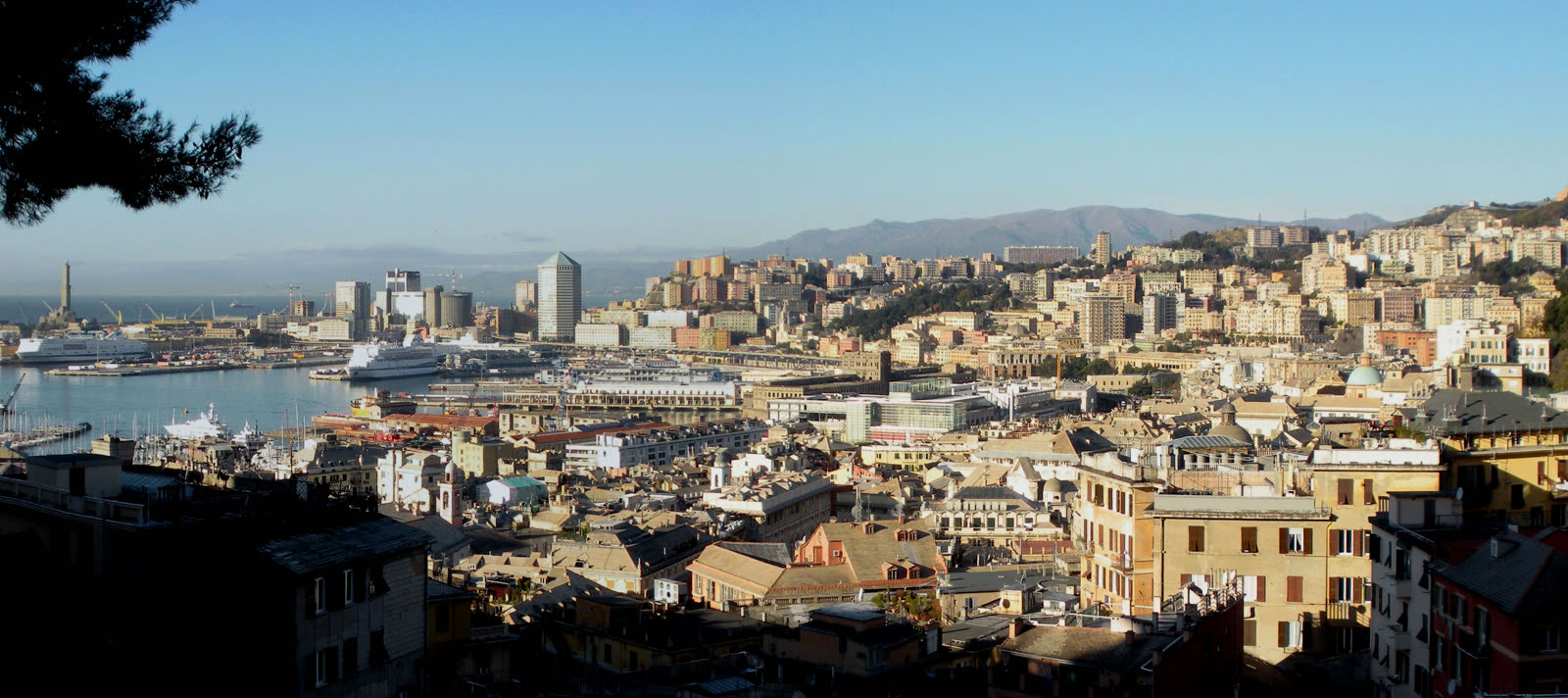
If you only borrow one Genoa move, make it this: do not climb to Castelletto the hard way first. Start at Piazza Portello, step into the Ascensore di Castelletto Levante, and let the city reveal itself in the order Genoa handles best: vertical lift first, balcony second.[1][3][4] The route is tiny, but the payoff is structural. You are not just collecting a viewpoint. You are using one piece of everyday hillside infrastructure to turn the old city into something readable.
That is why this works best late in the day. Visit Genova describes Spianata Castelletto as the place where the city lies under you with its slate roofs, towers, domes, and the sea behind them; it also notes that the overlook became famous through early twentieth-century photographs, including the Alinari brothers' views from 1910.[4] Another official Visit Genova page goes further and names sunset directly, describing the city as if a prairie were set ablaze by the red evening glow.[5] This is not decorative wording. It is an operating instruction. Midday gives you information; the last hour of light gives you form.
The lift matters just as much as the terrace. AMT's page on the Castelletto Levante elevator calls it one of the city's symbolic plants and dates the present Liberty-style system to 1909, with the famous wrought-iron and wood cabin restored in 2003.[1] The current AMT winter timetable, valid through 12 June 2026, shows service every day from 06:40 to 24:00 between Piazza Portello and Spianata Castelletto.[3] That time span is the practical reason this route is so good. It works as a first city read, an after-museum reset, or a late-light detour before dinner, and it does not ask you to build a whole afternoon around it.
The local/community material points the same way. Recent Genoa advice on Reddit still treats the overlook as a must-do even in compact one-day itineraries, and one current thread explicitly frames Castelletto as one of the city's safest, most pleasant residential areas with a beautiful spianata and the old walls nearby.[6][7] Google Maps' live place surfaces keep the same picture in the present tense: the overlook is still actively reviewed and used as a sunset stop, while the elevator is still treated as a living urban device, not a sealed heritage exhibit.[8][9]
Image context: the cover uses a real documentary photograph from Wikimedia Commons showing the roof-and-harbor spread from Spianata Castelletto. That is the right image for this article because the route depends on reading Genoa outward from slate roofs to cranes to sea, not on isolating one monument.[10]
Why this balcony works better than turning Genoa into a staircase test
Genoa punishes the visitor who insists on doing everything from street level first. The old city is dense, shadowed, and folded; if you begin by forcing a complete walking explanation, the place can stay fragmented for too long. The elevator fixes that. In one short ascent, Portello's traffic and stone walls give way to the city's roof grammar. Slate becomes the dominant material. Church domes rise out of compressed blocks. The port appears as the far industrial edge rather than as a separate district.[1][4][5]
Spianata Castelletto then does the second half of the work. It is not only a lookout rail where you stop for a photo and leave. It is a pause that teaches scale. From here the centro storico stops feeling like a maze and starts behaving like a topographic mass between hill and water.[4][8] That is the place portrait: one machine up, one terrace out, and suddenly Genoa's famous verticality no longer feels abstract.
This route also stays mechanically light. If the elevator is the only transport you need, AMT sells a EUR 1.20 single ticket specifically for lifts and funiculars. If you are chaining the move with buses or the metro, the standard urban ticket is EUR 2.00 and valid for 110 minutes on the network.[2] That means the expected spend can stay between EUR 1.20 and EUR 2.00 unless you deliberately add coffee, aperitivo, or more transport.
8 local moves that make the stop read correctly
- Start from Portello, not from the top. The whole point is to let the lift perform the reveal rather than arriving with the view already flattened.[1][3][4]
- Use the ticket that matches your actual route. If this is a self-contained up-and-down move, the EUR 1.20 lift/funicular ticket is cleaner; if you are linking buses or metro within 110 minutes, the EUR 2.00 urban ticket makes more sense.[2]
- Aim for the last 45-60 minutes before sunset. Visit Genova's own sunset framing is the clue here, and community advice still treats the overlook as a late-light stop rather than an all-day platform.[5][6][8]
- Spend the first 8-12 minutes at the balustrade without trying to optimize photography. The order of reading matters more than the first image: roofs first, domes second, port and sea last.[4][8]
- Stand slightly off the center crush if there is one. Google Maps' live place behavior suggests the middle rail gets the obvious clustering; one short sidestep often gives the cleaner frame and less elbow traffic.[8]
- Keep the dwell compact, around 20-30 minutes, unless the light is exceptional. This is a balcony, not a half-day attraction, and it works best when it remains a hinge rather than a camp.
- Use the lift down unless you specifically want more vertical walking. The local trick is restraint. Genoa offers endless stair punishment; this route does not need to become one more test.
- Keep the midnight boundary in mind for the return. The current official timetable runs to 24:00, so late-light use is easy, but there is no reason to drift so long that the route loses its compactness.[3]
Non-local trapline
Mistake 1: treating Castelletto as a climb you have to earn
Better move: use the elevator on purpose. The article's whole argument is that the lift is not a cheat code. It is the actual city mechanic that makes this balcony legible.[1][3]
Mistake 2: arriving at noon because "a view is a view"
Better move: wait for the late-afternoon or sunset band. The official tourism language and the current community surfaces both point to warm, slanting light as the condition that makes the stop memorable.[5][8]
Mistake 3: spending two minutes at the rail and immediately leaving
Better move: stay long enough to let the city sort itself into layers: roofs, towers, domes, cranes, water. Genoa is the rare city where orientation is the real attraction.[4][8]
Mistake 4: burying the stop inside a bloated old-town checklist
Better move: keep the route narrow. Current local advice still recommends Castelletto precisely because it works in a compact one-day rhythm without needing a whole district-sized commitment.[6][7]
Concrete go details
- Best window: the final 45-60 minutes before sunset, with a total route time of about 30-50 minutes including ascent, pause, and descent.[5][8]
- Expected spend: EUR 1.20 for the dedicated lift/funicular ticket or EUR 2.00 for the standard urban ticket valid for 110 minutes if you are connecting other AMT rides.[2]
- Queue and reservation reality: no reservation layer; the only real friction is a brief platform wait or rail clustering at the overlook, which is why this works better as a short, timed pause than as a vague open-ended hangout.[3][8][9]
- Where to stand: use the balustrade for the first read, then shift a step off the centerline if you want more breathing room.[4][8]
- Navigation cue:
Piazza Portello -> Ascensore di Castelletto Levante -> Spianata Castelletto -> same elevator back down.[1][3] - Numeric anchors worth keeping: 1909, 2003, 06:40, 24:00, EUR 1.20, EUR 2.00, 110 minutes, 1910, 20-30 minutes.[1][2][3][4]
Genoa has bigger plans than this and harder walks than this. What it does not have in large supply are tiny routes that explain the city so quickly. One lift, one balcony, one late-light pause: that is enough.
Sources
- AMT Genova, "L'ascensore Castelletto Levante, un viaggio nel'900" (official page on the Liberty-style elevator, its 1909 system, symbolic role, and 2003 restoration).
- AMT Genova, "Biglietto ordinario" (official fare page covering the EUR 2.00 urban ticket and 110-minute validity, with links to dedicated lift/funicular ticketing).
- AMT Genova, "Orario impianti speciali - Invernale dal 15/09/2025" PDF (official timetable showing Piazza Portello-Spianata Castelletto service from 06:40 to 24:00, valid through 12 June 2026).
- Visit Genova, "Spianata Castelletto" (official tourism page on the overlook, the slate-roof panorama, and the 1910 Alinari photographic fame).
- Visit Genova, "10 cose da non perdere a Genova" (official city guide describing the sunset glow from Spianata Castelletto).
- Reddit, r/Genova, "Neighbourhood safety" (recent local/community thread describing Castelletto as a pleasant area with a beautiful spianata and nearby old walls).
- Reddit, r/Genova, "Suggestions Genoa for 1 Day" (recent local/community thread recommending Spianata Castelletto and using the elevator to Portello in a compact itinerary).
- Google Maps search, "Spianata Castelletto Genova" (current community-review and timing surface; accessed 2026-04-29).
- Google Maps search, "Ascensore di Castelletto Genova" (current place-status and community-review surface for the elevator; accessed 2026-04-29).
- Wikimedia Commons, "File:Panorama da Spianata Castelletto.JPG" (documentary photograph used for the cover image).