Gdańsk is easy to flatten at night. Visitors stay on Długie Pobrzeże, drift with the souvenir current, photograph the Crane once, and then leave with the feeling that the riverfront has already given everything it has. The cleaner move is narrower and calmer: cross to Ołowianka with the footbridge schedule in mind, let the ship-museum Sołdek and the former industrial island do the work, then come back only after the Motława has started reflecting more light than noise.[1][2][3][5] One anchor is the bridge, because the island's rhythm is set by whether you catch or miss its lift windows. The second is Sołdek, because the old hull keeps the whole walk from turning into generic waterfront prettiness.[5]
That pairing matters because Ołowianka is not a decorative side loop. It is an island with a working history still visible on its surface. In Your Pocket's current local note traces the name back to ołów, or lead, because lead from Olkusz was once stored here in the Teutonic era; later the warehouses became granaries, and the old utility and port layer never fully disappeared.[3] Gdańsk Strefa adds the harder municipal texture at the north end: the island's infrastructure zone was shaped in 1869-71, when Gdańsk installed a waterworks system and what the local history piece calls the first gravity sewer network in Europe.[7] The Polish Baltic Philharmonic building folds another layer into the scene, because its red-brick shell used to be the city's power plant before culture took it over.[3] This is why Ołowianka reads well after dark. The island is not pretending to have always been leisure space.
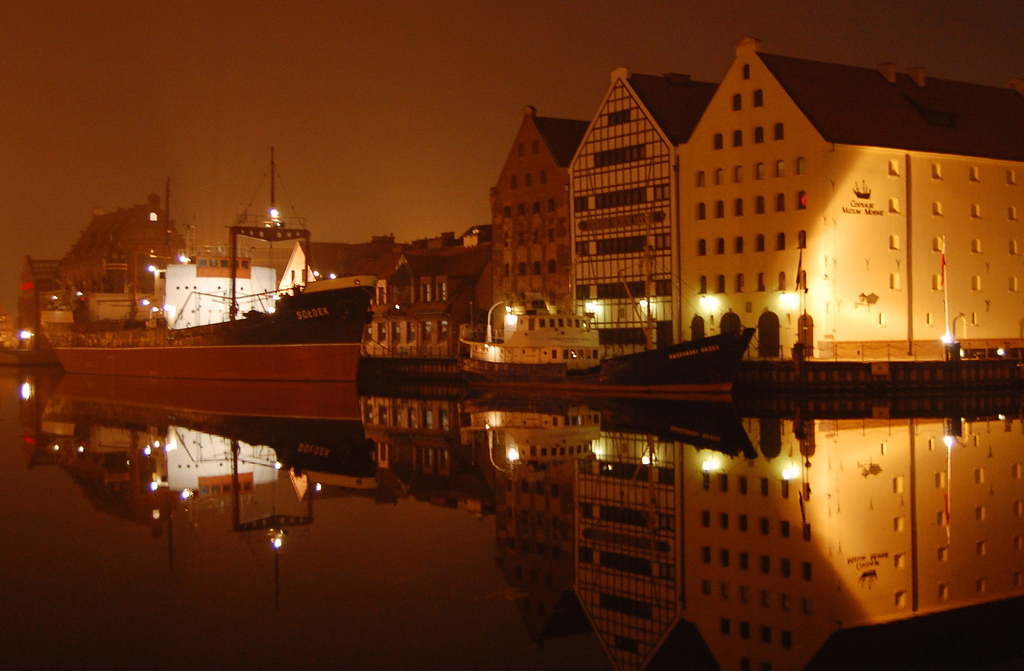
Image context: the cover uses a real documentary Wikimedia Commons photograph of Sołdek lit at night on Ołowianka. That is the right visual cue here because the article is not about the postcard strip in general but about one moored object that keeps the island's industrial memory visible even when the rest of the waterfront is running on evening atmosphere.[9]
The bridge is not a detail; it is the route's clock
The first practical fact is that the Ołowianka footbridge is useful precisely because it is not frictionless. In Your Pocket's March 2026 entry notes that the bridge opened in June 2017, links the Main Town side near the Hilton to Ołowianka, and is raised at set times for tall-mast shipping.[2] The current schedule collected by Trojmiasto is the detail that changes behavior: from April 1 to October 31, openings for vessels run on repeated half-hour windows including 19:00-19:30, 20:30-21:00, and 22:00-22:30, with the caveat that the listed times do not include the additional minutes needed to raise and lower the span.[1]
That means the route works best when you decide deliberately which side of the closure you want to be on. If you cross before the 19:00 lift, Ołowianka becomes an early-evening room: more families, more people still circling the river, and enough light left on the brick for a slower first lap. If you wait and cross after 19:30, the island shifts into a second register. The bridge has already interrupted the flow once, the Main Town side has started to shed its through-traffic, and the walk feels less like a continuation of sightseeing and more like a separate act.[1][2]
This is also where many visitors misread the place. They treat the bridge as a neutral connector and then get irritated when it is raised. The better reading is the opposite. The lift is the point. It forces an interval into a waterfront that otherwise encourages constant motion. Gdańsk's river edge becomes more legible when something makes you stop and look back at it.
Sołdek keeps the island honest
Without Sołdek, Ołowianka could slide too easily into generic night-promenade language. With it, the walk keeps one hard object in frame. The National Maritime Museum's ship history page is explicit about the scale of that object: Sołdek was the first ocean-going vessel put into operation in the history of the Polish shipyard industry, built in Gdańsk after the war, launched on 6 November 1948, sent on its first voyage on 21 October 1949, and by 2 January 1981 it had completed 1479 voyages, carrying more than 3.5 million tons of cargo.[5]
That is the right amount of historical weight for this walk. You do not need to board the ship to feel it. The hull does enough from the quay. It keeps the island from becoming only a view back toward the old city. Instead, the relationship runs both ways. You look across to the Crane and the lit facades, then back to a vessel that belongs to postwar shipbuilding rather than medieval nostalgia.[5]
This is why the island feels better at blue hour than in bright afternoon. Daylight can flatten Ołowianka into "museum, bridge, photo, continue." Evening lets the materials separate. Riveted metal, brick granaries, black water, and the old power-station mass of the Philharmonic start reading as different eras stacked beside one another. The island's old lead-storage and granary identity explains the commercial layer; the pumping-station history explains the infrastructural layer; Sołdek explains the industrial-maritime afterlife.[3][5][7]
Use the museum only if it sharpens the walk
If you want an interior component, keep it disciplined. As of publication, the National Maritime Museum's main building on Ołowianka runs Tuesday 10:00-17:00, Wednesday 13:00-17:00, and Thursday-Sunday 10:00-17:00, with last entry 60 minutes before closing; a regular ticket is 23 PLN, discount 17 PLN, and Wednesday gives free entry to the permanent exhibition except the third floor.[4] The same official page also notes that the Maritime Gallery at the main building has been closed since March 2, 2026 for renovation until further notice.[4]
That makes the boundary clear. Do not build the whole evening around an indoor marathon. If you care about the museum, arrive early enough to use it surgically and leave the island's best register for outside. The night-room value here is not a maximalist ticket strategy. It is the sequence from bridge to quay to ship to waterline.
Visit Gdańsk's partner page for the granaries reinforces that point almost accidentally. The address block is simple, current, and practical: Ołowianka 9-13, with the same 10:00-17:00 shoulder-season pattern visible on the official surface.[6] The island does not ask for complicated logistics. It asks for the right hour and the right order.
8 local moves that make this night room land
- Choose your bridge side before you start. The biggest avoidable mistake is wandering to the bridge at 18:59 and acting surprised that the island is suddenly unavailable for the next half hour.[1]
- If you want interiors, enter early and get out early. With last admission 60 minutes before closing, the museum is a first act, not the whole evening.[4]
- Use Wednesday if you want the cheapest cultural add-on. The permanent exhibition is free that day except for the third floor, which makes it easier to spend money on time rather than tickets.[4]
- Cross with one small takeaway, not with dinner plans. A coffee in hand works better here than committing your whole route to a table; the island's value is in moving and pausing, not in occupying a room for two hours.
- Make Sołdek your first full stop on the island. The ship gives the walk its visual thesis immediately; if you postpone it, the route risks dissolving into casual milling.[5]
- Stand once facing back to the Crane, and once facing back to Sołdek. Ołowianka works because the city's old harbor symbols and its postwar shipyard symbol can be read against each other.
- Let one bridge closure dictate your pace instead of fighting it. The smartest versions of this walk are built around the 19:00, 20:30, or 22:00 shipping windows, not around an impatient return.[1]
- Use the live map surface before you head over. Current place-status checks matter more than saved screenshots on a waterfront where bridge operations and evening crowd density can change the feel of the route quickly.[8]
Non-local trapline: 4 mistakes and the better alternative
Mistake 1: treating the footbridge like a permanently open sidewalk
Better alternative: remember the actual warm-season lift windows and plan around them. The island feels better once you stop expecting uninterrupted flow.[1][2]
Mistake 2: doing Ołowianka only as a daytime museum appendage
Better alternative: if you visit the museum, let it sharpen the route and then stay for the island's night register instead of leaving as soon as the ticketed part ends.[4][6]
Mistake 3: using the old-city side as the only evening stage
Better alternative: cross over. Ołowianka gives you distance from the densest promenade while still keeping the Main Town skyline in frame.[2][3]
Mistake 4: reading Sołdek as mere scenery
Better alternative: treat the ship as the article's second anchor. Once you know its dates and scale, the island stops looking like a generic waterfront backdrop and starts reading like Gdańsk's industrial memory moored in place.[5]
Concrete go details
- Best working window: either cross just before 19:00 to catch the early-evening island, or wait for the bridge to reopen after 19:30 if you want the quieter second shift; the same logic repeats around 20:30-21:00 and 22:00-22:30 in the warm-season schedule.[1]
- Expected spend: 0 PLN if you keep the route fully outside; 23 PLN regular or 17 PLN discount if you add the main museum building; Wednesday lowers the indoor cost if the permanent exhibition is enough for you.[4]
- Queue and reservation reality: no reservation for the bridge, quay, or island walk; the real bottleneck is the bridge timetable, not ticketing.[1][2]
- What to order and where to stand: if you buy one thing, make it a takeaway coffee before the crossing, then take your first proper pause beside Sołdek rather than on the busier Main Town side.
- Navigation cue:
Długie Pobrzeże -> Ołowianka footbridge -> Philharmonic frontage -> Sołdek -> granaries quay -> return when the bridge drops back into place.[2][6][8] - Numeric anchors worth remembering: June 2017, 19:00-19:30, 20:30-21:00, 22:00-22:30, 10:00-17:00, 13:00-17:00, 60 minutes, 23 PLN, 17 PLN, 1479 voyages, 3.5 million tons.[1][2][4][5]
Gdańsk has louder evening routes than this one. Very few are better composed. One bridge that occasionally refuses you, one island with utility history still visible in its brick and water, one ship that refuses to become mere decoration: that is enough to turn the Motława from a backdrop into a room.
Sources
- Trojmiasto, "Kładka na Ołowiankę Gdańsk" - local current schedule page listing the April 1-October 31 bridge-lift windows and the warning that the operation itself takes additional time.
- In Your Pocket Gdańsk, "Ołowianka Footbridge" (13 Mar 2026) - local guide noting the June 2017 opening, the Main Town connection, and the fact that the bridge rises for tall-mast shipping.
- In Your Pocket Gdańsk, "Ołowianka Island" (13 Mar 2026) - local context on the island's lead-storage origin, later granary use, and the former power-station shell now occupied by the Philharmonic.
- National Maritime Museum in Gdańsk, "NATIONAL MARITIME MUSEUM - THE MAIN BUILDING" - official hours, last-entry rule, ticket prices, Wednesday free-entry note, and the March 2, 2026 Maritime Gallery closure notice.
- National Maritime Museum in Gdańsk, "History of the ship" - official Sołdek history covering its 1948-49 build, first voyage, 1479 voyages, and 3.5 million tons carried.
- Visit Gdańsk, "National Maritime Museum - Granaries on Ołowianka Island" - official tourism partner page confirming the Ołowianka 9-13 location and current shoulder-season hours surface.
- Gdańsk Strefa Prestiżu, "Na północnym krańcu Ołowianki" (5 Jan 2026) - local history piece on the 1869-71 utility works and the island's infrastructural layer.
- Google Maps search, "Ołowianka Footbridge, Gdańsk" - current wayfinding and place-status surface for the bridge and island approach.
- Wikimedia Commons, "File:Gdańsk Sołdek.JPG" - documentary night photograph used for the cover image.