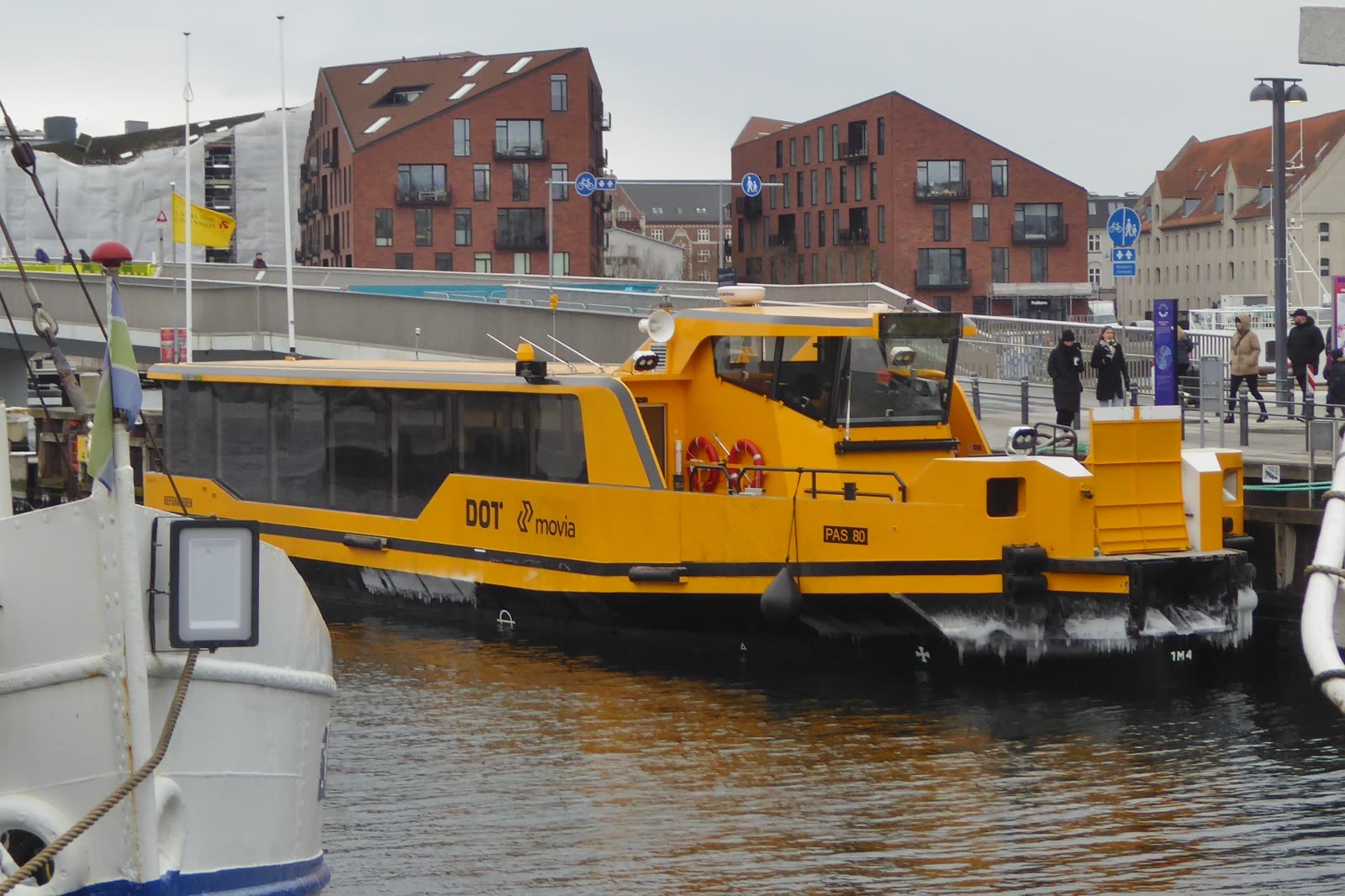
Copenhagen rewards people who stop trying to conquer the whole waterfront in one afternoon. The higher-value move is to follow one object that already knows how the city connects. Here that object is the yellow harbour bus, and the cleanest version of the run uses only two anchors: Nyhavn (Kobenhavns Havn) as the boarding point and Copenhagen Contemporary at Refshaleoen as the landing.[1][5][6]
The point is not novelty. VisitCopenhagen's harbour-bus guide is explicit that these boats run on a regular bus ticket, not on a premium sightseeing fare, and that the northbound and southbound services are simply Havnebus 992 and 991 inside the normal public-transport system.[1] Once you accept that, the harbour stops behaving like a backdrop and starts behaving like infrastructure.
That change matters because Refshaleoen is better as a controlled landing than as a vague "creative district" wander. The area carries old shipyard weight, newer cultural uses, and one of the simplest water-to-door transitions in the city when you actually know the last 250 meters.[6][7]
Why this one object works
The yellow harbour bus compresses several Copenhagen advantages into one ride: low friction, strong visual payoff, and simple fare logic. VisitCopenhagen's current guide says the route has 9 stops zig-zagging across the harbour, with 991 heading south toward Teglholmen and 992 heading north toward Orientkaj.[1] Rejseplanen's live Nyhavn departure board shows what that means in practice: departures such as 07:41 or 14:11 from Nyhavn reach Refshaleoen at 08:00 or 14:30, so the useful planning number is about 19 minutes on the water.[5]
That is short enough to feel spontaneous and long enough to reset your sense of the city. You leave the decorative canal edge at Nyhavn, cut past Operaen and the naval side of the harbour, and arrive at a former industrial peninsula that still feels physically larger than central Copenhagen's postcard core.[1][5][7]
Place-specific texture is what keeps this from collapsing into generic ferry advice. TipKBH's Refshaleoen guide describes the peninsula as a former shipyard and engine-factory zone where B&W once employed up to 10,000 Copenhageners before closing in 1996.[7] The big halls, raw quay edges, and oversized yards still register that history. Copenhagen Contemporary sits inside that afterlife rather than disguising it.[6][7]
Ticket math and time window
The harbour bus is only a bargain if you stop making it complicated. DOT's ticket guide says the lowest adult single-ticket price is 24 DKK, and the smallest ticket covers 2 zones.[2] VisitCopenhagen's zones explainer says that same 2-zone floor of 24 DKK applies across Copenhagen public transport and that the harbour bus uses the same zone logic as the rest of the network.[3]
If this ride is one water leg plus one return by bus, bike, or foot, the ordinary single-ticket logic is enough. If you know you will add airport transit or several more rides that day, DOT's City Pass page sets the next breakpoint clearly: City Pass Small starts at 100 DKK for 24 hours, covers zones 1-4, includes harbour buses, and travel without a valid ticket can trigger a fine of at least 750 DKK.[4]
A good working block is 75 to 95 minutes:
- Reach Nyhavn dock 10 to 15 minutes before the departure you want.
- Take northbound 992 to Refshaleoen, about 19 minutes.[5]
- Dock and use 8 to 10 minutes for the walk to Copenhagen Contemporary.[6]
- Hold the peninsula edge, forecourt, or current exhibition window for 25 to 40 minutes.
- Decide your exit: another harbour-bus leg, bus 2A, or a bike/public-space extension.[1][6]
That timing works because it preserves the object-lens discipline. The ferry remains the spine; Refshaleoen is the proof that the spine leads somewhere worth reading slowly.
Image note: the cover photo shows the actual yellow harbour-bus type at Nyhavn, which is the right visual anchor because this article is built around the vessel as a city object rather than around a generic Copenhagen skyline.[9]
8 local moves that materially improve the run
First, board at Nyhavn, not at a later stop, if this is your only water leg. The route becomes legible faster when you start from the old-centre edge and watch the harbour widen outward.[1][5]
Second, choose 992 northbound on purpose. VisitCopenhagen's route note makes the directionality simple: 991 runs south, 992 runs north.[1] If your goal is Refshaleoen from Nyhavn, indecision is just wasted dock time.
Third, treat 24 DKK as the base case and 100 DKK as the "I am clearly making a transit day of this" threshold.[2][4] Copenhagen gets expensive when visitors overbuy convenience products without checking how little water transport actually costs inside the normal network.
Fourth, do not wait until the quay to figure out payment. The easiest ticket path is the Rejsebillet app or another official mobile ticket option before you board.[2][4]
Fifth, on arrival, follow Copenhagen Contemporary's exact harbour-bus directions instead of wandering inland by instinct: stay on the same side as the dock, walk along the paved pier, turn right at the yellow house, go around the far side, then follow the parking area for 250 meters on Refshalevej until you see the vertical "Art Center" sign and the two orange C's.[6]
Sixth, use the museum forecourt and exterior first, even if you are unsure about going inside. Copenhagen Contemporary's own visit page makes the practical case for the stop: current hours run 11:00-18:00 Tuesday, Wednesday, Friday, Saturday, and Sunday, with 11:00-21:00 on Thursday, so it gives the landing a real clock instead of leaving you in unstructured quay space.[6]
Seventh, remember that Refshaleoen is close in Copenhagen terms but not central in old-town terms. Copenhagen Contemporary says the bike ride from Kongens Nytorv is about 10 minutes.[6] That number is useful even if you are not cycling, because it tells you the peninsula is near enough for a one-anchor detour and far enough to feel like a change of city.
Eighth, if you want community confirmation rather than only institutional copy, use local surfaces before improvising. TipKBH frames Refshaleoen as a short leap from the center and reads Copenhagen Contemporary as one of the peninsula's defining non-food anchors, while Google Maps gives the live handoff point for Nyhavn dock navigation.[7][8]
Non-local trapline: 4 mistakes and cleaner alternatives
Mistake 1: paying for a canal experience when a regular harbour-bus ticket already does the job
Better move: use the ordinary network first. The harbour bus is explicitly sold as normal public transport on a regular ticket, not as a separate scenic product.[1][2]
Mistake 2: boarding without deciding between single-ticket logic and day-pass logic
Better move: make the 24 DKK versus 100 DKK decision before you reach the dock. Copenhagen punishes fuzzy fare planning with wasted time and sometimes an expensive mistake.[2][4]
Mistake 3: getting off too early because Operaen feels like the obvious waterfront stop
Better move: stay on to Refshaleoen if your real goal is the former shipyard side and Copenhagen Contemporary. The harbour-bus object works best when it delivers you all the way to the peninsula instead of dropping you one stop short.[1][5][6]
Mistake 4: docking at Refshaleoen and then drifting toward the wrong yard
Better move: use the exact yellow-house / 250-meter / Art Center sign sequence from Copenhagen Contemporary's visit page. This is one of those small Copenhagen navigation cues that saves the whole run.[6]
One-screen route card
- Object: yellow harbour bus, northbound 992.[1]
- Boarding anchor: Nyhavn (Kobenhavns Havn).[5][8]
- Landing anchor: Refshaleoen plus Copenhagen Contemporary, Refshalevej 173A.[6]
- Ride time to plan around: about 19 minutes from Nyhavn to Refshaleoen on current live-board examples.[5]
- Fare floor: 24 DKK adult single ticket, 2-zone minimum.[2][3]
- Pass breakpoint: 100 DKK for City Pass Small 24h in zones 1-4.[4]
- Capacity note: up to 80 passengers on the harbour bus.[1]
- Last navigation cue: yellow house, around the far side, then 250 meters to the Art Center sign.[6]
- Current indoor anchor hours: usually 11:00-18:00, with Thursday until 21:00.[6]
- Enforcement note: no valid ticket can mean a fine of at least 750 DKK.[4]
Copenhagen has many places that look good from the water. Refshaleoen is better because the yellow hull does not leave you at a postcard. It leaves you at a working edge where shipyard memory, public transport, and contemporary culture still touch the same quay.
Sources
- VisitCopenhagen, "The Harbour Bus | See Copenhagen from the water" (route numbers, 9 stops, regular-ticket rule, electric boats, 80-passenger capacity).
- DOT / Public Transport, "Single Tickets" (lowest adult fare, 2-zone minimum, ticket validity across modes).
- VisitCopenhagen, "Zones" (2-zone minimum at 24 DKK and zone logic across Copenhagen public transport).
- DOT / Public Transport, "City Pass" (City Pass Small coverage and price; minimum fine for travel without a valid ticket).
- Rejseplanen, Nyhavn (Kobenhavns Havn) live departure board (current Nyhavn-to-Refshaleoen timing examples).
- Copenhagen Contemporary, "Visit" (address, opening hours, bike timing, harbour-bus and bus 2A walking directions).
- TipKBH, "Refshaleoen - Oplev Kobenhavn fra den mest ra og laekre side!" (local guide on Refshaleoen's shipyard history, under-10-minute harbour-bus framing, and Copenhagen Contemporary's role on the peninsula).
- Google Maps, "Nyhavn (Kobenhavns Havn)" (local handoff point and live community navigation surface for the boarding stop).
- Wikimedia Commons, "File:Havnebus Refshaleoen 01.jpg" (photographic image source used for the cover).