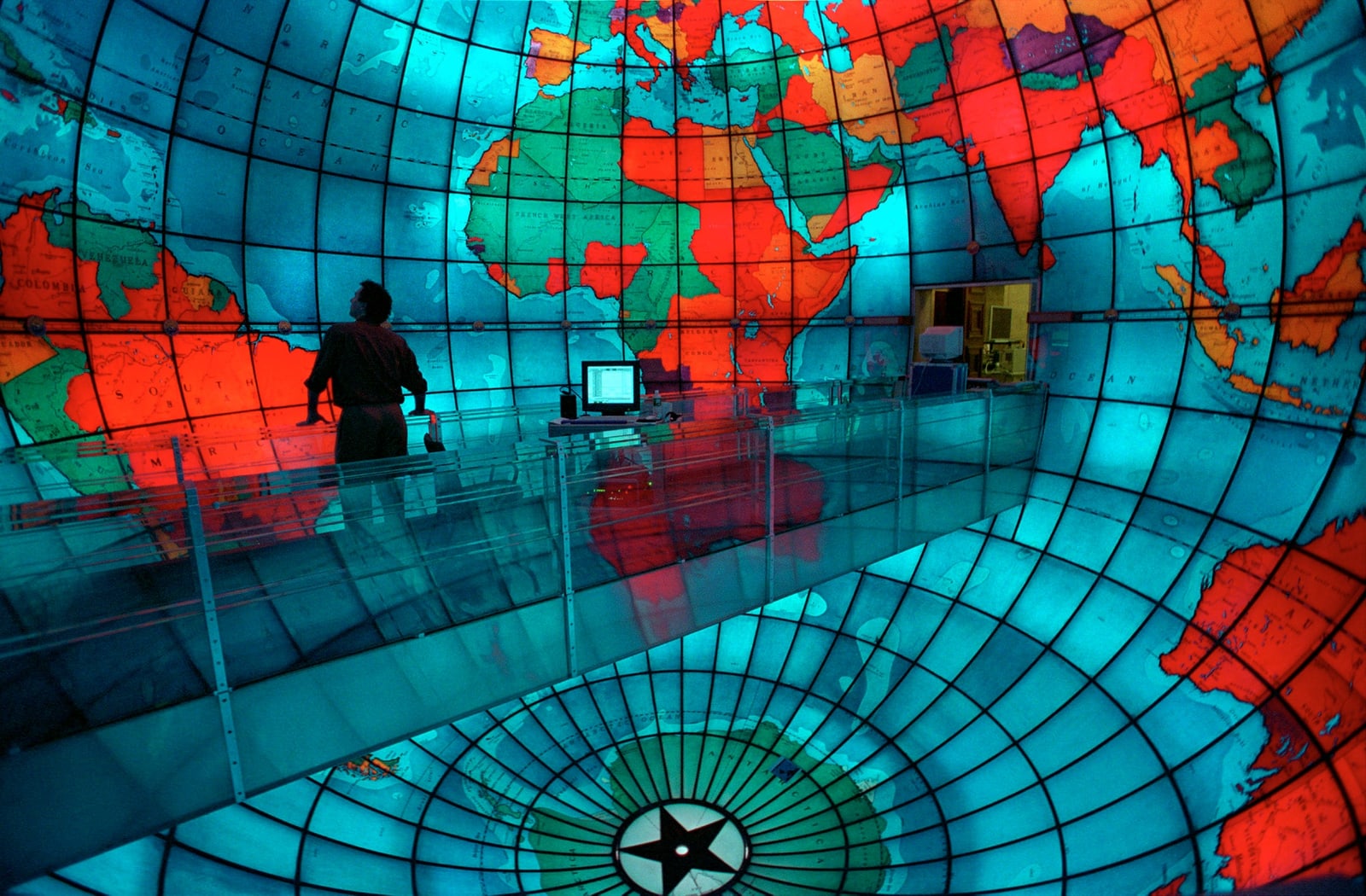
The bridge inside Boston’s Mapparium gives you something a desk globe cannot: a place inside the world. Glass surrounds the visitor, carrying a map preserved from 1935.[1] Continents rise above the handrail; the southern oceans curve beneath the transparent crossing. In Suzanne Kreiter’s photograph, a lone visitor makes the room’s scale immediately comprehensible.[6] The practical question is where to stand once you get there.
There are two useful answers. At the centre, your own voice seems to surround you; at opposite ends, two people can hear each other whisper. A guided visit reported in the Beacon Hill Times describes both effects.[2] Stopping only at the centre means missing half the experiment.
Read the date in the glass
Architect Chester Lindsay Churchill conceived the room for the Christian Science Publishing House. The library’s archival account connects the globe to the organisation’s international activities and describes a 30-foot sphere crossed by a glass bridge. The building accommodated both religious publishing and The Christian Science Monitor. Looking outward from inside the map made that worldwide reach into a physical experience.[1]
Look for Iran, with Persia in parentheses. The Beacon Hill Times quotes guide Bert Hogan explaining that the name changed shortly before the opening; this was the last panel installed.[2] The paired names give you a small historical detail to hold onto. Read one label closely before trying to identify every country.
The current host presents the globe within the How Do You See the World? experience, alongside exhibits about global progress and Christian Science.[7] That institutional viewpoint belongs to the visit. The preserved map records one moment; the surrounding interpretation asks visitors to think about subsequent change. You can appreciate the room’s craftsmanship while looking carefully at how its host frames the world.
Give a small visit enough room
Local recommendations help set the scale. In a July 2026 r/boston discussion, contributors praise the acoustics and the pleasure of recognising changed geography. Another recalls a previous visit as allowing only about 10 minutes inside.[3] That is an individual recollection, not a guaranteed current tour length. It is useful evidence against planning an afternoon of unrestricted wandering within the globe.
I would allow 30–45 minutes for arrival, admission and the visit, with more time if you want the surrounding exhibits. This is a planning allowance, not a measured queue forecast. Boston.com reader Heather, identified as a Roslindale resident, recommends incorporating the Mapparium into a walk through this part of Boston.[6] That makes sense for an object whose appeal is concentrated: give it a deliberate stop, then leave room around it.
Use 210 Massachusetts Avenue, the Publishing House address. The church edifice is separately listed at 250 Massachusetts Avenue. For a straightforward transit approach, take the Green Line E branch to Prudential, then cross Belvidere Street onto the Christian Science Plaza. The official directions distinguish that route from Hynes Convention Center, served by the B, C and D branches.[5] Choose the branch before boarding; the shared colour on the transit map does not mean the same final approach.
My suggested window is 10am–noon on a weekday, because it allows advance booking and leaves recovery time if your journey slips. Regular hours are 10am–5pm Monday–Saturday, 11am–5pm Sunday; the final tour starts at 4:40pm. Weekend afternoons, 1–5pm, are sold onsite only, subject to availability.[4] Reserve another window if certainty matters more than spontaneity.
Budget US$0–6 per person for admission: adults pay $6, while ages 0–17 enter free; transport is additional.[7] Everyone still needs a ticket. Check the official closure calendar before choosing a date.[4]
Listen before reaching for the phone
The local discussion contains both devoted repeat visitors and people who would rank other Boston attractions higher.[3] The distinction is helpful. This visit suits someone interested in a peculiar room, a historical map and an acoustic surprise. Its value depends on attention more than duration. Expecting a large museum can make a satisfying short visit feel unnecessarily small.
Ask the guide when you can try the two listening positions. At the ends, use a whisper and let your companion answer; in the centre, notice what happens to your own voice.[2] Keep the experiment brief enough for others to participate. The most interesting exchange may be an ordinary sentence, because you already know how it ought to sound.
Save personal photographs for after the light-and-sound presentation, when the current rules permit them. Do not record the presentation; flashes, tripods and selfie sticks are prohibited.[4] Visitor details were checked on 12 October 2026. Once the phone comes down, look again at the bridge: it is the little piece of ordinary floor that makes this extraordinary room usable. Someone can stand at its far end, speak softly, and become unexpectedly close.
Sources
- Mary Baker Eddy Library, “From the Collections: The Christian Science Publishing House” (27 November 2023) — archival history of the building, the globe and Churchill’s design.
- Beacon Hill Times, “Mapparium, Mother Church are Hidden Gems in the Back Bay” (21 July 2018) — local reporting on the Iran/Persia panel and the bridge’s two acoustic effects.
- r/boston, “First time in Boston—what should we check out before our show at The Middle East?” (July 2026) — community recommendations and an explicitly retrospective visitor account; anecdotal, not an operating schedule.
- The First Church of Christ, Scientist, “How Do You See the World? experience visitor information” — current hours, weekend booking restriction, ticket requirements, closures and photography rules; checked 12 October 2026.
- The First Church of Christ, Scientist, “Directions” — separate building addresses and the Prudential E-branch approach.
- Annie Jonas, “Map: What to see, eat, and do with 36 hours in Boston, according to readers,” Boston.com (18 July 2024) — Roslindale reader Heather’s walking recommendation and the Mapparium photograph credited to Suzanne Kreiter / Globe Staff.
- The First Church of Christ, Scientist, “How Do You See the World? experience” — the host’s exhibit framing and adult/youth admission prices; checked 12 October 2026.