As of 2026-07-05T02:43:16Z UTC, the useful way to read Wan2.2 is not as another eye-catching AI-video clip. The stronger AI-China signal is that Alibaba Cloud's Wan team made a video model release legible as a systems package: a timestep-specialized Mixture-of-Experts denoising design, a high-compression VAE, separate model tiers, GitHub instructions, Hugging Face weights, and a claim that one 5B path can run at 720p / 24fps on a consumer-grade RTX 4090-class card.[1][2][3][4]
That packaging matters because video generation is where open models usually hit their hardest operational wall. A text model can become useful with a single endpoint and a decent context window. A video model has to survive memory pressure, temporal consistency, VAE bottlenecks, sampling time, prompt control, image conditioning, pipeline wrappers, and the messy creator tooling around it. Wan2.2 is important because the release makes those boundaries visible instead of asking users to infer them from a polished demo reel.
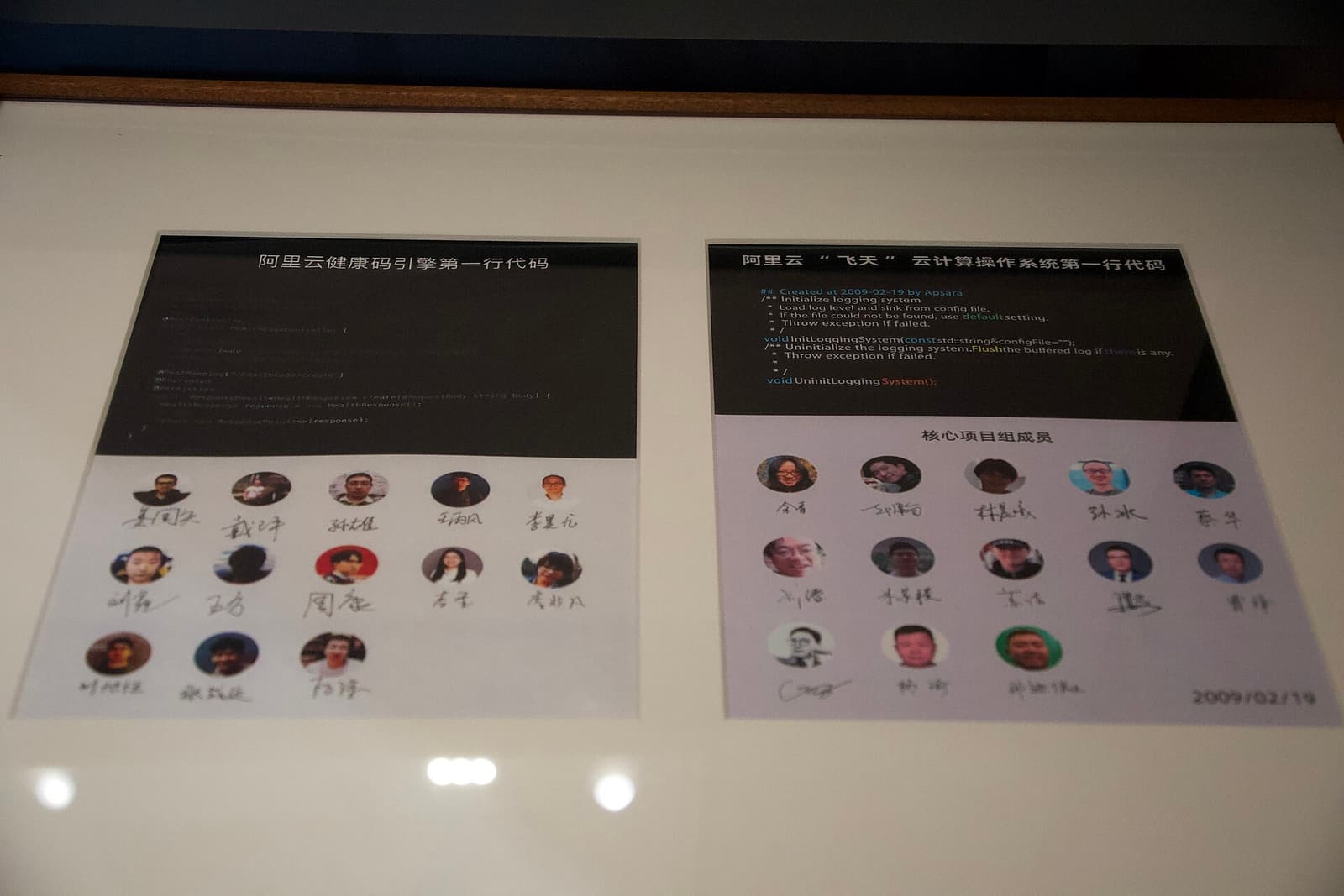
Image context: the cover uses a real Wikimedia Commons photograph of Alibaba Cloud source-code material displayed at Hangzhou National Archives.[6] It is intentionally documentary rather than synthetic. This post is about an open release becoming inspectable infrastructure, so a source-code archive photograph is more relevant than generated video output.
What Changed
Wan2.2's headline is the MoE video-diffusion move. The official release says the model separates the denoising process across timesteps with specialized expert models, increasing overall capacity while keeping inference cost closer to the prior operating envelope.[1] The public repository presents that as two complementary expert regimes: a high-noise expert that handles the earlier, more global phase of generation and a low-noise expert that handles later, detail-heavy refinement.[2]
That is more than an architectural flourish. Video generation has to maintain scene layout, motion, subject identity, texture, and camera continuity across frames. If the early and late denoising phases are doing different kinds of work, splitting capacity by timestep is a plausible way to add model strength without making every inference step pay for the whole system. The release should not be read as proof that MoE is the final answer for video diffusion. It should be read as Alibaba showing exactly where it thinks extra capacity belongs.
The second change is data and aesthetics. Wan's release language emphasizes substantially larger and more curated training material than Wan2.1, with stronger coverage for cinematic composition, complex motion, and aesthetic preference.[1][2] Those claims are vendor-side and should be treated as directional unless independently benchmarked. Still, they explain why the release is not framed only around resolution. Alibaba is arguing that an open video model has to compete on filmable behavior: motion that stays coherent, prompts that survive object complexity, and scenes that feel like clips rather than animated screenshots.
The 5B Lane Is The Adoption Wedge
The most practical detail is the Wan2.2-TI2V-5B path. Its model card frames it as a hybrid text-image-to-video model using the Wan2.2 VAE, able to support text-to-video and image-to-video generation at 720p / 24fps while running on consumer-grade graphics cards such as the RTX 4090.[3] That claim is the adoption wedge. A 14B or larger model can win attention, but a 5B model that creators and researchers can actually run becomes the one that shapes toolchains.
This is a familiar China-AI pattern, but video makes it sharper. Open weights do not automatically create an ecosystem. The ecosystem appears when the artifact can fit into local wrappers, ComfyUI-style workflows, hosted notebooks, experimental fine-tuning, evaluation scripts, and small studio pipelines. The 5B lane gives Wan2.2 a path into those surfaces without requiring every user to rent a data-center GPU before learning whether the model fits their job.[2][3]
The A14B text-to-video and image-to-video model cards still matter because they mark the higher-capability lane.[4] But strategically, the split is the point. Wan2.2 is not one model asking one audience to accept one hardware budget. It is a family release that gives different users different entry points: inspect the larger system, run the lighter one, and compare whether the quality jump justifies the hardware jump for a particular production path.[2][3][4]
The VAE Is Not A Footnote
The release's VAE language is easy to skim past, but it may be the most practical systems detail. Wan2.2's 5B path is built around a high-compression VAE with a stated 16 x 16 x 4 compression ratio.[1][2][3] In video generation, the VAE is not a mere accessory that sits after the glamorous model. It determines how raw video is compressed into the latent space where the diffusion model works and how generated latents return to pixels.
That makes the VAE a supply-chain decision. A stronger compression scheme can lower memory pressure and make higher-resolution workflows more practical; a weak one can leak artifacts, hurt temporal detail, or make downstream tooling brittle. If a team wants to use an open video model for storyboards, advertising tests, animation references, synthetic data, or research, the question is not only "how good is the model?" It is "does the whole compression-and-generation path behave predictably enough to build on?"
The original Wan technical report helps place that choice in a longer line. The report describes Wan as an open suite of video foundation models built around diffusion transformers, a novel VAE, data curation, scalable pre-training, and evaluation design.[5] Wan2.2 is best read as a continuation of that systems program rather than a stand-alone splash. Alibaba is not only publishing clips; it is iterating the substrate that makes open video generation portable.
The Benchmark Boundary
Wan2.2's release materials compare the model favorably against other open and closed systems, but those results need a clear boundary.[1][2] Video benchmarks are harder to interpret than text leaderboards because the evaluation target is partly perceptual: prompt adherence, motion quality, identity stability, temporal coherence, aesthetics, and artifact rate do not collapse neatly into one universal score.
The useful takeaway is therefore not "Wan2.2 beats everything." The useful takeaway is narrower: Alibaba has made the evaluation object inspectable. The repository, model cards, and paper trail let outside users test the claims on their own prompts, hardware, wrappers, and tolerance for failure.[2][3][4][5] That is a stronger open-source signal than a single comparison table. A studio evaluating open video does not need a trophy score; it needs to know where the model breaks, how much memory it consumes, which conditioning modes work, and whether failures are recoverable inside the workflow.
This is also where Wan2.2 differs from a purely managed API story. A closed service can hide the systems tradeoff behind a button. That is useful for users who want finished output. It is less useful for builders who need to inspect model behavior, localize the pipeline, route around costs, or build tools on top of the weights. Wan2.2's value is that the messy middle is visible.
The China AI Signal
The broader AI-China signal is that Alibaba is pushing open video generation into the same distribution logic that made Chinese text and multimodal models travel quickly: publish weights, publish code, document hardware lanes, mirror to Hugging Face, and let downstream toolchains absorb the release.[2][3][4] That does not guarantee commercial dominance. It does make the release harder to dismiss as a demo.
For developers, the watch items are concrete. First, see whether the 5B lane remains the default community target because it fits available GPUs.[3] Second, watch whether the A14B models become practical outside specialist setups or remain mainly benchmark and hosted-service material.[4] Third, watch adapter support, inference wrappers, quantization paths, and UI integrations; those layers will decide whether Wan2.2 becomes a durable open-video baseline or a powerful checkpoint that only a narrow group can operate comfortably.[2]
The falsifier is equally clear. If the open models produce attractive clips but remain too slow, memory-hungry, brittle under ordinary prompts, or difficult to integrate into repeatable creator workflows, then Wan2.2 is a strong research release rather than an ecosystem shift. The stronger thesis survives only if the MoE, VAE, and model-tier choices translate into real local experimentation.
For now, Wan2.2 is worth tracking because it moves the open-video conversation to the right layer. The question is not whether Alibaba can publish a better sample clip. The question is whether China AI can make video generation inspectable, runnable, and modifiable enough that builders treat it as infrastructure.
Sources
- Wan AI, "Wan2.2" official release blog (MoE framing, data/aesthetic upgrade, VAE compression, 720p / 24fps and consumer-GPU positioning).
- Wan-Video, "Wan2.2" GitHub repository (official code and release package; model-family overview, MoE/VAE notes, installation paths, and usage examples).
- Wan-AI, "Wan2.2-TI2V-5B" Hugging Face model card (hybrid text-image-to-video 5B lane, 720p / 24fps claim, VAE compression, and consumer-GPU framing).
- Wan-AI, "Wan2.2-T2V-A14B" Hugging Face model card (higher-capability text-to-video lane and model-family release context).
- WanTeam et al., "Wan: Open and Advanced Large-Scale Video Generative Models," arXiv:2503.20314 (baseline Wan technical report covering diffusion-transformer design, VAE work, data curation, and open video-model suite context).
- Wikimedia Commons, "File:Source Codes from Alibaba Cloud, Hangzhou National Archives 73.jpg" (source page for the real photograph used as this article's cover image).