As of 2026-05-28 UTC, the useful way to read vivo's BlueLM work is not as a small-model curiosity. The sharper AI-China signal is that vivo is trying to make the phone itself a serious AI endpoint, and that forces a different technical discipline from cloud-first model competition. On a handset, the decisive questions are memory, heat, latency, quantization, camera input, OS hooks, and whether the assistant can use local context without turning every action into a remote round trip.[1][2][3]
That is why BlueLM deserves a company dossier even though vivo is not usually placed beside the model-first Chinese labs. The public record shows a coherent path: a BlueLM developer surface, an open BlueLM-7B line, a CVPR 2025 BlueLM-V-3B paper built explicitly for mobile multimodal inference, a later BlueLM-2.5-3B technical report, and OriginOS material that says the system layer is being rebuilt around BlueLM capabilities.[1][2][3][4][5] Read together, these are not just research artifacts. They are vivo's attempt to connect model design to handset distribution.
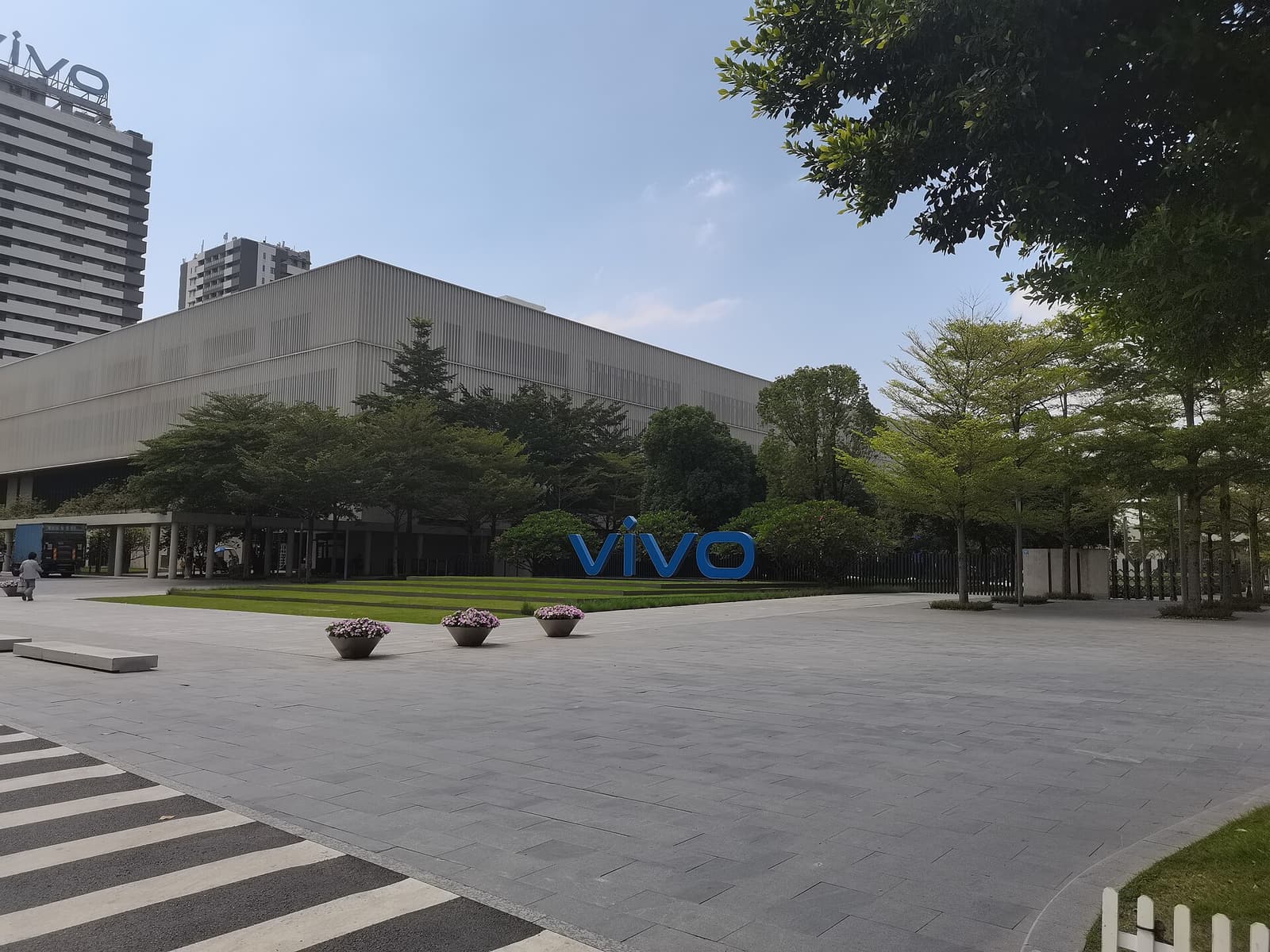
Image context: the cover uses a real Wikimedia Commons photograph of vivo's global headquarters in Dongguan. It is a photographic image, not a generated visual, diagram, or benchmark chart. That matters because the article's argument is institutional: BlueLM is meaningful only if model, OS, silicon budget, camera stack, and device channel can be made to work as one product system.[7]
The lab signal is mobile first, not chatbot first
vivo's BlueLM developer page frames the model family as an AI capability layer with safety controls and independent review interfaces, while the open vivo-ai-lab/BlueLM repository preserves an earlier research branch around open multilingual 7B models and fine-tuning support.[1][2] Those materials matter because they show vivo did not begin from a pure phone-feature press line. It put a model-family name, developer documentation, and code-facing artifacts into public view.
The more important shift, though, is visible in BlueLM-V-3B. The CVPR 2025 paper's title gives away the thesis: "Algorithm and System Co-Design for Multimodal Large Language Models on Mobile Devices."[3] The paper is not only asking whether a compact vision-language model can score well. It asks how the model has to be redesigned when the deployment target is a phone. It names a 2.7B-parameter language model, a 400M-parameter vision encoder, 4-bit LLM weight quantization, and a reported 24.4 tokens per second on a MediaTek Dimensity 9300 processor.[3]
Those numbers are modest only if one compares them with cloud-scale frontier models. On device, they are the point. A 3B-class multimodal model has to survive inside a power envelope and memory budget where a server habit of throwing more experts, more context, and more speculative branches at the problem is not available. The phone cannot hide every inefficiency inside a larger cluster.
The paper's dynamic-resolution work is especially telling. Mainstream multimodal systems often increase visual tokens aggressively to preserve detail. That is expensive on a handset. BlueLM-V-3B instead treats visual resolution as a budgeted decision: enough detail to answer the task, not so much that the phone spends its limited memory and compute on redundant pixels.[3] This is the difference between "we can see images" and "we can see images locally without making the phone feel broken."
BlueLM-2.5-3B points toward a unified on-device lane
The later BlueLM-2.5-3B technical report extends the same theme. It describes a compact dense multimodal model designed for on-device use, built with diversified data curation, key-data resampling, hybrid heterogeneous reinforcement learning, and high-performance training infrastructure.[4] The notable signal is continuity. vivo is not treating the CVPR model as a one-off paper. It is iterating on a 3B-class mobile multimodal lane.
That matters because the hardest product problem is not one benchmark score. It is repeatable capability under constraints. A phone assistant may need to understand a screenshot, extract text from a camera frame, reason over a visible UI, summarize a document, edit an image, or answer a local question while preserving responsiveness. Each task pulls the model toward richer perception. The hardware budget pulls the other way.
This is where vivo's company position becomes relevant. Unlike a model API vendor, vivo controls the device surface. It can tune the OS, camera pipeline, image features, assistant entry points, memory scheduling, and NPU utilization around the model. It can also choose which tasks stay local and which tasks escalate to a cloud model. The strategic value of BlueLM is not that every workload must run offline. It is that vivo can make the local/cloud boundary an owned product decision instead of a generic API routing problem.
The public OriginOS material supports that reading. vivo's OriginOS 5 service page says the system was developed based on BlueLM and that AI capabilities were integrated across system layers.[5] The global OriginOS 6 page is less BlueLM-specific, but its emphasis on system-wide intelligent surfaces, smart suggestions, and productivity tools shows the user-facing direction: AI is being framed as part of the operating system, not only as a separate chat app.[6]
The benchmark claims are useful only with deployment boundaries attached
Secondary reporting on vivo's October 2025 BlueLM 3B announcement says the company presented an on-device multimodal reasoning model with 128K context and claimed top performance among sub-10B models on mobile-oriented leaderboards.[8] Those claims are useful as market color, but they should be read with strict boundaries. Company launch rankings and third-party leaderboard snippets do not tell us enough about prompt templates, thermal duration, privacy modes, language mix, app integration, or how performance holds after repeated user sessions.
The stronger evidence is the engineering direction documented in the papers and official materials. BlueLM-V-3B's reported 2.2 GB peak memory footprint, compact vision-language design, and phone-chip throughput claims are more actionable than a generic "best small model" label.[3] BlueLM-2.5-3B's focus on training recipe and on-device multimodal behavior is likewise more important than one score row.[4] For builders, the question is not whether vivo can name a leaderboard. It is whether the company can turn small-model efficiency into stable OS behavior.
That is also the main risk. On-device AI can be oversold quickly. A model may run locally but still be too slow for an everyday interaction. It may handle screenshots but fail across messy app states. It may preserve privacy in one path but require cloud fallback in another. It may work well on the latest flagship silicon while producing a weaker experience on midrange devices. Those are not footnotes. They are the product.
What to watch
The first watch item is whether vivo keeps publishing technical boundaries. BlueLM's credibility improves when vivo discloses model size, quantization, memory, benchmark conditions, and device-class assumptions.[2][3][4] It weakens if the story collapses into vague AI-phone language.
The second watch item is OriginOS depth. If BlueLM becomes a system-level layer for screenshots, document handling, camera intelligence, editing, scheduling, and app actions, vivo's phone distribution becomes strategically meaningful.[5][6] If it remains mostly a branded assistant, the advantage narrows.
The third watch item is local/cloud routing. The most durable phone-AI stack will not be purely local or purely remote. It will decide which tasks deserve on-device execution because of latency, privacy, offline availability, or sensor access, and which tasks deserve larger cloud models because reasoning depth matters more than immediacy.
That is the clean conclusion. vivo's BlueLM is important in AI-China because it makes the AI-phone thesis concrete. It says the next contest is not only bigger models and cheaper APIs. It is whether a handset company can fit useful multimodal reasoning into a real phone budget, bind it to the OS, and make the result feel native enough that users stop thinking about where the model is running.[1][3][5][6]
Sources
- vivo Developers, "BlueLM" product page (developer-facing BlueLM entry point, safety capability framing, and contact surface for vivo AI developers)
- vivo AI Lab,
BlueLMGitHub repository (open BlueLM model-family artifacts, technical-report pointer, and fine-tuning/code-facing materials) - Lu et al., "BlueLM-V-3B: Algorithm and System Co-Design for Multimodal Large Language Models on Mobile Devices," CVPR 2025 open-access paper page
- vivo AI Lab, "BlueLM-2.5-3B Technical Report," arXiv:2507.05934 (compact dense multimodal model, data curation, reinforcement learning, and on-device MLLM framing)
- vivo China service page, "OriginOS 5" overview noting development based on BlueLM and AI integration across system layers
- vivo, "OriginOS 6" global product page (current OS-level intelligent surfaces, productivity tooling, and system-wide smart-suggestion context)
- Wikimedia Commons, "File:Vivo Global Headquarters DONGGUAN.jpg" (source page for the real photograph of vivo's Dongguan headquarters used as the article image)
- Pandaily, "Vivo Unveils BlueLM 3B, an On-Device Multimodal Model that Ranks No.1 among Sub-10B Models" (October 10, 2025; secondary launch summary and benchmark-claim context)