Five kinds of Martian meteorite supplied the ingredients. The desired product was a catalyst that could help release oxygen from water. Between the rocks and the gas lay a problem of choice: which mixture should a laboratory make, and how could it find a useful recipe without trying every possibility?[1][3]
A team at the University of Science and Technology of China (USTC), working with the Deep Space Exploration Laboratory, gave that problem to its robotic AI chemist. The study appeared online in Nature Synthesis on November 13, 2023. Its enduring interest is the way a proposed use of local resources became a measurable laboratory task: prepare a material, test it, and let the result inform the next choice.[1][2]
This was an experiment on Earth using meteorite samples. Keeping that setting in view makes the achievement easier to appreciate. The researchers were investigating how an automated laboratory might develop a useful material from the ingredients available to it. A working oxygen supply on another planet would require many additional systems.[3]
Start with the ingredients you have
The oxygen in this proposal comes from water. The meteorites provide material for a catalyst that helps the oxygen-producing reaction proceed. That distinction gives the experiment its particular shape: the machine needs to discover something useful within a constrained supply of raw materials, rather than assume that a preferred catalyst can simply be delivered.[1]
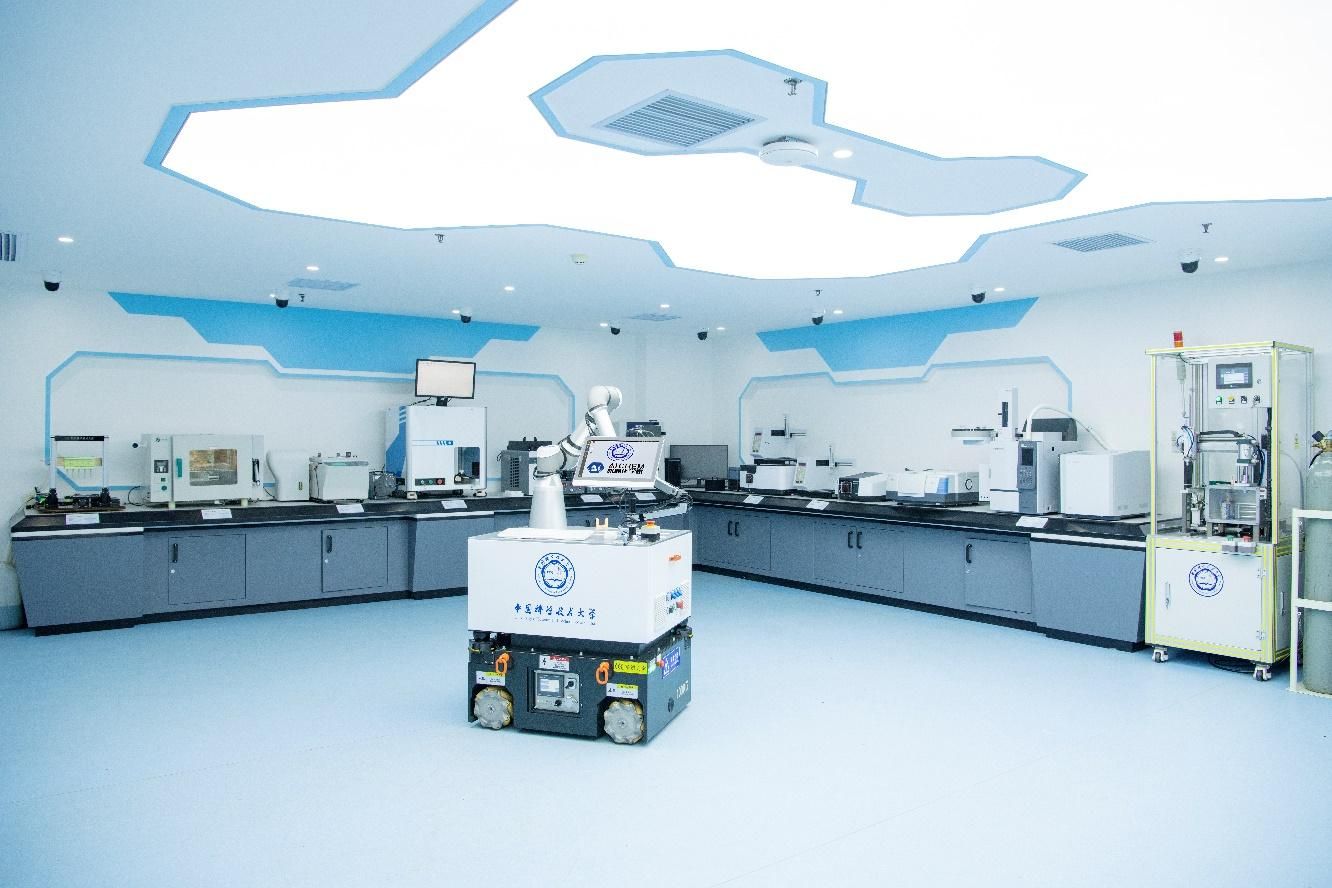
USTC's December 2023 account describes a robot that can move between laboratory benches and manipulate equipment with an arm. A laser-based measurement establishes the sample's composition; chemical processing then dissolves and separates material before the system prepares and tests candidate catalysts. The photograph shows the physical setting behind those operations: a mobile machine among laboratory workstations.[3]
There is a practical reason to care about the ingredients first. A recipe optimized for a catalog of purchasable chemicals solves a different problem from a recipe constrained by a particular collection of rocks. For a future exploration mission, the composition of the available feedstock would become part of the experiment's starting conditions. The machine's useful freedom would lie in choosing among feasible mixtures.
The hardware also had a history before the Mars study. In September 2022, the USTC team published its broader AI-Chemist platform in National Science Review. That system combined literature reading, a mobile robot operating across 14 workstations, and computation that could use experimental feedback to propose another iteration. The paper demonstrated three chemical tasks.[4]
The meteorite experiment gave that general arrangement a sharply defined purpose. It connected a materials constraint to a performance measurement, making the success of the search something that an electrode test could challenge.
Choosing the next mixture
A robot can automate handling while still following an unchanging list of instructions. The more consequential step here was selecting the recipe. USTC's Chinese announcement explains that the system combined quantum-chemical simulations with physical experiments to build a predictive machine-learning model, then used Bayesian optimization to select a promising composition for robotic verification.[2]
In plain terms, the calculations supplied a reasoned expectation about which mixtures might work. Measurements supplied evidence about what a prepared sample actually did. The search could then spend its next experiment on a candidate suggested by the model. This is a way to make experiments more selective; it does not require physically manufacturing every composition in the search space.
That distinction also puts the publicity in proportion. USTC compared roughly two months of optimization with an estimated 2,000 years of exhaustive work.[2] The meaningful comparison is with checking the possible recipes one by one. It is not a measured contest against a human research team using its own chemical knowledge and selective experimental strategy. The time-saving claim illustrates the size of the search; the tested material establishes whether the search produced something useful.
The earlier platform paper makes the underlying dependency clear: experimental observations must return to the computational process.[4] My reading of the Mars application is that this return path is its central achievement. If the system merely selected a formula and stopped, it would leave the decisive question unanswered. Preparing and testing the selected material forces the prediction to encounter the chemistry.
What the electrode test establishes
The reported catalyst operated for more than 550,000 seconds—about 153 hours—at a current density of 10 milliamperes per square centimetre and an overpotential of 445.1 millivolts. Those are laboratory operating conditions attached to a durability result, not a statement of how many people a complete installation could support.[1]
Current density relates the electrical current to electrode area. Overpotential describes the extra driving voltage needed beyond the reaction's equilibrium requirement. Together with operating duration, they make the result more informative than the bare claim that a sample produced bubbles. They still leave plant-scale questions: obtaining and preparing water, supplying electricity, replacing consumables, collecting oxygen, and keeping the equipment functioning over a mission.
NASA's MOXIE provides a useful comparison in what evidence can establish. Its September 2023 mission report describes oxygen production on Mars itself, using carbon dioxide from the atmosphere. Across its runs aboard Perseverance, the instrument generated 122 grams of oxygen. NASA nevertheless identified further development, including oxygen liquefaction and storage, as work for a future full-scale system.[5]
MOXIE and USTC's catalyst address different parts of the resource problem. One demonstrated atmospheric processing at the destination; the other explored how to make a useful catalyst from Martian material in an Earth laboratory. Their oxygen figures cannot serve as a simple ranking because the feedstocks, apparatus and test environments differ.[1][5]
For the USTC approach, a persuasive next demonstration would make those surrounding dependencies visible: repeat the search with different feedstocks, account for imported reagents, and operate the linked preparation and oxygen-production equipment for an extended period. Those are proposed tests of the idea, not milestones established by the 2023 study.
The most interesting object in the story remains the electrode. It is where an AI-selected recipe became a physical material with a measured performance. That gives the Mars ambition a concrete scientific starting point: a machine can help decide what to make from what is at hand, then submit its choice to an experiment.
Sources
- Qing Zhu et al., “Automated synthesis of oxygen-producing catalysts from Martian meteorites by a robotic AI chemist,” Nature Synthesis 3, 319–328 (published online November 13, 2023; experimental scope and electrode performance).
- USTC News Center, “USTC's robotic chemist intelligently creates oxygen-producing catalysts from Martian meteorites” (November 14, 2023; first-hand Chinese account of the team, model-guided optimization and exhaustive-search comparison).
- University of Science and Technology of China, “An AI robot that can make breathable oxygen on Mars” (December 23, 2023; laboratory setting, meteorite feedstocks, chemical processing and source of the photograph).
- Qing Zhu et al., “An all-round AI-Chemist with a scientific mind,” National Science Review 9, nwac190 (September 8, 2022; platform architecture, experimental feedback and three demonstrated chemical tasks).
- NASA Jet Propulsion Laboratory, “NASA's Oxygen-Generating Experiment MOXIE Completes Mars Mission” (September 6, 2023; atmospheric oxygen extraction on Mars and the remaining system-development tasks).