As of 2026-04-28 UTC, the strongest AI-China signal from Trae SOLO is not that ByteDance has another coding assistant. The stronger signal is architectural. Trae's public product surfaces describe a system that tries to move software work out of the old copilot frame and into a managed workspace where requirements, repository context, tools, execution, and review live inside the same loop.[1][2][3]
That distinction matters because the coding market is crowded with chat panes, inline completion, and one-shot code generation. Trae is publicly framing something narrower and more ambitious: an AI worker that can read the brief, break down the task, call the right tools, keep project files in one place, and return work in a form a human can inspect rather than merely admire.[1][2][3]
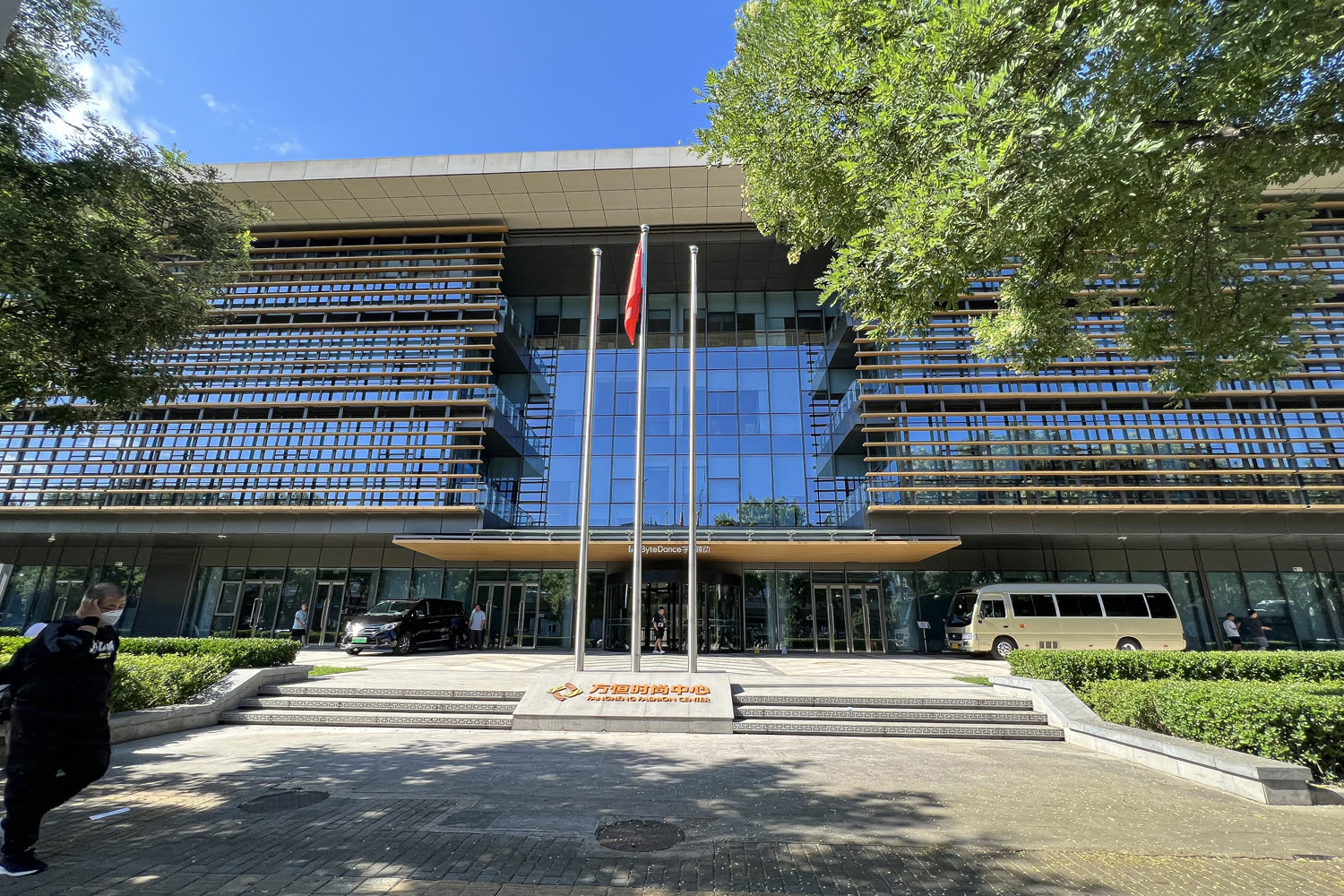
Image context: the cover uses a July 2022 Wikimedia Commons photograph of Fangheng Fashion Center in Beijing with ByteDance markings. The image fits because this article is about company-level workflow packaging rather than a single model demo or leaderboard moment.[8]
The useful use case is not "write me a function." It is "hold the whole task together."
The Chinese homepage already gives away the product ambition. Trae describes itself as an AI development engineer that can understand requirements, call tools, and independently complete different kinds of development tasks, then places TRAE SOLO Web and downloads on the same front door.[1] That is a broader claim than smart completion. It suggests ByteDance wants users to think in terms of delegated work, not just assisted typing.[1]
The global SOLO Web page makes the use case concrete. It says SOLO breaks tasks down automatically, calls the tools needed to complete them, and keeps all project files inside a single workspace so the user does not keep re-uploading documents or hunting for the latest version.[2] The same page says the system can reason across mixed context such as .docx, .csv, .pptx, and Python files, then generate structured output while leaving room for comments and revisions.[2] That is already enough to identify the workflow ByteDance is chasing: not code generation in isolation, but spec-to-deliverable coordination.
If you put those claims together, the cleanest Trae SOLO use case is a bounded internal-software job. A team has a product brief, some legacy repository context, a few structured files, and a human reviewer who still needs visibility into what the agent is doing. SOLO is being positioned as the surface where those ingredients stop living in separate tabs and become one supervised execution lane.[1][2]
ByteDance is explicitly packaging tool orchestration, not just model access
The second important clue sits on the broader SOLO overview page. There, Trae says SOLO orchestrates browsers, terminals, editors, and essential tools around the codebase while keeping the user visually in the loop.[3] The page also frames a progression from plugin to IDE to SOLO: first AI entered the workflow as a feature, then the IDE became AI-first, and now the tools themselves become features for an agentic workspace.[3]
That progression is the heart of the story. In a normal IDE-copilot pitch, the model helps the developer work faster inside the editor. In Trae SOLO's pitch, the editor is just one surface among several. The real product is the control layer that decides when to read docs, when to inspect the repo, when to open a browser, when to run a command, and when to hand a result back for approval.[3]
The same overview page sharpens this by dividing the system into SOLO Builder and SOLO Coder. Builder is described as moving from idea to live product, while Coder is framed as deeper planning and precise execution, with specialized sub-agents working as a flexible team.[3] That makes the Trae signal more legible. ByteDance is not only selling "better answers." It is selling a division of labor inside the product.
In AI-China terms, this is a meaningful shift. A lot of public discussion still collapses Chinese coding AI into model choice, pricing, or benchmark scores. Trae SOLO's public pages suggest that ByteDance wants leverage one layer above that: whoever owns the workspace can route models, tools, and human approval into one durable habit.[1][2][3]
The supporting docs show what ByteDance thinks an AI workspace must control
The documentation structure reinforces that reading even when it is more procedural than promotional. Trae maintains dedicated documentation pages for Model Context Protocol, Skills, Auto-run & security, and Codebase indexing.[5][6][7][4] Those page titles are revealing because they describe the operational surfaces ByteDance thinks are worth naming separately.
Model Context Protocol points to external tool connectivity as a first-class feature rather than an afterthought.[5] Skills suggests reusable agent behavior or workflow packaging matters enough to formalize.[6] Auto-run & security makes clear that hands-off execution is only sellable if the trust boundary is managed inside the product.[7] Codebase indexing implies repository understanding is not supposed to be a lucky side effect of a long prompt; it is meant to be a maintained system layer.[4]
That combination is why Trae SOLO looks more like a workspace product than a flashy shell around an API. The value proposition is being built from coordination primitives: index the codebase, attach tools, preserve reusable skills, constrain execution, and then place human review at the end of the loop.[4][5][6][7]
The rollout itself shows where the boundary still is
The download page is useful because it shows the product split in plain operational terms. TRAE IDE is already distributed across macOS, Windows 10/11, and Linux (.deb/.rpm), while TRAE SOLO is listed separately, available on macOS with Windows still marked as coming soon.[4] That staging matters. It suggests the company is still controlling how fast the more agentic workspace expands relative to the broader IDE footprint.[4]
This is why the Trae SOLO story should stay grounded. Publicly, ByteDance is showing a coherent product direction: one workspace, multi-format context, tool orchestration, Builder/Coder role split, and dedicated control surfaces for MCP, security, skills, and indexing.[1][2][3][4][5][6][7] Publicly, it is not yet showing universal availability or proof that this workflow has become the default environment for a large share of developers.[4]
That boundary does not weaken the signal. It clarifies it. The interesting move is not that Trae SOLO has already won AI coding. The interesting move is that ByteDance is trying to define the next use case more ambitiously than "chat with your editor." It is trying to make a cloud workspace where the brief, the repository, the tools, and the review surface all stay together long enough for software work to look like managed execution instead of assisted typing.[1][2][3]
What to watch next
The first watch item is whether the SOLO rollout broadens across operating systems and regions without losing the review-centric workspace shape.[4]
The second is whether the MCP, skills, indexing, and security surfaces deepen into a genuine ecosystem rather than staying as feature labels around the core workspace.[5][6][7][4]
The third is whether ByteDance can make this workflow sticky for real teams. If developers keep returning because Trae SOLO reduces handoff friction between requirements, code, tools, and approval, then the company will have built something more defensible than another fast copilot.[1][2][3]
Sources
- TRAE 中国官网(将 Trae 定位为“能理解需求、调动工具、独立完成各类开发任务”的 AI 开发工程师,并将 TRAE SOLO Web 与下载入口并列展示)。
- TRAE, "NEW SOLO" (single-workspace framing, mixed-file context, desktop/web continuity, and parallel execution).
- TRAE, "SOLO: The Responsive Coding Agent" (plugin-to-IDE-to-SOLO progression, browser/terminal/editor orchestration, Builder/Coder split, and parallel agents).
- TRAE, "Download" (platform availability split between TRAE IDE and TRAE SOLO, including Windows support for the IDE and pending Windows rollout for SOLO).
- TRAE Docs, "Overview" (the documentation section located at
/ide/model-context-protocol, indicating dedicated MCP support as a first-class product surface). - TRAE Docs, "Skills" (dedicated documentation page for reusable agent/workflow behavior in the IDE surface).
- TRAE Docs, "Auto-run & security" (dedicated documentation page for supervised execution and security controls).
- Wikimedia Commons, "File:Fangheng Fashion Center with ByteDance markings (20220728154237).jpg" (source page for the article image).