As of 2026-04-24 UTC, the sharper way to read Manus's Google Drive connector is not as one more app integration on a feature checklist. The useful signal is that Manus is trying to make a file-native reporting lane. Its own blog frames the connector as a way to turn personal Google Drive into an external database for workflows, so the agent can retrieve, update, organize, and write information directly in Drive instead of forcing users through the older download-upload-export loop.[1] That matters because many agent demos still break at the handoff: the model can research or draft, but the real working materials remain trapped in folders, spreadsheets, and shared documents somewhere else.
Manus is trying to close that gap. The connector blog describes Drive not as passive storage, but as a dynamic, queryable database that Manus can both read from and write back into.[1] That is a much stronger product move than "attach your files." It means the file system becomes part of the task runtime. Reports can be generated straight into a shared folder, sheets can be updated after web research, and existing documents can act as live context instead of one-off uploads.[1]
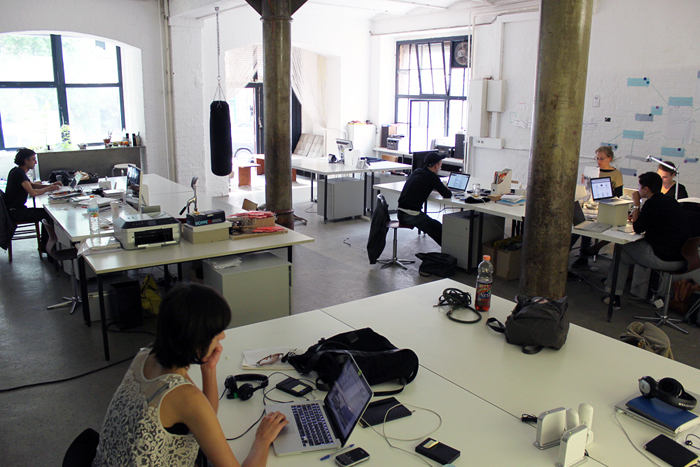
Image context: the cover uses a real Wikimedia Commons photograph of a Berlin coworking space. That is the right visual here because the article is about collaborative reporting work in a visible shared environment. The point is not abstract AI spectacle. The point is what happens when documents, credits, comments, and outputs stop living in separate places.[4]
Why this connector matters more than a convenience feature
The blog post spells out the old friction very clearly: data sits in Drive, work happens in Manus, and users keep shuttling files back and forth by hand.[1] In many agent products that friction is treated as normal. Manus is treating it as a product defect. The connector is presented as a way to keep the knowledge base and the workspace in one loop.[1]
That changes the meaning of the agent. If the agent only answers in its own session window, the result is still transient. A polished paragraph or analysis can be impressive, but the durable object of work remains elsewhere. Once Manus can update a sheet, create a document in the right folder, or pull context from existing files, the deliverable stops being "chat output" and starts becoming an artifact that lands where the team already works.[1]
This is why the phrase file-native reporting lane is the right one. The connector is not mainly about storage sync. It is about routing research, analysis, and writing into files that already have an owner, a folder path, and a review destination.
Collab and Team plans make the handoff operational
The connector by itself would still be only half the story if the surrounding product remained single-player. Manus's own collaboration docs show the other half. Manus Collab is described as one shared workspace where a team can prompt, edit, and refine work together; it creates a single source of truth accessible through one link, lets everyone see updates instantly, and says only the task owner consumes credits.[2]
That matters because a reporting workflow is rarely finished when the first draft appears. Someone wants the chart enlarged, someone else wants a slide added, and the manager wants speaker notes or a revised summary. Manus is explicitly packaging that iteration surface as shared work rather than solitary prompting.[2] The Drive connector then gives that shared work an external memory and output layer.[1][2]
The pricing page pushes the same thesis into account structure. The Team Plan is described as a plan for collaborative access with a shared team credit pool and admin controls.[3] The same page also highlights usage history and dashboard-level tracking of remaining balance and past task consumption.[3] My inference from these sources is narrow but important: Manus is trying to make agent work feel governable enough for teams, not just individually useful. Shared credits, shared task history, and admin controls are what make a reporting lane legible to a manager instead of to a lone enthusiast.[2][3]
The real use case is not "better chat"; it is report movement
The connector blog is strongest when it stops speaking in generic integration language and starts naming actual work. It describes Manus updating a Google Sheet with new data, generating a report directly into a target folder, and using Drive files as live context for subsequent tasks.[1] It also says Drive can become a single source of truth and supports automated reporting into a shared folder for a team to review.[1]
That is the operational wedge. In practice, many organizations do not need an agent to behave like a general digital being. They need it to take a recurring information task and move the output into a place where other people can review, comment, and keep working. A shared Drive folder is a mundane surface, but that is exactly why it matters. Mundane surfaces are where repeated work actually sticks.
Seen this way, Manus's Google Drive connector is a good ai-china signal because it shows a Chinese-origin agent company competing on workflow surfaces rather than only on model theater. The market is getting crowded with claims about autonomy, deep research, and multi-agent execution. A file-native lane is different. It asks whether the agent can land useful work inside the team's existing document graph, with clear ownership and visible iteration.[1][2][3]
What to watch next
Three verification points matter more than marketing language.
First, watch whether Manus keeps extending this pattern beyond Drive into other systems where teams already store work. If Drive is the first strong file-native lane, the next question is whether the same logic appears across more enterprise surfaces.[1]
Second, watch whether collaboration stays central rather than decorative. The connector becomes strategically more important if teams routinely use Collab to refine outputs after Manus writes them into shared folders.[2]
Third, watch whether the governance layer deepens. Shared credits, admin controls, and usage history are enough to make the product more team-shaped than a solo chatbot, but long-term enterprise stickiness will depend on whether those controls become more granular and more auditable over time.[3]
The narrow conclusion is already defensible. Manus's Google Drive connector matters because it turns file storage into a live reporting surface. In that design, Drive is no longer just where source material waits and final documents go to die. It becomes the place where agent context, team review, and finished output can meet inside one visible loop.[1][2][3]
Sources
- Manus Blog, "Google Drive Connector on Manus" (official product post describing Drive as an external database, a dynamic queryable store, a single source of truth, and a shared-folder reporting surface).
- Manus Documentation, "Manus Collab" (official docs on one shared workspace, one-link source of truth, real-time updates, and owner-only credit consumption).
- Manus Documentation, "Plans and Pricing" (official docs on Team Plan shared credit pools, admin controls, and usage-history visibility).
- Wikimedia Commons, "File:Coworking Space in Berlin.jpg" (source page for the real coworking photograph used as the article image).