As of 2026-04-23 UTC, the most useful way to read SiliconFlow is not as one more China AI company trying to win the next flagship-model headline. The stronger reading is infrastructural. SiliconFlow is trying to sit in the middle of the market as a third-party inference switchboard: close enough to open-model supply to aggregate it, close enough to cloud and enterprise deployment to operationalize it, and close enough to popular agent shells to turn model access into recurring usage.[1][2][3][4]
The company's own public material points in that direction. Its about page says SiliconFlow was founded in August 2023, built a self-developed inference engine, and now offers a one-stop large-model cloud service, an enterprise MaaS platform, and the BizyAir cloud plugin for ComfyUI users.[1] The same page also gives the scale markers that matter for this dossier: by December 2025, the platform said it had passed 9 million registered users, served 10,000+ enterprise users, listed 150+ models, and launched a private-deployment MaaS solution.[1] Those are not the metrics of a single-model lab. They are the metrics of a company trying to become a service layer between many models and many downstream use cases.
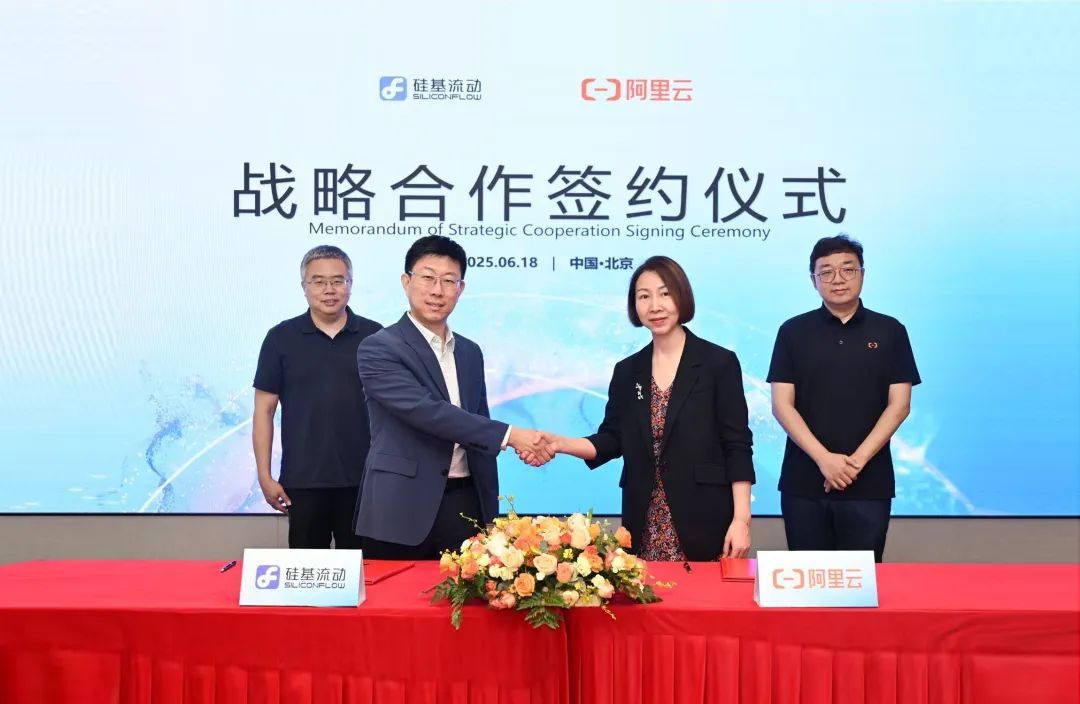
Image context: the cover uses SiliconFlow's own June 18, 2025 photograph from its Alibaba Cloud strategic-cooperation announcement. The image fits because the company's current position is best understood through alliances, infrastructure, and distribution rather than through one self-branded frontier model.[6]
The clearest tell is that SiliconFlow sells access, not allegiance
SiliconFlow's model-list documentation is blunt about what the platform is for. It describes SiliconCloud as a service built on top of strong open-source foundation models, then emphasizes three product traits: many model families, ready-to-use inference acceleration, and lower trial-and-error cost for developers who want fast application delivery.[2] The examples are revealing too. The page mixes Qwen, DeepSeek, GLM, Yi, Mistral, embedding models such as BAAI/bge, and image-generation models such as SDXL and InstantID.[2]
That inventory matters because it changes the company's economic role. A lab with one signature model needs to defend brand, benchmark prestige, and model differentiation. A platform like SiliconFlow is playing a different game. Its value rises when developers can move across multiple model families without rebuilding their whole stack every time. In that structure, the platform does not need users to swear loyalty to one model lineage. It needs them to keep routing traffic through SiliconFlow's inference surface.[2]
This is why the company dossier should be framed around switching costs rather than raw model novelty. SiliconFlow's strategic question is not whether it can outshine every model provider on research headlines. It is whether it can become the easiest place to sample, route, and deploy the open-model inventory that China AI keeps producing.
The strongest evidence is in the agent-shell documentation
The most revealing sources are not the homepage slogans. They are the tool-integration guides. SiliconFlow's own Claude Code documentation shows users how to point Anthropic-style environment variables at https://api.siliconflow.cn/, choose a SiliconFlow-served model, and run Claude Code against that external endpoint.[3] The document is practical rather than philosophical, but that is exactly why it matters. SiliconFlow is not asking developers to abandon existing shells and move into a closed first-party workspace. It is documenting how to enter the tools developers already use.[3]
The OpenClaw guide sharpens the same pattern. It explicitly says SiliconFlow can be connected through OpenAI-compatible mode, instructs users to set https://api.siliconflow.cn/v1 as the base URL, and shows how to register a SiliconFlow model inside openclaw.json before switching to it with /model.[4] In other words, SiliconFlow is not merely exposing an API. It is systematically mapping itself into the control surfaces of current agent software.[4]
That is a very important AI-China signal. Many China model companies still think in terms of model release, model pricing, or first-party app distribution. SiliconFlow is trying to capture value one layer higher than that: if the shells stay popular, SiliconFlow wants to be the inference backend those shells can easily point to. This is not a prestige strategy. It is an access-and-routing strategy.
The open-source surface says the company wants technical leverage, not only reseller margin
The public GitHub organization reinforces the infrastructure reading. SiliconFlow describes itself there as delivering scalable and standardized AI infrastructure powered by a self-developed inference engine, integrating hundreds of state-of-the-art open-source models across language, speech, vision, and multimodal domains.[5] Its highlighted repositories matter too: OneDiff is an acceleration library for diffusion models, while BizyAir lets ComfyUI nodes run without a local GPU.[5]
That combination is strategically coherent. If SiliconFlow only wanted reseller economics, it could stop at API aggregation and enterprise sales. Instead, it is also building tooling that helps shape how workloads actually run. OneDiff sits near performance optimization; BizyAir sits near cloud-assisted creative workflow; the larger GitHub footprint suggests that the company wants credibility with builders as well as buyers.[5]
This is where SiliconFlow differs from an ordinary model supermarket. The company's open-source layer gives it more chances to influence runtime behavior, hardware efficiency, and workflow adoption. That matters in a market where model capabilities are moving quickly and where many upstream labs are happy to let somebody else solve delivery, acceleration, and workload fit.
Cloud alignment is not a side detail. It is part of the moat attempt
SiliconFlow's June 18, 2025 partnership announcement with Alibaba Cloud is the clearest public statement of how the company wants to scale this middle position. The company said SiliconCloud would connect into Alibaba Cloud Bailian, rely on Lingjun intelligent-computing clusters, and explore deeper cooperation in compute coordination, industry solutions, and domestic and international market expansion.[6] The same announcement described SiliconCloud as the country's fastest-growing third-party MaaS platform, said it had already integrated 100+ mainstream open-source models, and said it had served 6 million+ users and thousands of enterprise customers at that point.[6]
That source matters because it shows SiliconFlow trying to solve a classic middle-layer problem: how to stay independent enough to aggregate many model families while becoming allied enough with major cloud and compute providers to guarantee scale, elasticity, and enterprise trust. The company does not need to replace the hyperscalers. It needs to become difficult for them to ignore because it concentrates model demand and developer traffic.
In AI-China terms, this is a meaningful position. Labs produce the models. Clouds provide the heavy infrastructure. Agent shells own the user habit. A company like SiliconFlow tries to live in the seams between them.
Why this dossier matters now
The China AI market is getting crowded with excellent open models and increasingly competent agent software. That crowding changes where durable leverage can live. Some leverage still sits with the model creators. Some sits with the clouds. But a growing amount may sit with the companies that make heterogeneous model supply easy to consume from existing software surfaces.
SiliconFlow's public evidence points toward that ambition. The company timeline shows fast scaling from a 2023 founding to millions of users and a large enterprise base.[1] The model list shows breadth across text, embedding, and image lanes rather than dependence on one flagship family.[2] The Claude Code and OpenClaw guides show deliberate occupation of agent shells that SiliconFlow does not own.[3][4] The GitHub org shows engineering effort in acceleration and workflow tooling, not only in sales pages.[5] The Alibaba Cloud partnership shows that cloud alignment is being used to stabilize the platform's supply side while the company expands its demand side.[6]
That does not mean the model-switchboard thesis is already secure. The same middle position is exposed to pressure from both sides. Upstream labs may want more direct distribution. Agent shells may add their own preferred provider layers. Hyperscalers may decide they no longer need an intermediary. But for now, SiliconFlow looks less like a model brand and more like a broker of usable AI capacity.
What to watch next
The first watch item is whether SiliconFlow keeps expanding its tool-surface integrations. If the list of supported agent shells keeps growing, the switchboard thesis gets stronger.[3][4]
The second is whether the company keeps adding technical leverage rather than only commercial inventory. More acceleration tooling, workflow plugins, or deployment primitives would strengthen the claim that SiliconFlow is infrastructure, not just packaging.[1][5]
The third is whether cloud alliances deepen without turning the company into a captive channel. SiliconFlow's edge depends on being open enough to route many model families while being operationally solid enough for enterprise workloads.[2][6]
If those three pieces hold together, SiliconFlow may become one of the more important middle-layer companies in AI-China: not because it owns the most famous model, but because it helps many models arrive inside the places where people already work.
Sources
- SiliconFlow, "公司介绍 / About" (founded in August 2023; self-developed inference engine; enterprise platform; BizyAir; timeline milestones including 9 million registered users, 10,000+ enterprise users, and 150+ models by December 2025).
- SiliconFlow Docs, "模型列表 / Model List" (platform positioning, supported model families, and real-time inventory framing for SiliconCloud).
- SiliconFlow Docs, "Claude Code" (official integration guide showing SiliconFlow as an external endpoint for Claude Code via base URL and model environment variables).
- SiliconFlow Docs, "OpenClaw" (official OpenAI-compatible integration guide showing SiliconFlow model registration, base URL configuration, and runtime switching inside OpenClaw).
- SiliconFlow GitHub organization (self-description of scalable AI infrastructure, self-developed inference engine, and flagship open-source projects including OneDiff and BizyAir).
- SiliconFlow, "硅基流动与阿里云达成战略合作,共建大模型生态" (June 18, 2025; Alibaba Cloud partnership, Bailian connection, Lingjun cluster support, model-count and user-scale claims, and source page for the signing-ceremony photograph used as the article image).