China has spent much of the generative-AI boom counting models, parameters, tokens, accelerators, and benchmark points. Its newest count is deliberately less glamorous. On August 31, the Ministry of Industry and Information Technology (MIIT) ordered provincial-level authorities to build a national resource pool of more than 2,000 AI application service providers by the end of 2026 and at least 3,000 by the end of 2027.[1]
The number will attract attention. The job description matters more.
MIIT defines these providers as companies or institutions that work around a customer’s need across consulting and planning, delivery and implementation, operations management, and safety governance.[1] This is not a new category of foundation-model laboratory. It is the missing middle between a capable model and a workflow that employees will use, auditors will accept, and an operations team can keep alive after the demonstration ends.
Five days before the notice appeared, Vice Minister Xin Guobin previewed the initiative at a State Council Information Office briefing. He promised lightweight, low-cost, easily deployed industry solutions that enterprises could genuinely use and afford.[2] The wording and the rapid follow-through are a useful field signal: Beijing is treating implementation capacity as infrastructure in its own right.
A census of the middle, not 3,000 new champions
The pool should not be misread as 3,000 newly created companies, 3,000 certified integrators, or 3,000 successful deployments. The notice asks regions first to survey providers already operating locally, including locally registered central state-owned enterprises, and create dossiers for them. MIIT will aggregate those records, use relevant standards to form the national pool, and publish it “at an appropriate time.” It does not describe a licence or promise that inclusion guarantees technical quality.[1]
The calendar reinforces that reading. Regional inventories are due by December 1, 2026, only three months after publication. Provinces containing a national AI-industry innovation application pilot zone are expected to have at least 100 providers in their regional pools by the end of 2027.[1] Those deadlines can map and classify an existing market much faster than they can create a mature one.
Even so, a map has value. Enterprise AI delivery is fragmented among cloud vendors, model developers, industrial-software companies, data specialists, cybersecurity firms, systems integrators, universities, research institutes, and the customer’s own technology and operations teams. A resource pool gives government buyers and industrial users a legible set of counterparties. It also gives MIIT a way to see where China has model supply but lacks deployment skills, industry knowledge, or ongoing support.
The risk is that a directory becomes its own success metric. A province can fill a spreadsheet without producing one repeatable solution. The meaningful test is therefore not whether the pool reaches 3,000 names. It is whether the program changes how those names work together and what they can show after go-live.
Three design choices reveal the actual bottleneck
The first is the service team. Each reporting region should submit at least ten teams. Every team needs one provider in the lead and at least two upstream or downstream partners.[1] That structure admits that the deployment unit is rarely one vendor. A model supplier may need a chip-and-runtime partner, an industrial-data specialist, an integrator who understands the existing software, and a security operator who can monitor the result.
MIIT names “model–data resonance” and coordination among computing and electricity as possible team types. It also calls out multi-model collaboration, software–hardware adaptation, safe operating systems, databases, and AI training and inference chips.[1] The provider layer is thus being asked to absorb the incompatibilities that a polished model API hides: formats, permissions, latency, device support, old enterprise systems, changing versions, and the division of responsibility when an output is wrong.
The second choice is productization. Providers are told to start with frequent, necessary, reusable business needs and package modular, standardized offerings described as “small, fast, light, and precise.”[1] This is an attempt to escape the economics of permanent customization. If every factory, hospital, or logistics company requires a fresh data model, a bespoke connector, months of process discovery, and an indefinite on-site team, adoption can rise while provider margins and customer returns remain poor.
The notice pairs that product ambition with demand support: open real scenarios for testing, promote model, agent, and Token-service procurement, and explore first-purchase, first-use, and risk-compensation mechanisms.[1] Those are policy instruments, not disclosed purchase orders. No national appropriation, procurement volume, reimbursement rate, or revenue target appears in the document. Most of the operative verbs are “support,” “encourage,” “guide,” and “explore.” The state is reducing friction and signaling demand; it has not guaranteed a market.
The third choice is unusually concrete: providers are encouraged to build frontline deployment engineer (FDE) teams that stay close to the customer site.[1] A national industrial policy document using the English abbreviation matters because it identifies the scarce work with surprising precision. The problem is not only installing a model. It is translating a process owner’s complaint into a bounded task, finding usable data, connecting tools, designing approvals, measuring errors, teaching staff, and returning when the workflow or model changes.
That emphasis matches evidence outside the policy system. A 2026 Deloitte–University of Hong Kong survey of more than 100 C-suite leaders in mainland China and Hong Kong reported that more than one-third of organizations were still exploring AI and 56% had reached only limited implementation. Just 23% reported measurable financial impact, 4% described transformation, and 9% of projects delivered negative returns. Respondents’ leading obstacles were organizational and executional—silos, resistance, unclear business cases, limited understanding, and unforeseen implementation complexity—rather than model capability alone.[6]
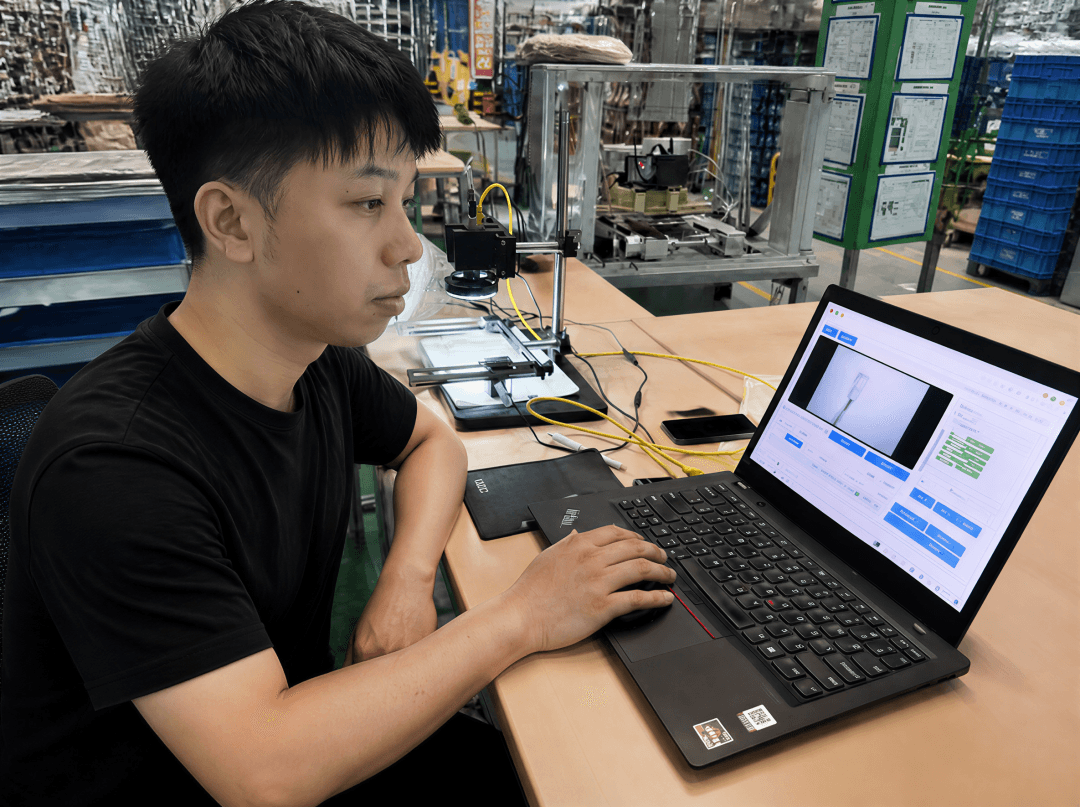
A local-government report from Wuhan, published the day Notice 414 was dated, shows what this work looks like at micro scale. Sileco, a two-person industrial-vision company, had installed an AI inspection system on a tier-one supplier’s seat-cover line for Dongfeng Voyah. The device scans cut interior pieces for scratches, damage, marks, and missing material, then sends exceptions to an operator for a second review. The report put accuracy above 98%.[7] More revealing than that company-reported figure is the development history: training on internet images did not transfer to the real line, so the provider moved to customer samples, repeated testing, error feedback, and on-site tuning. It now says it wants modular configurations that can be deployed for other customers without repeating all the development.[7] This is a promotional government profile, not independent validation of performance or economics. But the process is recognizable: domain discovery, real data, hardware and software integration, human review, field debugging, and an attempt at reuse.
The survey is small and not a nationally representative census, so its percentages should not be projected across Chinese industry. But its diagnosis helps explain why MIIT is specifying delivery roles, reusable packages, cross-company teams, and staff at the customer site. The initiative is designed around the work that begins after an API call succeeds.
The policy ladder has moved from adoption goals to delivery machinery
This provider push did not appear from nowhere. The State Council’s August 2025 “AI+” plan set a broad goal: by 2027, next-generation intelligent terminals and agents should exceed a 70% application penetration rate. The same plan called for AI application service providers and a service chain around model-as-a-service and agent-as-a-service offerings.[3] Its official interpretation was unusually candid about poor supply–demand matching and a “last kilometre” obstacle to implementation.[5]
The eight-department “AI+ Manufacturing” plan, dated December 2025 and published in January 2026, then made the industrial demand side more tangible. By 2027 it seeks deep manufacturing use of three to five general-purpose models, 1,000 high-level industrial agents, 100 high-quality industrial datasets, 500 representative scenarios, and 1,000 benchmark enterprises. It also calls for providers that can combine model tuning, data governance, and security services.[4]
Notice 414 adds the delivery machinery: provider dossiers, regional quotas, partner teams, test and pilot facilities, computing vouchers, interfaces to results from data-and-model programs, on-site engineers, and periodic evaluation.[1] This does not mean China’s model race is over. It means policymakers now see that cheap, capable models do not distribute themselves into production.
The sequence also exposes a tension. Standardized packages scale; deep industry work resists standardization. An effective provider has to know which layer can be reused—the connector, evaluation harness, permission model, deployment recipe, or monitoring system—and which layer remains specific to a plant, clinic, port, or insurer. “Small and light” cannot mean removing the integration and safety work that makes the application trustworthy. It has to mean reusing that work without pretending every customer is the same.
What would turn a directory into delivery capacity
The first evidence arrives with the December filings. The public should be able to learn more than how many providers and teams each region found. Useful records would show the industries served, the role of each partner, the product package being reused, time from discovery to production, the customer system connected, and the named operator responsible after launch.
The second test is repeat use. A convincing provider should be able to deploy substantially the same core package for a second and third customer without rebuilding it, while documenting where local adaptation was necessary. Renewal, expansion, accepted-output rates, human override rates, uptime, security incidents, and measured changes in cost, cycle time, defects, or revenue would say more than a catalogue label.
The third is accountability across the service team. Consortia can combine missing skills, but they can also diffuse responsibility. Contracts and public case studies should make clear who owns the data, model version, system integration, safety review, incident response, and rollback. An FDE at the site is valuable only if that engineer has an escalation path and the authority to stop a failing workflow.
Finally, watch the denominator. A pool of 3,000 may be large or small depending on how many have active production customers, qualified staff, repeatable products, and stable economics. If the pool grows while disclosures stop at membership, demonstrations, and subsidized first purchases, the program will have catalogued aspiration. If it produces reusable solutions with renewals and operational receipts, China will have built something less visible than a frontier model and potentially more consequential: a national implementation layer.
The strongest signal in Notice 414 is therefore not the target at the top. It is the policy’s recognition that AI value is assembled in the middle—between model and machine, vendor and operator, first purchase and second deployment. China is beginning to count that work. The next question is whether it can count the outcomes.
Sources
- Ministry of Industry and Information Technology, “Notice on carrying out the special action to cultivate AI application service providers,” MIIT Science Letter No. 414 (dated August 27 and published August 31, 2026; provider definition, pool targets, service teams, reusable packages, FDEs, reporting dates, and support measures; in Chinese).
- Ministry of Industry and Information Technology, transcript of the State Council Information Office briefing on implementing the 15th Five-Year Plan and advancing new industrialization (August 26, 2026; Xin Guobin’s announcement of the provider initiative and deployment objective; in Chinese).
- State Council of China via the Cyberspace Administration of China, “Opinions on Deeply Implementing the ‘AI+’ Action,” State Council Document No. 11 (August 21, 2025; adoption goals and the original call for application providers and service chains; in Chinese).
- Eight Chinese departments via the National Data Administration, “Implementation Opinions for the ‘AI+ Manufacturing’ Special Action” (dated December 25, 2025 and published January 9, 2026; 2027 industrial-model, agent, dataset, scenario, enterprise, and provider targets; in Chinese).
- National Development and Reform Commission, official Q&A on the State Council’s “AI+” action (August 26, 2025; supply–demand mismatch, the implementation “last kilometre,” pilot bases, and provider-service chains; in Chinese).
- Deloitte China and the University of Hong Kong, “HKU and Deloitte China AI Adoption Index 2026” (survey scope, implementation maturity, financial impact, negative returns, and organizational barriers).
- Wuhan Economic and Technological Development Zone Media Center, “Sileco’s two-person team independently develops an industrial-vision AI inspection system, adopted in Dongfeng Voyah’s supply chain within one year” (August 27, 2026; factory deployment, reported results, on-site iteration, and modularization plans; in Chinese).