As of 2026-05-05 UTC, the most useful way to read Tencent Cloud's new Hermes Agent push is to stop treating it as one more agent tutorial and to read it instead as a server lane.[1][2][3][4] The important change is not the phrase "AI agent" by itself. The important change is that Tencent Cloud has decided to package a specific kind of open-source agent into a repeatable cloud-onboarding contract: choose a Lighthouse image, choose a region and bundle, log into the instance, run the guided model setup, and connect the agent to a messaging channel that keeps it online after the laptop closes.[1][2][3]
That matters in ai-china because the competitive surface keeps moving upward and downward at the same time. One layer up, companies talk about agent products, app surfaces, and workbench loops. One layer down, the actual adoption problem is still brutally practical: where does the agent run, how isolated is it from the user's own machine, which model provider does it call, and what interface stays alive when the user walks away.[1][2][3][4] Tencent Cloud's public material now answers those questions with unusual specificity. My inference from these sources is narrow but important: Tencent wants to own the always-on agent server even when the model brain comes from somebody else.
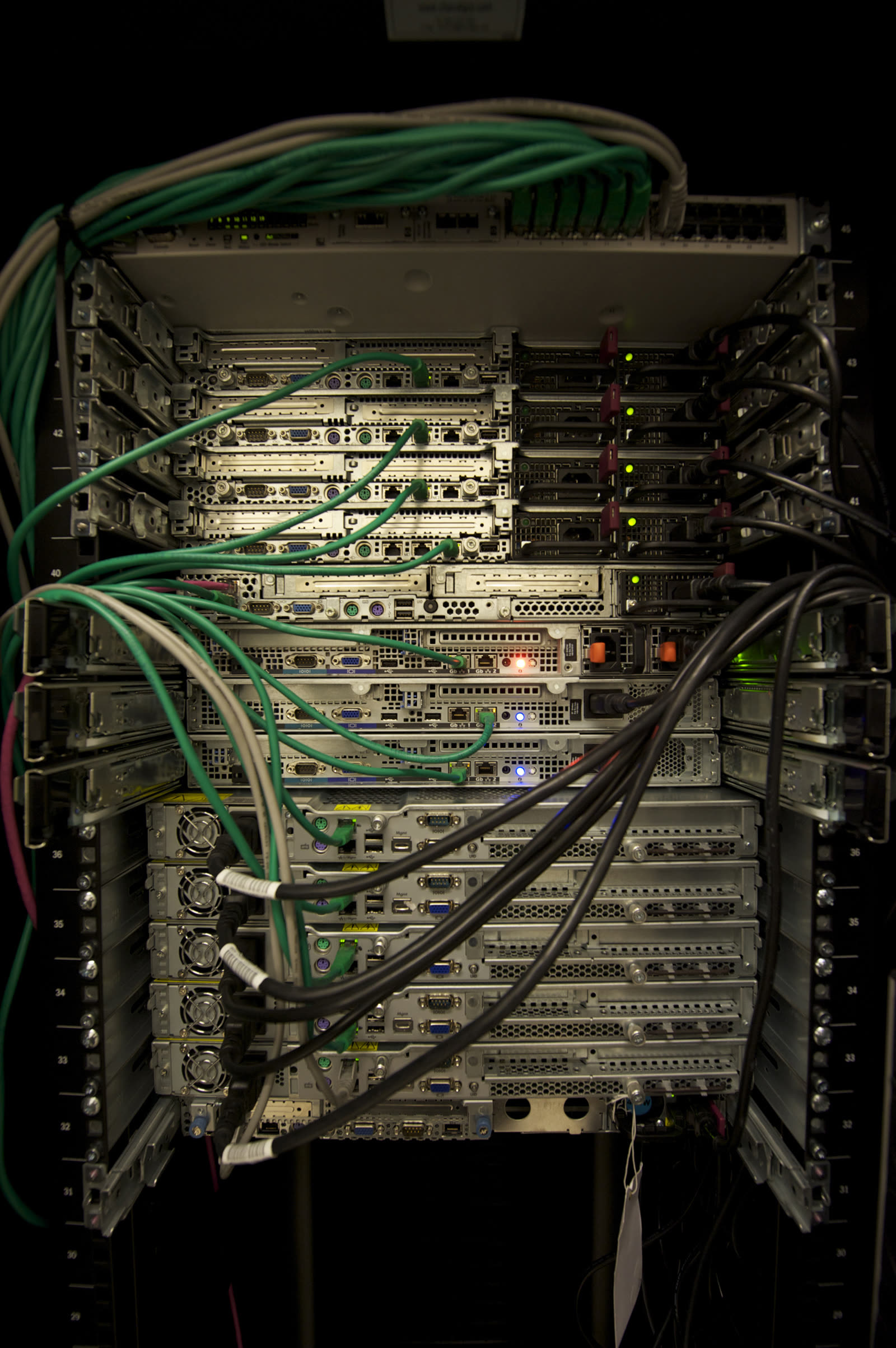
Image context: the cover uses a real Wikimedia Commons server-rack photograph. That is the right anchor here because this article is about the machine boundary beneath the agent. The product signal lives in packaged compute, network access, storage, and persistent uptime, not in a synthetic image of "AI intelligence."[5]
The update is really about packaging the host machine
The base Lighthouse documentation explains why this release-note cycle matters. Tencent describes Lighthouse as a lightweight, package-based cloud server for developers and SMEs, with bundled bandwidth, application-focused images, and a simpler one-click build path than an ordinary cloud VM.[1] The product page pushes the same point in more commercial language: one-click app deployment, unified operations, cost-effective bundles, and region choice for different end users.[1]
On their own, those are generic cloud-server claims. What changed is that Tencent has now attached Hermes Agent directly to that surface. The new deployment page says Lighthouse is the first cloud platform to support Hermes Agent as an official one-click option, then turns that support into pre-shaped bundles such as 2C2G Personal, 2C4G Best of Choice, and 4C8G Business, each framed around different always-on assistant workloads.[2] That is more than a blog post announcing compatibility. It is Tencent Cloud converting an open-source agent into a purchasable server archetype.
In other words, the image and the instance now ship together.
Tencent is standardizing isolation, uptime, and region choice
The tutorial is most revealing where it talks about deployment boundaries rather than agent theatrics. Tencent's May 5 setup guide says Hermes Agent has full system operation permissions for terminal execution, file read-write, and browser automation, and therefore should be deployed in an environment isolated from the user's primary computer.[3] It also says Linux is the recommended platform and that cloud deployment makes the agent available 24/7 through chat applications such as Telegram and Discord.[3]
That is the real release-note signal. Tencent is not telling users to copy a repo into a spare laptop and hope it stays awake. It is defining the correct operational home for the product: an isolated cloud server with persistent uptime.[2][3][4]
The region guidance matters too. In the same tutorial, Tencent tells users to choose an overseas region for Discord-style global platforms, but to prefer a domestic region when calling mainland-facing models such as Kimi, MiniMax, and Zhipu GLM.[3] This looks like a small onboarding detail. It is actually a sharp ai-china clue. Region choice, model access, and messaging-channel reach are being packaged together at the moment of first deployment. The "agent server" is not neutral plumbing anymore. It is a route-selection surface.
The lane stays open even when Tencent does not own the model
This is the part that makes the rollout more interesting than a closed Hunyuan-only story.
Tencent's own tutorial uses MiniMax China as the example model provider, walks the user through obtaining a MiniMax API key, then shows hermes setup exposing a model list that includes MiniMax-M2, MiniMax-M2.5, MiniMax-M2.7, and MiniMax-M2.7-highspeed.[3] The same guide also notes that domestic Lighthouse instances are usually the right choice for domestic model access.[3] The tutorial is not quietly hiding rival providers behind the scenes. It is operationalizing them inside Tencent's server lane.
That changes the reading of the release. Tencent Cloud is not only trying to win through its own model stack. It is trying to become the cloud habit around an agent that can talk to many model vendors. Once the user has accepted Tencent's image, instance sizing, login flow, terminal, network setup, and always-on operations posture, model choice becomes a layer that can move above the server contract rather than replacing it.[1][2][3]
The companion overview article makes the same architecture visible from another angle. It says Lighthouse pre-installs the runtime dependencies Hermes Agent needs, including the Linux environment, process-management support, persistent storage, and public network access, leaving the user mainly to finish model configuration and messaging setup.[4] That is why "server lane" is the right phrase. Tencent is compressing the hard part of first deployment into a stable sequence that keeps the infrastructure choice in its own hands even when the inference endpoint is external.
Messaging is the handoff from cloud instance to daily use
The release-note cycle also makes a second design choice clear: the real interface is not the terminal window. It is the messaging channel.
Tencent's deployment page markets Hermes Agent through WhatsApp, Telegram, Discord, and Slack scenarios on the global side, while the detailed tutorial spends major effort on WeCom setup for China-based work communication.[2][3] The logic is straightforward. A cloud agent only becomes habit-forming when it can report, accept instructions, and stay reachable in the communication surface the user already checks all day.
That makes this rollout different from a local-model hobby guide or an IDE-only assistant. The operational destination is a channel-native assistant that lives on a server, not a notebook experiment that resets when the shell closes.[2][3] Tencent Cloud is selling not just install convenience but a persistent handoff from server to work chat.
The boundary is still small-team infrastructure, not full enterprise dominance
The public material supports a narrower claim than "Tencent has solved enterprise agent infrastructure."
First, Lighthouse is consistently positioned for developers, beginners, and SMEs, not as the final answer for every large deployment.[1][4] The overview article itself says teams that outgrow Lighthouse should move toward heavier cloud-server options such as CVM, and it frames Lighthouse as strongest for personal or small-team agent hosting.[4]
Second, this is a CPU-first lane. The overview page explicitly says Lighthouse is focused on CPU workloads and that GPU-heavy local inference belongs elsewhere.[4] That keeps the current rollout centered on API-driven or light-hosted agents rather than on sovereign local inference clusters.
Third, the rollout proves packaging discipline, not usage depth. The sources show that Tencent has made Hermes Agent easy to host, easy to isolate, and easy to connect to domestic or global channels.[2][3][4] They do not, by themselves, prove that most Chinese teams will standardize on this path. The more defensible conclusion is smaller: Tencent Cloud now has a concrete answer to the onboarding problem that sits between a raw open-source repo and a full managed enterprise agent platform.
Bottom line
Tencent Cloud's May 2026 Hermes Agent push matters because it turns an open-source autonomous agent into a server lane.[1][2][3][4] Lighthouse supplies the package-based host machine, the one-click image, the region logic, the instance sizing, and the isolation boundary. The setup flow then lets the user attach a model provider and carry the result into WeCom or global messaging channels.[2][3]
That is why the most important question is not "Does Tencent own the smartest model in this workflow?" The harder and more durable question is: who owns the machine where the always-on agent actually lives? Right now, Tencent Cloud is trying to make that answer its own.
Sources
- Tencent Cloud Docs, "Tencent Cloud Lighthouse" (product overview describing Lighthouse as a lightweight, package-based cloud server for developers and SMEs, with one-click application images, bundled traffic, and region-aware deployment).
- Tencent Cloud, "Hermes Agent 云端部署|7×24 小时 自我进化智能体" (official deployment landing page for one-click Hermes Agent on Lighthouse, with packaged 2C2G / 2C4G / 4C8G options, 24/7 positioning, and WeCom or global-IM scenario framing).
- Tencent Cloud Techpedia, "Getting Started with Hermes Agent: Deploying on Tencent Cloud Lighthouse" (published May 5, 2026; isolated deployment recommendation, Linux preference, domestic-versus-overseas region guidance,
hermes setup, MiniMax CN example, and WeCom integration flow). - Tencent Cloud Techpedia, "Tencent Cloud Lighthouse: The Fastest Way to Deploy an AI Agent in 2026" (current overview of the pre-installed Hermes template, static public access, storage and process-management assumptions, small-team fit, and boundary with larger CVM deployments).
- Wikimedia Commons, "Servers in a Rack" (direct Wikimedia file path for the real server-rack photograph used as the article image).