As of 2026-04-11 UTC, the most useful way to read Qwen's recent public materials is to stop asking only which flagship checkpoint Alibaba wants developers to benchmark next. The sharper signal now sits in the interface layer. Qwen is widening into a speech-and-terminal stack: Qwen3 supplies the hybrid reasoning core, Qwen Code turns that core into a terminal agent with a fast-moving tool surface, Qwen3-TTS and Qwen3-ASR extend the same brand into speech output and input, and Qwen App shows Alibaba trying to make that stack legible to ordinary users rather than only to model buyers.[1][2][3][4][5][6]
That does not mean every part of the stack is equally mature. It does mean the release notes are no longer pointing in four unrelated directions. They are starting to describe one branded interaction system: type, speak, listen, code, and execute inside adjacent Qwen surfaces rather than isolated one-off products.[1][2][3][4][5][6]
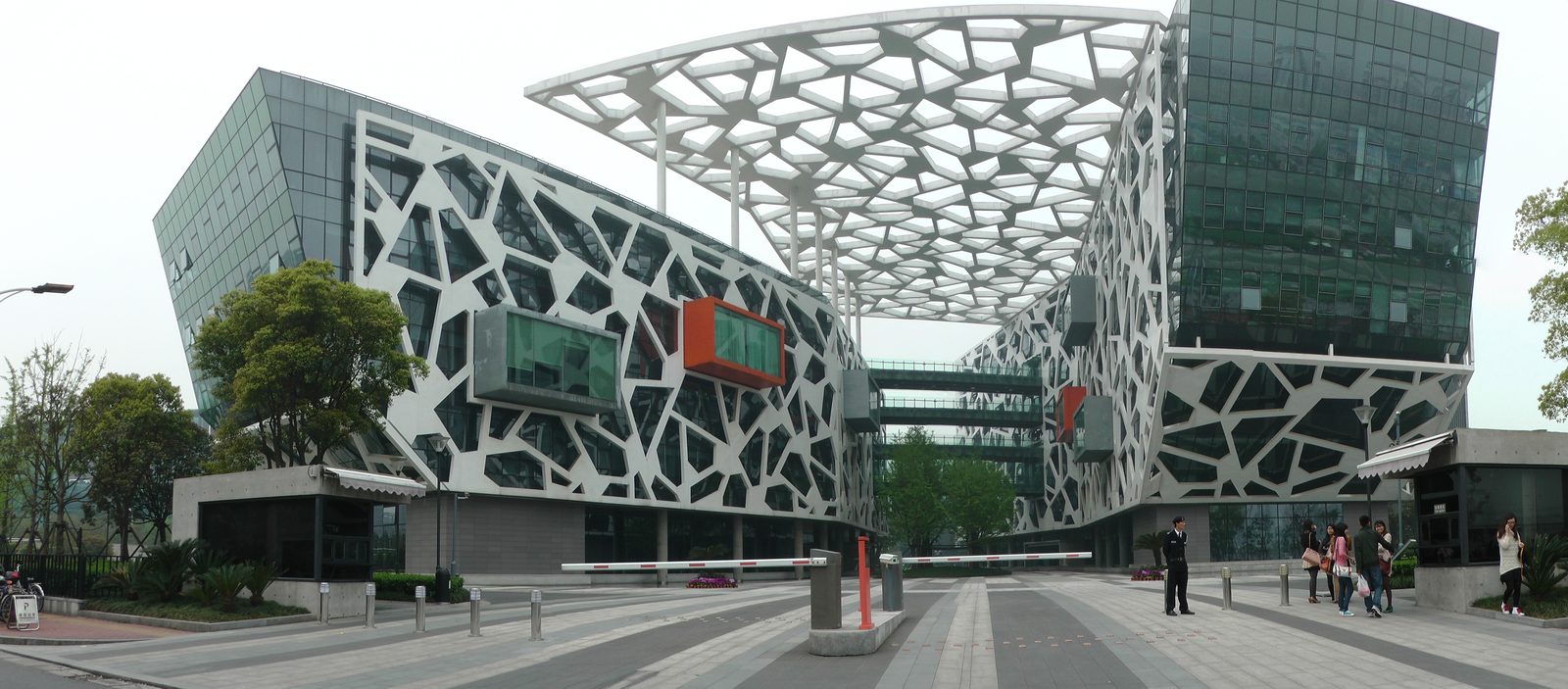
Image context: the cover uses a real Wikimedia Commons photograph of Alibaba Group's global headquarters in Hangzhou. It fits this article because the argument is about Alibaba widening Qwen through real organizational surfaces across cloud, tooling, and consumer products. A documentary campus photo with visible entry and people is more honest here than a stylized AI graphic.[7]
Qwen3 still matters because it supplies the control layer
The stack only makes sense if the base model already supports multiple operating modes. That is why the older Qwen3 release still belongs in a current digest.[1]
In the Chinese first-hand launch post from 2025-04-29, the Qwen team framed Qwen3 around three capabilities that are still doing work today: a thinking / non-thinking switch, support for 119 languages and dialects, and stronger agent and code ability with explicit MCP support.[1] The same post also said the pretraining corpus expanded to roughly 36 trillion tokens, nearly double the Qwen2.5 figure cited there.[1]
Those details matter because they describe Qwen less as a single chat endpoint and more as a controllable base layer. If Alibaba wants one brand to travel from terminal coding into speech interfaces and then into a consumer assistant, it needs the underlying model family to tolerate different latency, cost, and interaction shapes. My inference from [1] is that Qwen3's real strategic contribution is not only raw quality. It is the budgetable control surface that lets Alibaba keep one model identity while switching between deep reasoning, fast responses, multilingual work, and tool use.
Qwen Code turns the model story into a terminal workflow
The next step in the stack is Qwen Code. The 2026-01-30 announcement did not present it as a light wrapper around a model API. It introduced an open-source, free AI coding tool powered by Qwen3-Coder, explicitly framed around the new era of agentic workflow.[2]
The product language is revealing. Qwen Code is described as a programmer companion that can deconstruct tasks, read and write files, execute scripts, self-correct, and deliver whole applications or documentation rather than isolated snippets.[2] It is also placed across several environments at once: terminal, IDE, CI/CD, browser, and SDK-level embedding.[2] That is already a larger claim than "Alibaba has a coding model."
The 2026-03-20 weekly update makes the same point from the maintenance side. Alibaba doubled the token limit from 8K to 16K, added JetBrains support beside Zed, and pushed project-level skill sharing through a versioned .agents directory.[3] Those are not benchmark headlines. They are workflow-friction changes. They tell you Alibaba is spending release energy on how the agent lives inside repeated developer use, not only on how the model scores in a launch week.
That is why Qwen Code belongs in this digest. It converts Qwen from a model brand into a working terminal surface. Once that happens, the strategic question changes from "Can Qwen code?" to "Can Alibaba keep developers inside a Qwen-shaped operating loop long enough that the loop itself becomes sticky?"[2][3]
Qwen3-TTS and Qwen3-ASR widen Qwen into voice output and input
The speech layer is where the stack becomes more interesting.
The official Qwen3-TTS repository describes an open-source speech-generation series from Alibaba Cloud that supports stable, expressive, and streaming speech generation, free-form voice design, and vivid voice cloning.[4] The repo's release notes say the 0.6B and 1.7B models were released on 2026-01-22 and built on Qwen3-TTS-Tokenizer-12Hz.[4] The README also says the line covers 10 major languages and emphasizes adaptive control of tone, speaking rate, and emotional expression.[4]
On the input side, the Qwen3-ASR-Toolkit page does two things at once. First, it says the newly open-sourced Qwen3-ASR model line includes 0.6B and 1.7B all-in-one speech-recognition models supporting 52 languages and dialects, plus a forced-alignment model for 11 languages.[5] Second, the toolkit packages the operational layer around that model: splitting audio around silence, bypassing the official 3-minute API limit, processing chunks in parallel, and generating .srt subtitles for long-form media.[5]
That combination is more important than either release by itself. TTS widens Qwen into output voice; ASR and its toolkit widen Qwen into input voice and long-audio handling. My inference from [4] and [5] is that Alibaba no longer wants speech to sit outside the main Qwen identity as a separate specialist brand. It wants speech to become one more normal Qwen surface, the way code is becoming one more normal Qwen surface through Qwen Code.
Qwen App matters because it proves Alibaba wants consumer continuity too
The consumer layer matters not because app downloads are a moat by themselves, but because they show where Alibaba wants this branded stack to land.
Alibaba Group's 2025-11-25 press release says Qwen App surpassed 10 million downloads within the first week after its public beta launch on November 17, quickly reaching the top three of Apple's free-app chart in China.[6] More important than the number is the capability framing: the company describes the app as a smart personal assistant that goes beyond chat into deep research, AI-assisted coding, voice calls, camera functions, and task execution, including automatic generation of a research report and slide deck from one command.[6]
That matters in this digest because it closes the loop. Qwen3 supplies the model control layer, Qwen Code supplies the terminal agent layer, Qwen3-TTS and Qwen3-ASR supply the speech I/O layer, and Qwen App makes the same brand intelligible as a consumer-facing assistant rather than a developer-only system.[1][2][3][4][5][6] Alibaba is not merely releasing adjacent tools. It is training users to recognize Qwen as a multi-entry interaction stack.
What to watch next
Three follow-up questions now matter more than the next one-day benchmark headline.
First, watch whether the speech layer starts inheriting the same cadence that Qwen Code already has.[3][4][5] If TTS and ASR keep shipping operational improvements rather than static repo drops, the stack thesis gets stronger.
Second, watch whether Qwen Code and Qwen App begin to share more visible task primitives.[2][3][6] If coding, document work, search, and voice calls start to feel like variants of one execution system, Alibaba's brand architecture is compounding instead of just expanding.
Third, watch whether Alibaba keeps the Qwen3 base identity legible across these surfaces.[1] If the model controls, speech tooling, and app behavior drift too far apart, "Qwen" turns back into a loose label. If they stay coherent, Qwen will matter less as one more model family and more as Alibaba's full interaction stack.
Sources
- Qwen Team, 《Qwen3:思深,行速》 (2025 年 4 月 29 日;混合思考模式、119 种语言与方言、MCP 支持、36 万亿 token 预训练等).
- Qwen Code Docs, "Announcing Qwen Code: An AI Coding Agent That Thinks Like a Programmer" (January 30, 2026; open-source/free positioning, Qwen3-Coder core, agentic workflow, and multi-environment rollout).
- Qwen Code Docs, "Qwen Code Weekly: Token Limit Doubled, Real-time Usage Display, JetBrains Editor Support" (March 20, 2026; 8K to 16K token limit, JetBrains and Zed support,
.agentsproject skills, and workflow maintenance updates). - Qwen Team, "Qwen3-TTS" GitHub repository (January 22, 2026 release note for 0.6B/1.7B series; streaming speech generation, voice design, voice cloning, and multilingual TTS details).
- Qwen Team, "Qwen3-ASR-Toolkit" GitHub repository (open-source Qwen3-ASR note, 0.6B/1.7B speech-recognition models, 52 languages and dialects, long-audio chunking, parallel processing, and subtitle generation).
- Alibaba Group, "Alibaba’ Qwen App Surpasses 10 Million Downloads within the First Week of Public Beta Launch" (November 25, 2025; November 17 public beta, top-three App Store rank in China, deep research, AI-assisted coding, and voice-call positioning).
- Wikimedia Commons, "File:Alibaba group Headquarters.jpg" (source page for the cover photograph used in this article).