As of 2026-06-09 UTC, the useful signal in Qwen3-VL-Embedding and Qwen3-VL-Reranker is not that Alibaba has another model family with a higher table score. The sharper AI-China signal is that Qwen is formalizing visual RAG as a two-stage retrieval problem: first recall candidates cheaply with embeddings, then spend more compute on a reranker that judges whether a query and a document actually match across text, images, screenshots, video, or mixed inputs.[1][2][3]
That matters because a large part of enterprise AI work is not open-ended chat. It is finding the right thing before a generator answers: a product image, a scanned contract page, a training video moment, a dashboard screenshot, a bilingual support article, a diagram embedded inside a PDF, or a previous ticket with the same visual symptom. Text-only RAG can hide this boundary by pretending every document is already clean text. Qwen3-VL's retrieval pair makes the boundary explicit. The system has to represent visual and textual evidence in a shared space, then re-score the shortlisted results with finer cross-modal interaction.[1][2]
The basic release shape is compact. The GitHub repository describes the models as built on Qwen3-VL, with support for text, images, screenshots, video, and mixed-modal inputs. It lists 2B and 8B embedding models, 2B and 8B rerankers, 32K sequence length, embedding dimensions up to 2048 for the 2B embedding model and 4096 for the 8B model, plus Matryoshka Representation Learning for flexible vector dimensions.[1] The Hugging Face 8B model card adds Apache-2.0 licensing, 30-plus language support, and usage paths through Sentence Transformers and Transformers.[3]
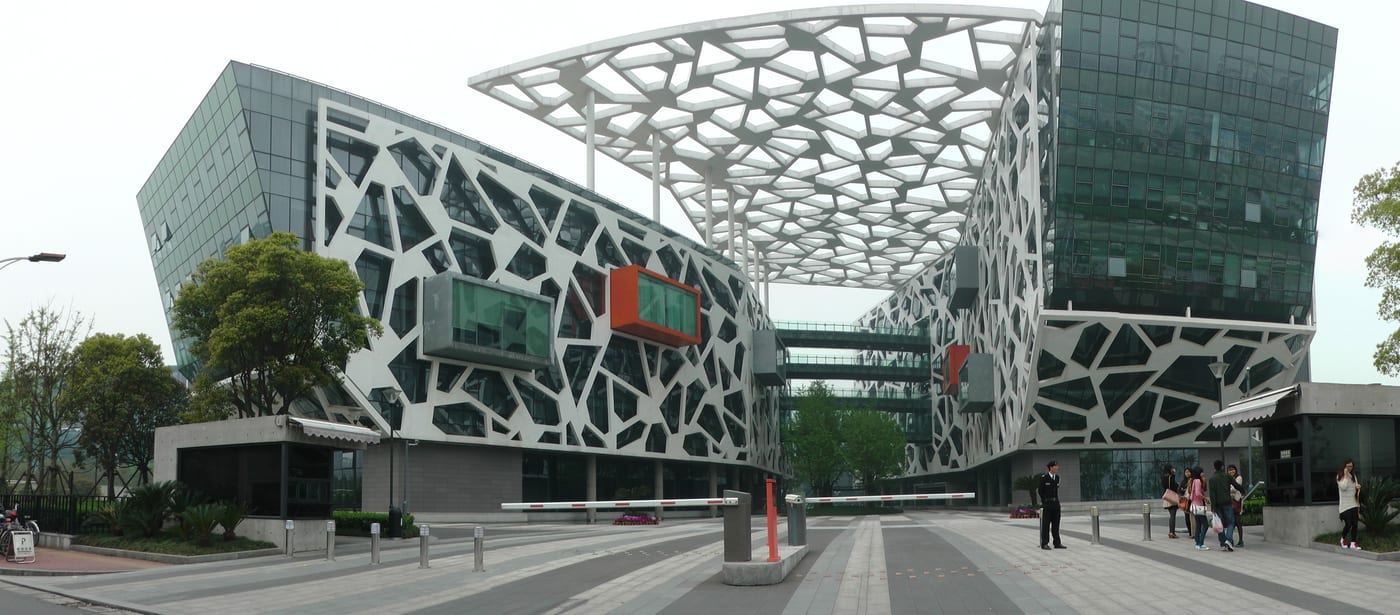
Image context: the cover is a real 2012 photograph of Alibaba Group headquarters in Hangzhou, not a model-generated illustration. It is used because this article is about Qwen's Alibaba-backed retrieval stack, and the campus photo gives the post a concrete institutional anchor without pretending to show the model itself.[6]
What changed from text embeddings
The simplest way to read Qwen3-VL-Embedding is as an expansion of the June 2025 Qwen3 text embedding line, not as a replacement for it. The earlier Qwen3-Embedding and Qwen3-Reranker models already put retrieval, classification, clustering, code search, bitext mining, instruction-aware prompts, and 0.6B/4B/8B size choices into the Qwen family.[5] Qwen3-VL keeps that retrieval grammar but changes the evidence type. Now the candidate document may be a screenshot, a video, a visual document page, text plus image, or another mixture of modalities.[1][2][3]
That changes evaluation pressure. A text embedding model can look strong while still failing when the relevant signal is visual layout, an icon, a product photo, a form field, or the frame in a video where an object appears. The arXiv report says the Qwen3-VL-Embedding model maps text, images, document images, and video into a unified representation space, while the reranker performs fine-grained relevance estimation for query-document pairs with a cross-encoder architecture and cross-attention.[2] In plainer terms: the embedding model is the fast filter; the reranker is the slower judge.
This is the most important boundary for builders. If a retrieval system only embeds everything once and trusts nearest-neighbor search, it is optimized for speed and scale but may miss precise relevance. If it reranks every possible item, it is too expensive. The two-stage contract is the compromise: vector recall gets the search space small enough, then the reranker spends attention on the candidate pairs that matter.[1][3]
How to read the benchmark tables
The Qwen materials make a clear benchmark claim, but the right reading is cautious. The Hugging Face model card reports 77.9 overall for Qwen3-VL-Embedding-8B on MMEB-V2 across image, video, and visual-document task groups, with 73.4 for the 2B model.[3] The GitHub README reports the same table shape and says the reranker family improves retrieval-stage results, with Qwen3-VL-Reranker-8B reaching 79.2 on the MMEB-V2 retrieval average and 66.7 on ViDoRe v3 in its reported reranking table.[1]
Those numbers are useful because they show where Qwen wants the evaluation boundary to sit. It is not only comparing image-text retrieval in isolation. The public table groups image classification, image question answering, image retrieval, grounding, video classification, video question answering, video retrieval, moment retrieval, visual document retrieval, and visual RAG-style datasets.[3] That breadth is the point. Qwen is making the claim that retrieval quality should be tested across the media types a real assistant might need before answering.
The caution is equally important. These are public release tables from the model publisher and its model cards, not a full independent production audit. They do not answer latency, memory, vector-store integration, security review, image preprocessing quality, OCR fallback behavior, or whether a company's private data resembles MMEB-V2, MMTEB, JinaVDR, or ViDoRe.[1][3][4] The correct conclusion is narrower: Qwen has made multimodal retrieval measurable enough to discuss as a system component, but each deployment still has to reproduce the relevant slice of the table on its own documents.
The product implication is visual memory, not prettier answers
Qwen3-VL-Embedding matters most when the downstream product needs memory over media. A support tool can retrieve screenshots that resemble the user's error state. An ecommerce assistant can search product photos, descriptions, and translated reviews in one retrieval pass. A compliance workflow can match a query against scanned pages where layout and seal placement matter. A training platform can find a video segment or slide image before asking a language model to summarize it.[1][2][3]
In that sense, this is less about making a chatbot more visually fluent than about making the retrieval layer stop throwing away visual evidence. Many current RAG systems still convert images and PDFs into text first, then search the extracted text. That approach is useful, but it makes OCR and captioning the gatekeepers. A multimodal embedding model shifts some of that burden into representation learning: visual form, text, and mixed context can be encoded before the answer generator appears.[2][3]
The reranker is the part that keeps this from becoming a loose demo story. The GitHub README describes a dual-tower embedding architecture for efficient independent encoding and a single-tower reranker that accepts query-document pairs for deeper inter-modal interaction.[1] That split is a practical design choice. The embedding side is built for scale; the reranker side is built for precision. A team that ignores the split will either overpay for ranking or under-check candidate quality.
Why it belongs in the AI-China file
AI-China coverage often overweights frontier chat models, app launches, and cloud pricing. Qwen3-VL-Embedding points to a quieter competitive layer: retrieval middleware for multimodal enterprise data. Alibaba already has Qwen, ModelScope, Model Studio, app surfaces, and cloud distribution paths. A visual retrieval family gives that ecosystem a way to make unstructured media searchable before generation, which is exactly where many enterprise workflows get stuck.[1][3][5]
The China-specific angle is not that only Chinese labs care about multimodal retrieval. They do not. The point is that Qwen is packaging the layer inside an open-weight, permissively licensed model family with Chinese and global distribution surfaces. Hugging Face makes the models visible to international developers, while the Qwen repository also points to ModelScope for domestic access.[1][3] That dual publication path fits the broader Qwen strategy: open enough for external adoption, connected enough to Alibaba's own infrastructure story.
The watch item is reproduction. If developers can take the 2B models into ordinary GPU budgets and preserve enough retrieval quality, Qwen3-VL becomes a practical visual RAG lane. If the strongest behavior concentrates in the 8B models or depends heavily on curated benchmark conditions, the release is still valuable but more like a high-end reference point. Either way, the evaluation frame has moved. For multimodal agents, the question is no longer only "can the model see?" It is "can the system find the right visual evidence before it speaks?"[1][2][3]
Sources
- QwenLM, "Qwen3-VL-Embedding & Qwen3-VL-Reranker" GitHub repository README (model list, inputs, architecture, usage, and evaluation tables).
- Mingxin Li et al., "Qwen3-VL-Embedding and Qwen3-VL-Reranker: A Unified Framework for State-of-the-Art Multimodal Retrieval and Ranking," arXiv:2601.04720, submitted January 8, 2026 and revised January 19, 2026.
- Qwen, "Qwen3-VL-Embedding-8B" Hugging Face model card (license, supported modalities, dimensions, usage examples, and MMEB-V2/MMTEB tables).
- TIGER-Lab, "MMEB-v2" Hugging Face dataset page (benchmark context for multimodal embedding evaluation).
- QwenLM, "Qwen3 Embedding" GitHub repository README (prior text embedding/reranker baseline, model sizes, 32K context, multilingual support, and MTEB tables).
- Thomas LOMBARD, "Alibaba group Headquarters.jpg," Wikimedia Commons, photographed April 14, 2012 (article image source).