A camera can show a plasma glowing inside a tokamak. Making that picture useful to the machine requires something more exact: a position, expressed in the right coordinates, delivered while there is still time to act. At China's Experimental Advanced Superconducting Tokamak, or EAST, researchers have been building that connection between seeing and steering.[1][4]
The attraction is practical. Long experiments ask instruments to remain trustworthy as the seconds accumulate. An optical measurement offers another way to check where the plasma is—and, eventually, a signal the control system can use directly.
A long pulse makes drift matter
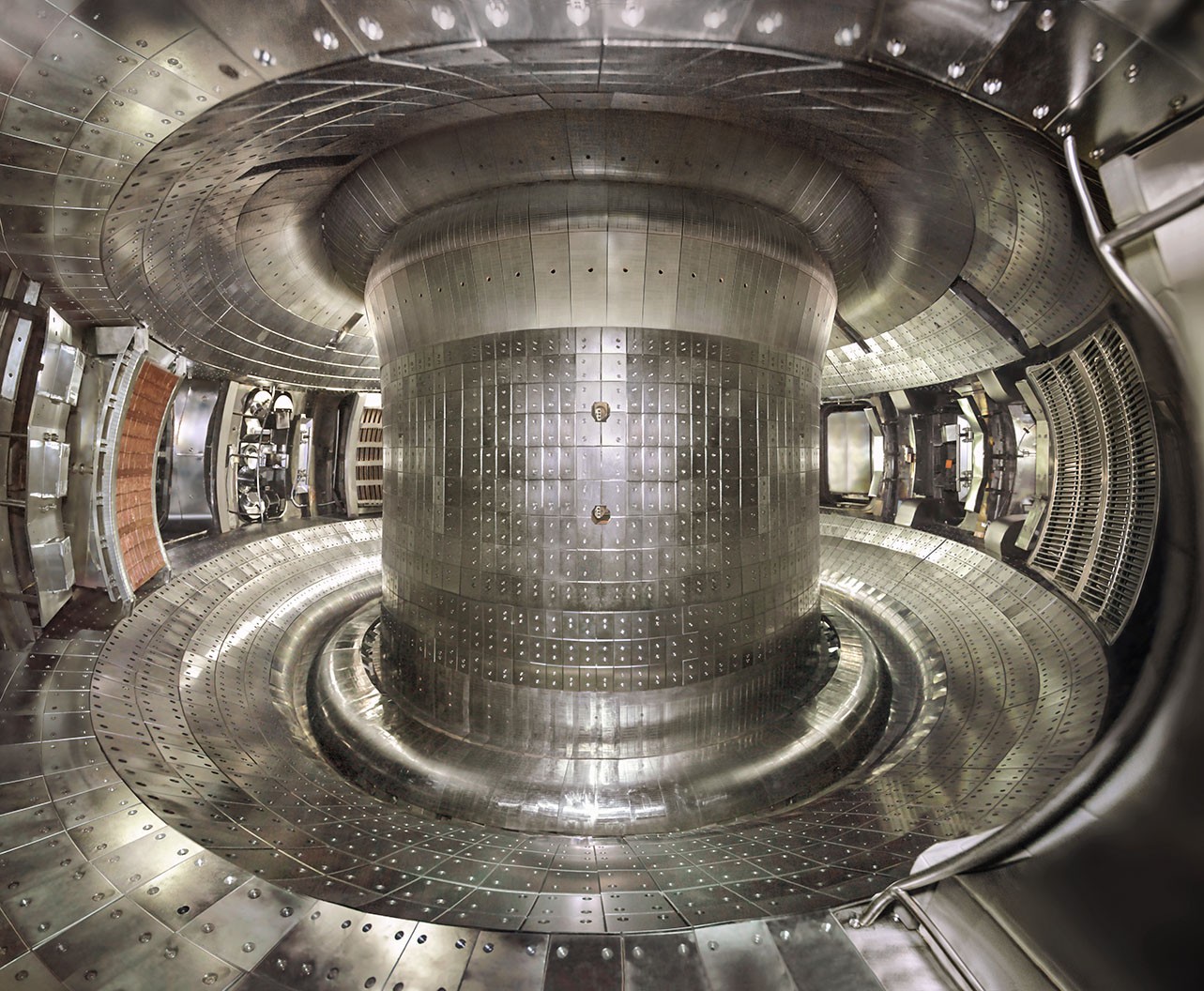
EAST sustained a high-temperature plasma for 1,056 seconds on December 30, 2021. In their subsequent account, the EAST team and ITER Science Division described the achievement as a collection of engineering and physics problems solved together. Heat had to be removed, impurities managed, current maintained and the plasma's position controlled throughout the discharge.[2]
Their account singled out a measurement difficulty: magnetic diagnostics needed electronics with very low drift. A small error that develops over time becomes consequential when the experiment lasts many minutes. That gives optical research a concrete purpose. It adds a measurement channel with different weaknesses to the instruments already watching the plasma.[2][4]
The relevant question is therefore more demanding than whether a camera produces a convincing picture. Can its output remain geometrically meaningful throughout the experiment?
Teaching a detector where to look
At an IAEA meeting in July 2024, Qirui Zhang and colleagues presented an EAST boundary detector built around YOLOv8. Their training material included different lighting conditions. They modified the network to take in more of the boundary's overall shape and to concentrate attention on useful features amid noise and obstruction.[3]
On the same test set, the reported mean intersection-over-union score rose from 0.74 to 0.79. This metric measures the overlap between predicted and reference regions. The improved recognizer took 4.3 milliseconds for one detection on a single NVIDIA 3090 GPU.[3]
Those results describe a particular recognition experiment. The timing belongs to that model and hardware; the overlap score belongs to its test images. Neither measures the full journey from camera exposure through coordinate conversion to a magnetic response. Keeping those distinctions visible makes the result more useful: it identifies a component that improved and leaves the rest of the instrument available for examination.
A pixel needs an address in the machine
A separate presentation by Ming Chen and colleagues at the same meeting described that wider reconstruction task. A camera at EAST's J port supplied visible-light images. Grayscale features helped extract the boundary; matched reference points calibrated the camera; geometric information mapped the result into a reconstructed plasma shape. The team reported real-time reconstruction and checks in EAST control experiments.[4]
This is why segmentation alone cannot finish the job. A location in an image describes where light landed on a sensor. A controller needs a location relative to the apparatus. Calibration connects those descriptions. A beautifully traced contour would still be inadequate if the conversion placed it incorrectly inside the machine.
Chen's team presented optical reconstruction as a supplement to magnetic measurement and a possible alternative. That framing leaves room for the two methods to check one another, rather than treating agreement with an attractive image as proof of accuracy.[4]
When the picture enters the loop
The institute's Chinese-language report of March 2, 2026 describes the next step. Its YOLO-GRAY method uses a learned detector to locate the luminous region, then grayscale analysis to extract the boundary more precisely. The division of labor is deliberate: recognition chooses where to look; another calculation refines the position.[1]
In the reported control demonstration, the system switched at 2.8 seconds from control-point positions calculated from the magnetic boundary to five points calculated from optical reconstruction. The institute reports stable shape control after that switch.[1]
That is a more consequential result than a higher image score: the estimate has become an input to an operating machine. It is also a specific demonstration, rather than evidence that optical sensing can handle every discharge condition. The useful next questions concern repeatability, changed camera views, and what the controller should do when the optical estimate becomes unreliable.
EAST's example gives AI a precise job inside an instrument. Its value emerges when a detected feature survives calibration and becomes a position that the rest of the machine can act on.
Sources
- Bihao Guo, Institute of Plasma Physics, Chinese Academy of Sciences, "EAST achieves a new method of shape control based on visible-light plasma boundaries," March 2, 2026 — Chinese first-hand report of YOLO-GRAY, coordinate mapping and the five-point control demonstration.
- The EAST team and ITER Science Division, "EAST demonstrates 1000-second steady-state plasma," April 4, 2022 — long-pulse operating requirements, magnetic-diagnostic drift and the archival chamber photograph.
- Qirui Zhang et al., "Plasma optical boundary detection based on instance segmentation," IAEA technical meeting, July 18, 2024 — model changes, test-set segmentation scores and GPU timing.
- Ming Chen et al., "Plasma Boundary Shape Reconstruction Using Visible Spectroscopy Diagnosis on EAST Tokamak," IAEA technical meeting, July 15, 2024 — image acquisition, camera calibration, coordinate mapping and reconstruction experiments.