As of 2026-06-11 UTC, the useful signal from Moore Threads is not simply that China has another domestic GPU vendor. The sharper signal is that the company is trying to make MUSA behave like an application migration surface: SDK packages, PyTorch backend shims, a vLLM hardware plugin, container runtime setup, and third-party inference guides are all appearing around the same hardware story.[1][2][3][4][5]
That matters because China's AI-chip bottleneck is not only chip availability. It is whether model builders can move real workloads without rewriting every assumption they inherited from CUDA. Moore Threads' own company timeline says it launched MUSA in 2022, MUSA Toolkit 1.0 and MUSIFY in 2023, the MTT S4000 LLM AI card and KUAE cluster in 2023, and then expanded KUAE from thousands to tens of thousands of GPUs in 2024.[1] Those claims should be read with the usual vendor caution, but they define the ambition: Moore Threads wants to sell a computing lane, not a board.
The field signal is therefore practical. MUSA is becoming a test of domestic runtime portability. If developers can keep PyTorch habits, serve models through familiar inference frameworks, and deploy workers through containers, Moore Threads becomes more than a procurement hedge. If every step requires bespoke repair, it remains a hardware story waiting for a software ecosystem.
The cover image follows the same evidence rule: it is a real 2025 WAIC photograph of Moore Threads signage, not a diagram, render, or generated illustration.[7]
The SDK page is more important than the slogan
Moore Threads' developer page describes MUSA SDK as a GPU parallel-computing SDK bundle with runtime, compiler, GPU acceleration libraries, migration and optimization tools, neural-network acceleration libraries, communication libraries, and related development tools.[2] That is the right shape for a CUDA alternative, but the details reveal the real constraint: support is cut by card generation, CPU platform, operating system, package format, and SDK version.
The current download list includes MUSA SDK v5.1.0 packages for MTT S5000 and MTT S4000, with combinations that mention Intel, AMD, and Hygon CPUs; Ubuntu, Alinux, openEuler, TencentOS, VesselOS, and Kylin-style environments; and both RPM and DEB packaging.[2] Older rows show community builds, MTT S80/S3000/X300 targets, and DeepSeek R1 distilled-model inference notes for selected combinations.[2] That matrix is not glamorous, but it is the work.
For enterprise teams, a domestic accelerator is deployable only when the compatibility matrix is explicit. It has to say which driver, which CPU host, which Linux distribution, which card, which container runtime, and which model-serving path have actually been exercised. The MUSA page does not prove broad parity with CUDA. It shows the vendor is publishing the kind of boring integration surface that real adoption requires.
The PyTorch signal is a backend name
The torch_musa repository is the cleanest developer-facing clue. Its README presents torch_musa as a Python extension based on PyTorch and says users can migrate by switching the backend string from cpu or cuda to musa.[3] That is a strong design claim because it locates the migration at a familiar layer: tensors, devices, kernels, and model code rather than a completely new application framework.
The claim has boundaries. A backend-name switch does not guarantee that every CUDA extension, custom operator, mixed-precision path, or distributed-training pattern will work unchanged. It does, however, describe the right target. AI teams have too much PyTorch code to treat a domestic GPU as useful if the first step is a full rewrite. The signal to watch is how much of the ecosystem can remain ordinary PyTorch while MUSA handles the device-specific work underneath.
This is also where China's domestic GPU race becomes less like a chip-spec contest and more like a software-maintenance contest. Hardware that looks acceptable on paper can still fail a buyer if model code breaks, dependencies pin to unsupported versions, or operators fall back to slow paths. The torch_musa layer is Moore Threads' attempt to make the first migration question concrete: can the model run as PyTorch with a different device target?[3]
vLLM support moves the story from notebooks to serving
The vllm-musa repository pushes the signal into production inference. It describes a vLLM hardware plugin for Moore Threads MUSA GPUs, following vLLM's hardware-pluggable architecture, and lists components including torchada for CUDA-to-MUSA compatibility, mthreads-ml-py for device management, MATE for LLM inference acceleration, and torch_musa for native MUSA device support.[4]
That combination matters because vLLM is where many open-model experiments become hosted services. A notebook backend is useful for porting. A serving plugin tests whether batching, memory management, worker lifecycle, custom operations, and model API behavior can sit inside a framework developers already know. The repository's supported-version table is narrow, naming vLLM v0.22.0, PyTorch 2.7.1, and V1 engine only support.[4] Narrow is not a failure; it is a useful boundary. It tells teams not to mistake "plugin exists" for universal compatibility.
The container layer tells the same story. GPUStack's Moore Threads guide says it supports inference on MTT S80, S3000, and S4000 devices under Linux x86_64 with Ubuntu 20.04 or 22.04, then walks through Docker setup, MUSA drivers, MT container toolkits, and a gpustack/gpustack:main-musa container.[5] That is the operational bridge domestic accelerators need: not just "the model runs," but "a worker can join an inference system with known runtime assumptions."
DeepSeek gave the stack a workload-shaped test
DeepSeek's 2025 visibility gave Chinese hardware vendors a convenient proving ground, and Moore Threads leaned into it. TechNode reported that Moore Threads deployed DeepSeek-R1-Distill-Qwen-7B inference on its domestic GPUs using an Ollama-based open-source path alongside a proprietary high-performance inference engine, with the company claiming CUDA compatibility and custom operator and memory-management improvements.[6]
The important part is not the press-claim performance. The important part is the workload shape. A distilled reasoning model is small enough to be a practical demo, but familiar enough that developers understand the expected serving loop: load weights, manage memory, stream tokens, keep latency stable, and avoid framework-specific dead ends. If MUSA can absorb that class of workload repeatedly across Qwen, DeepSeek, and other open models, it becomes a credible domestic inference lane. If it works only in curated demos, the market will notice.
The most realistic conclusion is mixed. Moore Threads has visible pieces of a portability stack: SDK releases, PyTorch backend work, vLLM integration, container guidance, and model-specific inference examples.[2][3][4][5][6] Those pieces do not yet prove ecosystem maturity. They do show where maturity will be measured.
What to watch
First, watch version lag. If torch_musa, vLLM-MUSA, MUSA SDK, and container tooling trail mainstream PyTorch and serving releases by too much, teams will face a constant choice between current model code and domestic hardware support.[2][3][4]
Second, watch operator coverage. The success condition is not a single chat demo. It is whether attention kernels, quantization paths, custom ops, multimodal preprocessors, and distributed-serving pieces keep working when models change.
Third, watch how much third-party infrastructure treats MUSA as a normal backend. GPUStack support is an early sign because it turns Moore Threads devices into scheduled workers rather than hand-managed machines.[5] More integrations of that kind would matter more than another broad "CUDA alternative" headline.
The AI-China read is straightforward. Moore Threads' competitive case will not be decided only by peak chip claims or IPO excitement. It will be decided by whether MUSA becomes ordinary enough for AI engineers to stop thinking about it. Portability is the product.
Sources
- Moore Threads, "About Us" (company timeline, MUSA launch, MUSA Toolkit, MTT S4000, KUAE cluster, and product scope).
- Moore Threads Developer Center, "MUSA SDK" (SDK components, package versions, supported MTT cards, CPU/OS combinations, and DeepSeek R1 distilled-model notes).
- MooreThreads, "torch_musa" GitHub repository README (PyTorch backend, migration claim, backend string behavior, and license note).
- MooreThreads, "vllm-musa" GitHub repository README (vLLM hardware plugin, component stack, supported vLLM/PyTorch versions, and environment variables).
- GPUStack, "Running Inference with Moore Threads GPUs" (supported devices, Ubuntu/x86_64 assumptions, Docker/runtime setup, and GPUStack worker container path).
- TechNode, "Moore Threads deploys DeepSeek distilled model for high-performance AI inference on domestic GPUs" (February 6, 2025; DeepSeek-R1-Distill-Qwen-7B deployment report and dual-engine framing).
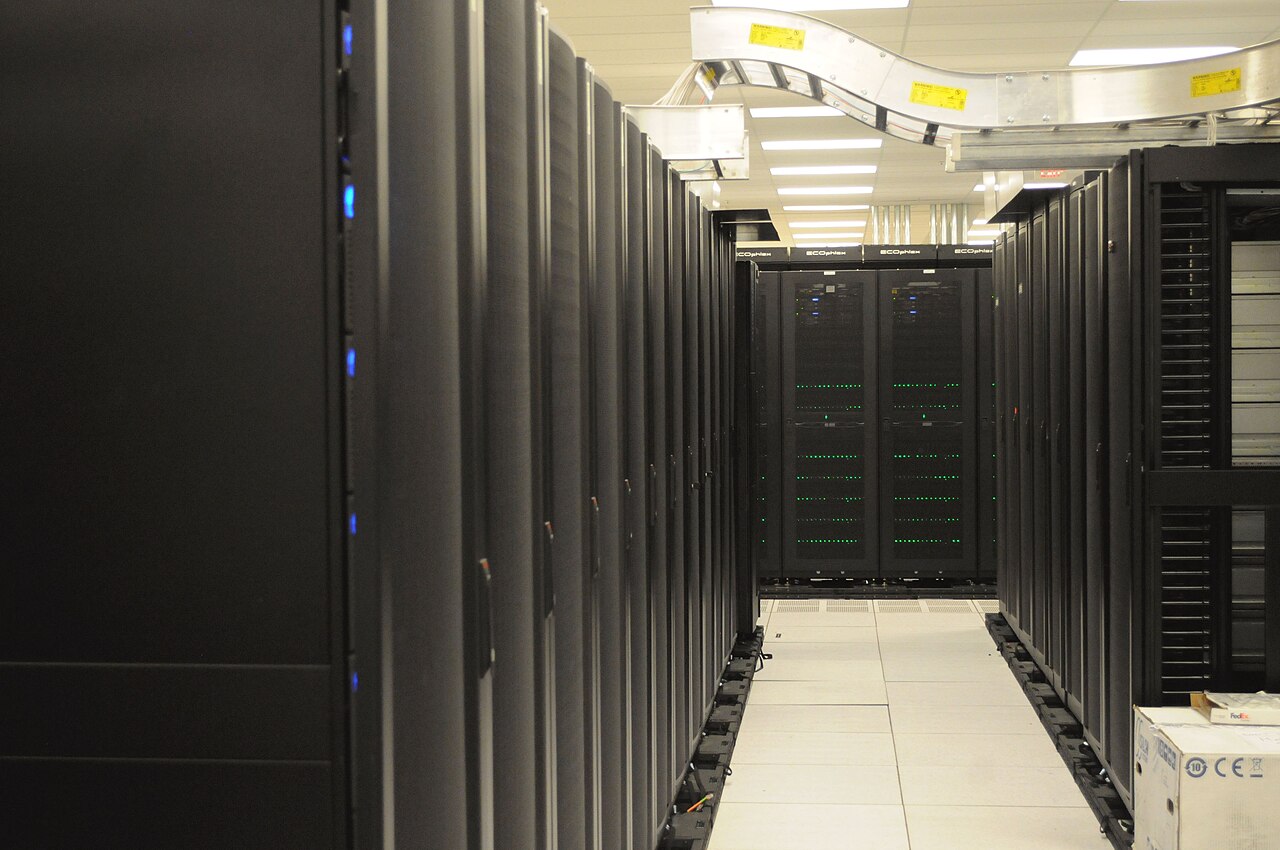
- Wikimedia Commons, "Front of server racks at NERSC.jpg" - real 2011 data-center rack photograph by Derrick Coetzee used as the article image source.