A photograph of a shopping street can be easy to describe and difficult to read. Buildings, pedestrians, signs: the scene announces itself. Ask which shop a distant sign belongs to, however, and the useful answer may depend on a handful of characters squeezed between a window and an awning. A fluent description can leave the actual question untouched.
MME-RealWorld makes that gap an evaluation problem. Introduced in August 2024 by a team including researchers at the Chinese Academy of Sciences' Institute of Automation and Nanjing University, it assembled 13,366 images averaging roughly 2,000 by 1,500 pixels. Human annotators produced 29,429 question-answer pairs across five domains, from street text to remote sensing and driving scenes.[1] The change in emphasis was consequential: the small detail could become the main event.
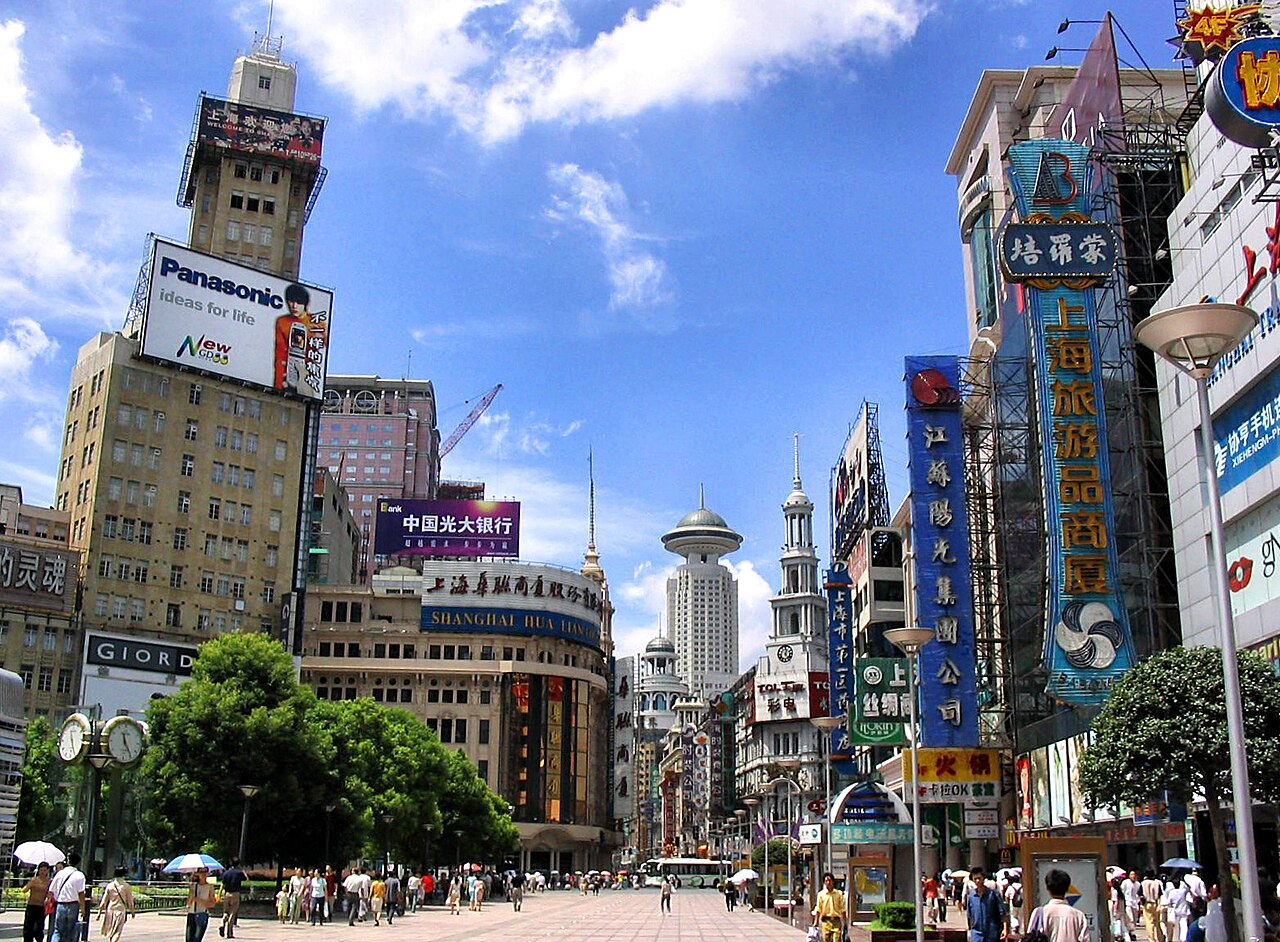
A Chinese test needs Chinese scenes
The benchmark's Chinese edition contains 5,917 question-answer pairs. It combines translated questions about selected monitoring, driving and remote-sensing images without English information with newly collected Chinese text, chart and table images. Those additions receive their own annotations.[1]
That is a substantive choice about what language competence means. Imagine translating a question about an English shopfront into Chinese. The instruction changes language; the sign still asks the model to read English. A locally collected image can instead put Chinese writing, visual conventions and surroundings into the same task.
There is a corresponding limit on interpretation. Because the Chinese and English sets are not merely paired translations of identical images, their score difference cannot isolate a language effect. The visual material changes too. For a reader comparing models, this makes the Chinese set valuable as its own test environment. It does not make it a controlled experiment in what happens when only the question's language changes.
The file is only the beginning of what a model sees
High resolution in a dataset does not guarantee that every evaluated system receives the same usable detail. Qwen's Chinese-language Qwen2-VL announcement, dated August 29, 2024, describes dynamic resolution: different image sizes become different numbers of visual tokens, the representations passed onward for processing. Its accompanying usage example exposes min_pixels and max_pixels settings to balance image input against speed and memory.[3]
Consider two runs using the same photograph and the same model weights. If one run reduces the picture more aggressively, a distant character may be harder to distinguish. A score change then has an additional possible explanation: the model received different visual evidence. It would be premature to attribute the entire change to reasoning.
This is why an informative evaluation report should preserve the image-processing settings alongside the model version. Pixel limits, resizing and crop policies belong with the prompt and dataset split. These details explain which task was actually attempted.
FALCON, a 2025 study from Harbin Institute of Technology, Shenzhen, and Huawei's Noah's Ark Lab, identifies another complication. Dividing a large image into separately encoded crops can create redundant visual tokens while splitting meaningful objects across boundaries. Its proposed visual registers compress information, while an interaction mechanism exchanges information between crops. The paper evaluates the approach on MME-RealWorld among its high-resolution tests.[4]
The engineering implication is broader than a contest over image size. Seeing a sign clearly and connecting it to the right doorway are related obligations. Keeping more local detail helps only if the system can still relate that detail to its surroundings. FALCON's design addresses that relationship; its reported results should be read within the paper's specific configurations, rather than as a general guarantee for every high-resolution workload.
A shorter test changes the balance
The official repository records the arrival of a Lite version on November 14, 2024. It takes 50 samples per task, or all available samples when fewer than 50 exist, to accelerate evaluation. The repository also publishes a common multiple-choice prompt asking for a single answer letter.[2]
Both details affect how to read a result. Lite reduces the work needed for a run, but sampling by task changes the composition relative to a full set whose tasks contain different numbers of questions. An overall percentage from one should not silently replace an overall percentage from the other. The prompt also defines a constrained recognition-and-selection task: a correct letter does not demonstrate that the model can produce a complete, accurate account of the scene without answer choices.
The paper distinguishes sample-weighted accuracy from class-based averages, which give subtasks equal weight within a domain.[1] In practical terms, one view asks how often the model succeeds across the supplied questions; the other prevents a large subtask from dominating simply because it contains more questions. Neither weighting answers every user's needs.
What progress would look like
My reading of these sources is that the strongest evidence would combine improving task scores with a clear account of the visual information and computation used to obtain them. Hold the test split and prompt steady; disclose the image settings; then examine where errors disappear. Better reading of small signs, better counting and better spatial relationships are different achievements.
For a particular application, the useful next step is to inspect its closest task category and several failures, rather than select a model from the aggregate alone. A shop-sign assistant and an aerial-image counter can care about different weaknesses in the same system. MME-RealWorld gives those weaknesses somewhere to show up. Its enduring contribution is to keep the question attached to the details in the picture.
Sources
- Yi-Fan Zhang et al., “MME-RealWorld: Could Your Multimodal LLM Challenge High-Resolution Real-World Scenarios that are Difficult for Humans?” Version 3; dataset construction, Chinese edition and scoring definitions.
- MME-Benchmarks, official MME-RealWorld repository; dated release history, Lite sampling rule and evaluation prompt. Accessed November 17, 2026.
- Qwen Team, “Qwen2-VL: To See the World More Clearly,” August 29, 2024; original Chinese-language announcement, dynamic resolution and image-input settings.
- Renshan Zhang et al., “FALCON: Resolving Visual Redundancy and Fragmentation in High-resolution Multimodal Large Language Models via Visual Registers,” ICCV 2025; architecture and MME-RealWorld evaluation.
- Agnieszka Bojczuk, “Shanghai – Nanjing Road,” photograph, August 2003; Wikimedia Commons file record and attribution.