MiniMax M3 has two defensible product release dates, with a technical paper arriving between them, and that sequence explains the product.
On June 1, 2026, MiniMax made M3 available through MiniMax Code, its Token Plan, and its API. The launch called the model open-weight, then closed by promising the technical report and corresponding weights within ten days.[1] The MiniMax Sparse Attention paper appeared on June 11.[4] On June 12, the public model repository's initial commit made the configuration, code, license, and downloadable checkpoint available.[2]
As of 2026-08-08T11:39:48Z UTC, both versions of the release are real. A customer can buy the managed model. An operator can inspect and host the artifact. But those are not the same kind of access, and M3 makes the difference unusually easy to measure.
The service-first launch showed MiniMax's distribution strategy. The later artifact exposed the engineering bet underneath it: native text-image-video training, a million-token context window, and a sparse-attention mechanism designed to stop long context from becoming quadratic punishment. What arrived was not simply M2.7 with a larger score. It was a model, an attention operator, a large checkpoint, a custom commercial contract, and a set of preferred serving systems released as one package.
The model update is really an attention update
M3 has about 428 billion total parameters, with public materials placing the active path at roughly 22–23 billion parameters per token. It accepts text, images, and video, and MiniMax says those modalities were mixed from the beginning of training rather than attached in a late adaptation stage.[2][5]
Its defining change is MiniMax Sparse Attention, or MSA. Standard full attention compares each query across an expanding field of keys, so cost grows sharply with sequence length. MSA inserts an index branch first. That lightweight branch scores blocks of the key-value cache for each grouped-query-attention group; the main branch then performs exact attention only over the selected blocks, always retaining the local block.[4]
That design turns a million-token window into a retrieval problem inside the model. The main branch can calculate exact attention over what the index chose, but it cannot recover a relevant block the index failed to admit. Context capacity therefore does not equal dependable recall. The useful question is not only whether M3 accepts one million tokens, but how its block selector behaves when the decisive evidence is rare, duplicated, contradicted, or separated from the query by hundreds of thousands of distracting tokens.
The speed claims need their test rigs attached. MiniMax's M3 launch reports one-twentieth the per-token compute of M2 at one million tokens, with more than 9× faster prefill and 15× faster decoding.[1] The MSA paper reports a different experiment: on a 109-billion-parameter multimodal model, attention compute fell 28.4×, while an H800 kernel test showed 14.2× prefill and 7.6× decode wall-clock speedups.[4] Those figures are not interchangeable. They involve different models, baselines, and measurement layers. Together they show that MiniMax has an architecture-plus-kernel result; they do not promise the same multiplier for every server, batch size, context distribution, or runtime.
Open weights do not make a lightweight object
The checkpoint gives outsiders something concrete to inspect. The current Hugging Face listing contains 59 safetensors shards. Adding the listed file sizes produces 854.18 GB, and the repository identifies BF16 and F32 tensor types.[2] That is before an operator budgets runtime state, key-value cache, temporary memory, redundancy, or the storage needed for another precision.
Mixture-of-experts activation helps explain why a model with roughly 428 billion stored parameters may compute with only about 23 billion at each token. It does not make the other experts vanish. The full collection still has to be stored and made reachable when routing selects it. Sparse compute is not sparse possession.
MiniMax's model card points to SGLang, vLLM, Transformers, KTransformers, Unsloth, and other serving or quantization paths.[2] NVIDIA's deployment note gives the hardware side of the same story: 128 experts, four selected per token, BF16 and MXFP8 formats, and a performance route centered on Blackwell, Dynamo, TensorRT-LLM, SGLang, and vLLM.[5] That support is valuable, but it also clarifies the audience. M3's public weights widen who can audit and adapt the model; serious full-context serving still belongs to teams that can engineer memory placement, parallelism, cache behavior, and low-precision execution.
The license adds another layer. M3 is downloadable under the MiniMax Community License, not a standard permissive software license. Commercial products must display “Built with MiniMax M3.” A product or service with $20 million or less in yearly revenue must send MiniMax a one-time notice; above that threshold it must obtain prior written authorization. The license also includes prohibited-use terms.[3]
The precise label is therefore open-weight under a custom license. The release enables local inspection and broad non-commercial use, and it creates a route for commercial use. It does not grant permission without conditions. Teams evaluating M3 need to review the license separately from the model's technical fitness.
The benchmark table comes with brackets
MiniMax reports 59.0% on SWE-Bench Pro and 66.0% on Terminal-Bench 2.1.[1] Those are useful signals only with the launch page's methodology attached.
SWE-Bench Pro was run on MiniMax infrastructure using Claude Code as the scaffold. Terminal-Bench used an 8-vCPU, 16-GB sandbox, a two-hour timeout, Terminus 2, and a maximum output length of 128,000 tokens. Some comparison scores came from the official leaderboard while other models were run through APIs on MiniMax's infrastructure.[1] A developer changing the agent harness, tool policy, timeout, prompt, or repository environment is changing the evaluation.
The multimodal comparisons are bounded too. For Video-MME, MiniMax sampled video at one frame per second, allowed M3 as many as 1,024 frames, inserted subtitles every 30 seconds, and used different output-token and temperature settings for M3 and external models. The page explicitly notes a 640-frame external API limit in that comparison.[1] This does not invalidate the result. It means the table partly evaluates product envelopes as well as raw model behavior.
The launch's most vivid demonstrations—a nearly 12-hour paper-reproduction run, 18 commits, and 23 experimental figures—are company-run case studies.[1] They show what MiniMax wants M3 to do: remain useful after a task has accumulated dense tool traces and many rounds of revision. Without a public trajectory, environment snapshot, and rerunnable harness, they are invitations to reproduce, not independent proof.
Service first is a business decision
On June 1, the easiest M3 path was deliberately managed. MiniMax Code, the Token Plan, and the API were live while the weights and report were still promised follow-ups. The API itself prices inputs above 512,000 tokens at a higher long-context rate and offers switchable thinking modes plus standard and priority service tiers.[1] Even before the checkpoint landed, the commercial surface treated extreme context as a separate operating class.
The later weight release does not undermine that service. It makes the service legible. Customers can see the model scale, attention mechanism, checkpoint shape, supported runtimes, and licensing terms before deciding whether to rent the result or own the machinery. Hardware and inference partners can optimize against a real artifact rather than a private endpoint. Researchers can test whether MSA's selector preserves the evidence their workloads depend on.
Three receipts would make the release much easier to judge. First, independent long-context curves should report task quality and retrieval failures at 32K, 128K, 512K, and one million tokens instead of treating the largest accepted input as the result. Second, serving reports should publish hardware counts, precision, batch sizes, cache policy, prefill and decode latency, and total cost for the public checkpoint. Third, MiniMax should follow through on its stated plan to open-source MiniMax Code, whose current harness is described as being built on OpenCode and Pi.[1] That would let evaluators separate model behavior from the managed agent around it.
M3 arrived first as something to use and then as something to examine. The first release proved MiniMax could distribute a new frontier product quickly. The second made its central claim falsifiable: million-token multimodal work can be made practical through block selection, kernel design, and system co-design.
That is more valuable than another context-window badge. It is also a larger obligation. Once the weights are public, the question is no longer whether M3 exists. It is whether its attention choices, deployment bill, evaluation results, and license still make sense when the whole system leaves MiniMax's hands.
Sources
- MiniMax, “MiniMax M3: Frontier Coding, 1M Context, Native Multimodality—All in One Model” (June 1, 2026; official launch, product availability, architecture claims, API packaging, benchmark results, and evaluation settings).
- MiniMaxAI,
MiniMax-M3model repository on Hugging Face (public model card, configuration, checkpoint shards, supported inference paths, and artifact metadata). - MiniMaxAI, “MiniMax Community License” for M3 (official license text; non-commercial grant, commercial attribution and notice/authorization thresholds, and prohibited uses).
- Xunhao Lai et al., “MiniMax Sparse Attention,” arXiv:2606.13392 (June 2026; index-branch design, training method, compute analysis, H800 kernel tests, and evaluation scope).
- NVIDIA Technical Blog, “Deploy Long-Context Reasoning and Agentic Workflows with MiniMax M3 on NVIDIA Accelerated Infrastructure” (June 12, 2026; model specifications and partner deployment stack).
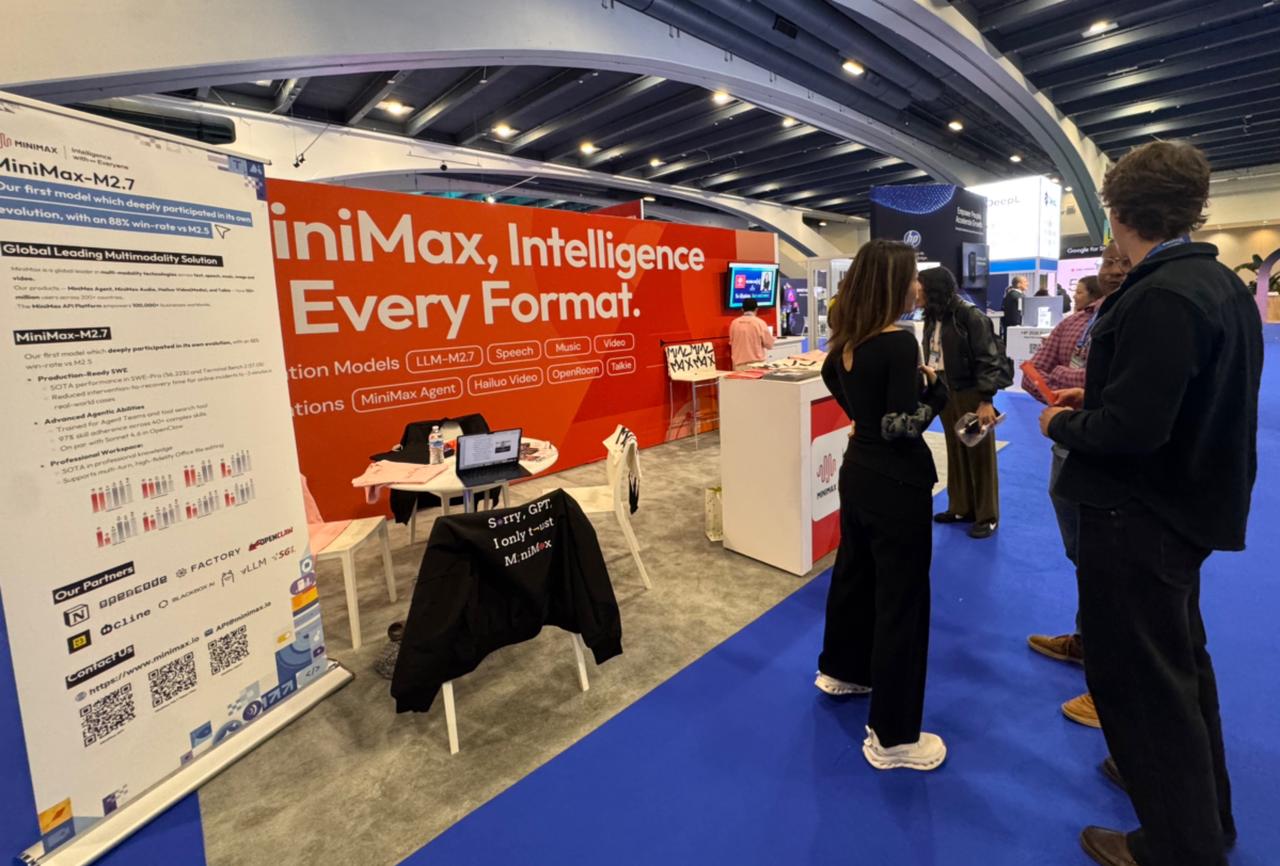
- MiniMax, “MiniMax at HumanX 2026” (April 15, 2026; official event report and source page for the photograph of MiniMax's M2.7-era conference booth).