As of 2026-05-15 UTC, the useful way to read MindSpore Transformers is not as a generic alternative to PyTorch tooling and not as a documentation footnote beneath Huawei's Ascend chips. The sharper ai-china signal is that it is becoming Huawei's Ascend-native large-model workbench: one lane for pre-training, fine-tuning, inference, service deployment, configuration, monitoring, and hardware-aware optimization.[1][2] That matters because the bottleneck in China's AI stack is no longer only access to accelerators. It is whether those accelerators come with software paths that developers can repeat without treating every project as a porting exercise.
The official docs make the ambition unusually explicit. MindSpore describes the Transformers suite as a full-process development environment for large model pre-training, fine-tuning, inference, and deployment, covering both large language models and multimodal models.[1] The same page emphasizes one-click single-card or multi-card workflows, hybrid parallel capability, system-level optimization for training and inference, configurable task components, and real-time monitoring of accuracy and performance.[1] In plainer engineering terms, Huawei is trying to package the boring middle of model work: not just "run on Ascend," but prepare, train, adapt, serve, watch, and recover on an Ascend-shaped stack.
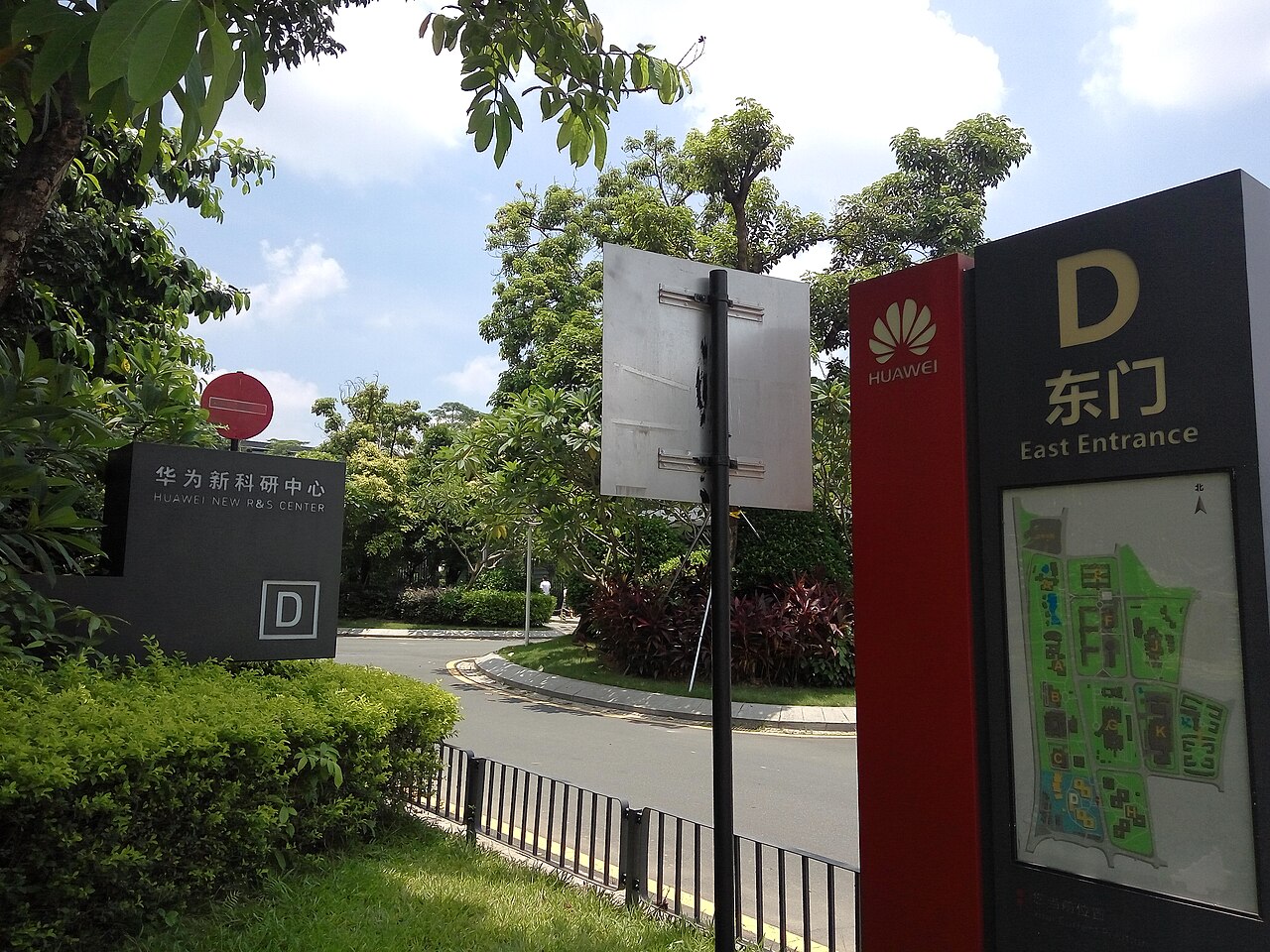
Image context: the cover uses a real Wikimedia Commons photograph of Huawei's Shenzhen Bantian base. It is not a photograph of a model card or benchmark chart. That is intentional. This piece is about the institutional software stack behind domestic AI compute, where campus, chips, framework, and deployment tooling are part of the same supply-chain story.[5]
The stack is trying to remove the exception path
The architectural page gives the clearest map. MindSpore Transformers says it supports Ascend's proprietary technology stack while also embracing open-source communities such as Modelers and Hugging Face.[2] Its southbound layer is based on MindSpore plus Ascend, using CANN to optimize compatibility and performance on Ascend hardware.[2] That sentence is the strategic center of the stack. Huawei is not only asking developers to accept a different chip. It is building a vertical lane in which framework, compiler/runtime layer, model library, and deployment path are meant to line up.
That is why the module list matters. The suite includes unified training and inference scheduling through msrun_launcher.sh, a registration and configuration layer, a large-model library, dataset interfaces, training components, utility tools for preprocessing and Hugging Face weight conversion, and high-availability support for fault diagnosis and monitoring.[2] None of those pieces is glamorous alone. Together, they attack the exact weakness that can make domestic hardware adoption fragile: the moment when a team discovers that the model works in principle but the surrounding training, conversion, monitoring, and serving steps are still bespoke.
My inference from these primary materials is that MindSpore Transformers is trying to change the status of Ascend from "special backend" to "default lane" for teams already inside Huawei's ecosystem. The difference is practical. A special backend needs exceptions, patches, compatibility warnings, and experts nearby. A default lane needs recipes, launch scripts, dataset adapters, weight conversion, and service deployment that ordinary platform teams can own.[1][2]
Compatibility is not surrender; it is supply-chain policy
The strongest detail in the docs is the deliberate compatibility language. MindSpore Transformers supports Hugging Face tokenizer use, Hugging Face model configuration loading, native Safetensors weight loading, and Hugging Face SFT datasets for fine-tuning.[1][2] It also says the suite can integrate into third-party training platforms, service components such as vLLM, and open-source communities including Hugging Face.[2] That is not a minor bridge for convenience. It is a supply-chain policy.
China's AI ecosystem cannot afford a purity strategy where every domestic accelerator requires a domestic-only toolchain with no clean contact surface to the wider model world. Qwen, DeepSeek, Hunyuan, GLM, InternVL, MiniCPM, and other model families already circulate through Hugging Face, ModelScope, GitHub, Gitee, and managed cloud APIs. If an Ascend-native lane cannot ingest common formats, tokenizers, datasets, and deployment habits, it becomes a defensive island. MindSpore Transformers is trying to avoid that trap by coupling tightly downward to Ascend and CANN while staying porous upward to model and data formats developers already use.[1][2]
That posture is different from simply chasing CUDA compatibility. The point is not to pretend the hardware boundary disappears. The point is to make the boundary operationally legible. If a team can convert weights, load familiar datasets, manage configuration through YAML, choose parallel strategies, and use a documented service deployment path, then the Ascend decision becomes a platform decision rather than a one-off porting bet.[1][2][3]
The model-work evidence is beginning to matter
The public validation layer is still narrower than Huawei would like, but it is no longer theoretical. Global Times reported in January 2026 that Zhipu AI's GLM-Image was open-sourced after being trained end to end on Huawei Ascend Atlas 800T A2 hardware and running on the MindSpore framework.[4] The report quotes Zhipu's account that the collaboration covered data preparation, large-scale training, and inference adaptation, with debugging and optimization support from Huawei.[4]
That source should be read carefully. It is not an independent benchmark audit, and it should not be treated as proof that every large multimodal training workload can now move to Ascend without friction. Its value is narrower and still important: it shows a visible Chinese model developer using the domestic hardware-and-framework lane for a serious multimodal release, then describing the process as a full-pipeline validation rather than a toy demonstration.[4]
That distinction is exactly where MindSpore Transformers fits. The suite's own documentation is full of the components that turn a chip claim into a model-work claim: multi-dimensional parallelism, data loading, optimizer and training wrappers, checkpoint and Safetensors handling, model construction, inference, deployment, and monitoring.[1][2] GLM-Image gives that stack a public case where the story is not only "Huawei has chips" but "a model team ran the pipeline."
The risk is ecosystem gravity, not feature count
The open question is whether the lane becomes broad enough to pull developer habit. MindSpore Transformers can list training, fine-tuning, inference, deployment, monitoring, Hugging Face compatibility, and CANN integration, but feature count alone does not create ecosystem gravity.[1][2] Gravity comes when model releases publish Ascend recipes early, when inference stacks support the path without delay, when debugging knowledge becomes searchable, and when teams can hire engineers who already know the workflow.
That is where Huawei's stack still faces a hard comparison. CUDA's advantage is not only performance; it is the accumulated memory of examples, libraries, bug reports, scripts, and operator habits. MindSpore Transformers is trying to compress some of that accumulation by packaging more of the large-model lifecycle inside one suite. The strategy is coherent, but it has to keep proving itself in model after model, not only in framework documentation.
The useful watch item is therefore not whether MindSpore Transformers gains another feature page. It is whether more Chinese model artifacts start to treat Ascend-native support as a launch condition rather than a later adaptation. If new releases arrive with clear MindSpore Transformers paths, CANN-version expectations, conversion notes, service templates, and failure-mode documentation, Huawei's stack becomes more than a sovereign-compute talking point. It becomes a real operating lane.
For now, the signal is strong enough to track. MindSpore Transformers matters in AI-China because it shows the software shape required for domestic accelerators to matter at scale. Chips without a repeatable model lifecycle are procurement. Chips plus a documented training, inference, deployment, compatibility, and recovery path are infrastructure.[1][2][4]
Sources
- MindSpore, "MindSpore Transformers Documentation" (suite scope across pre-training, fine-tuning, inference, deployment, hybrid parallelism, monitoring, configuration, Hugging Face compatibility, and service deployment links).
- MindSpore, "Overall Structure" for MindSpore Transformers 1.8.0 (Ascend/CANN southbound layer, modules, scheduling, large-model library, dataset support, Hugging Face integration, and high-availability features).
- Gitee,
mindspore/mindformersrepository (source repository for the MindSpore Transformers suite and its Chinese open-source project surface). - Global Times, "Zhipu AI open-sources advanced multimodal model trained on Huawei Ascend chips" (January 2026 report on GLM-Image, Ascend Atlas 800T A2, MindSpore, and full-pipeline adaptation).
- Wikimedia Commons, "File:Zone D of Huawei Shenzhen Base.jpg" (source page for the real 2019 photograph of Huawei's Shenzhen Bantian base used as the article image).