As of 2026-07-02T10:35:04Z UTC, the useful AI-China signal in the low-altitude economy is not simply that China wants more drones, cargo aircraft, and eVTOLs in the sky. The sharper market read is that low-altitude activity is becoming a workflow layer: regulated airspace access, registered vehicles, automated docks, cloud dispatch, multimodal inspection, data governance, and industry-specific models are being wired together around repetitive physical tasks.[1][3][5]
That distinction matters because "drone race" is too hardware-heavy. A drone can fly; a low-altitude AI business has to decide where it may fly, what mission it runs, how images become decisions, how exceptions are escalated, and how the result enters a city, utility, construction, public-safety, logistics, or civil-aviation workflow. The market will reward airframes, but the compounding value sits in the operating loop.
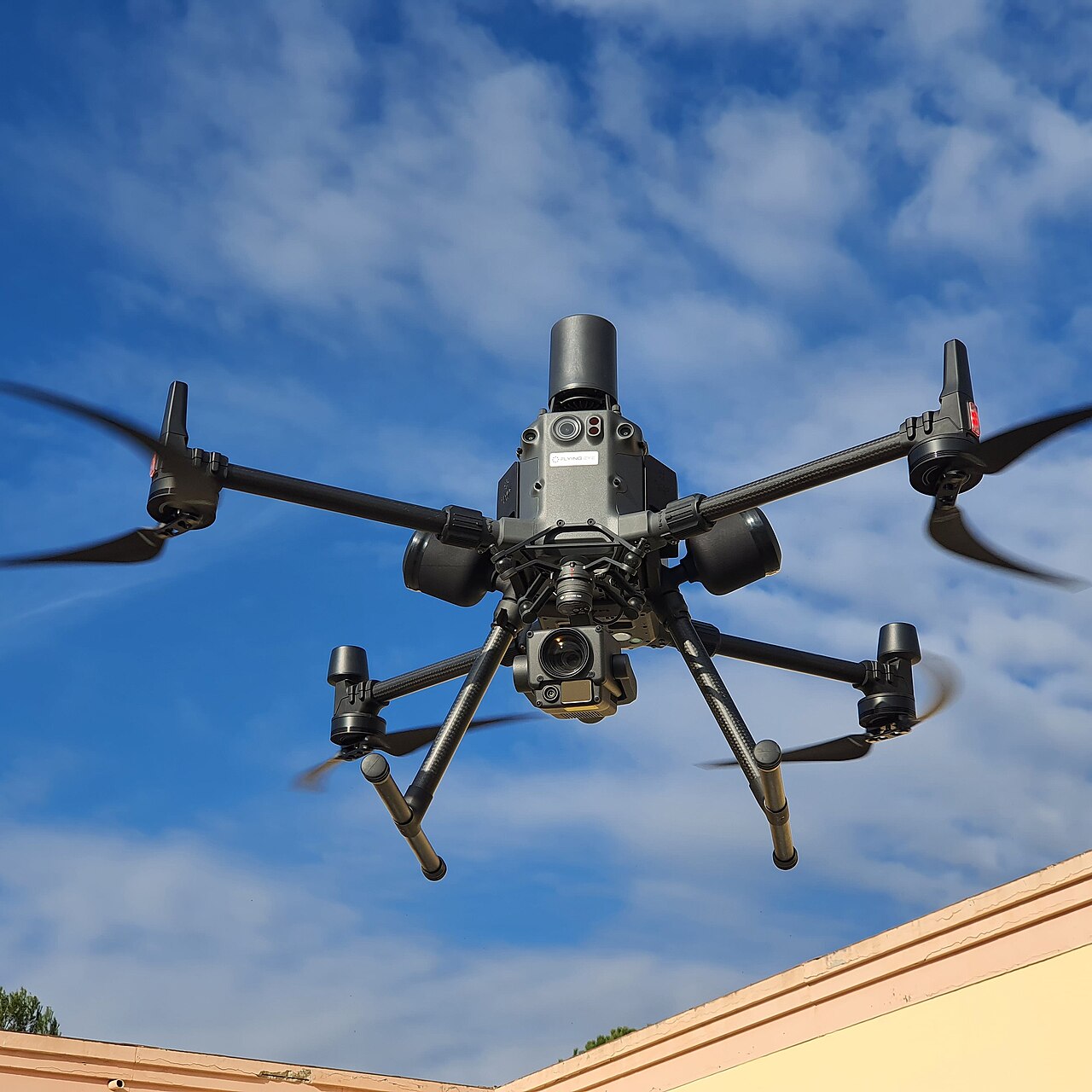
Image context: the cover uses a real Wikimedia Commons photograph of a DJI Matrice 300 RTK in flight.[7] It is deliberately a physical enterprise drone rather than a diagram, AI concept image, or dashboard screenshot. The article's argument depends on low-altitude AI being read as an applied operating surface: aircraft plus sensors plus dispatch plus data plus regulation.
The policy floor is already operational
China's civil-aviation regulator has been unusually explicit about the foundation. A January 2025 Civil Aviation Administration of China essay described low-altitude economy as a strategic emerging industry and placed it inside a practical list of inspection, emergency rescue, city patrol, forest fire prevention, medical aid, logistics, tourism, mapping, communications relay, and border-support scenarios.[1] That is not a speculative consumer gadget market. It is a set of repeatable field jobs.
The scale markers are already large enough to change the analysis. CAAC said that by the end of November 2024, China had 744 general-aviation enterprises, 3,226 registered general-aviation aircraft, 470 general airports, nearly 19,000 drone operating enterprises, and 2.158 million registered domestic drones. From January through November 2024, traditional general-aviation flying reached 1.23 million hours, while drone flying reached 25.449 million hours, up 15.3 percent year over year.[1]
Those numbers do not prove profitability or safety at scale. They do prove that the market is past the toy-demo stage. A sector with millions of registered drones and tens of millions of flight hours will not be managed by pilots, spreadsheets, and one-off permission calls alone. It needs airspace-service systems, data standards, vehicle identity, mission planning, weather feeds, safety monitoring, and software that turns flight into a managed job.
Airspace service is the hidden control plane
The underappreciated layer is not the aircraft. It is flight service. In an April 2024 CAAC piece on low-altitude flight service support, the regulator said China had built a national information management system, regional information-processing systems, and 32 flight service stations by the end of 2023, with a civil unmanned-aircraft integrated management platform covering real-name registration, suitable-airspace lookup, and flight-activity applications.[2]
The same document gives a small but important operating detail: routine general-aviation flight applications had moved from a prior-day submission and same-night approval rhythm to a process where routine applications could be submitted four hours before takeoff and approved two hours before takeoff, with emergency and disaster-relief missions handled as they arise.[2] That is where the macro story becomes concrete. Faster approval does not merely reduce paperwork. It changes which missions can become services.
For AI companies, that means the low-altitude market is partly a routing market. Better models matter, but they sit inside a larger decision path: can the mission be filed, approved, deconflicted, flown, monitored, and converted into useful data quickly enough that the customer stops thinking of the drone as a special event? The winners may look less like aircraft sellers and more like workflow operators.
AI enters where flight becomes data
The clearest official AI bridge is CAAC's December 2025 implementation opinion on "AI + civil aviation." The document calls for high-quality datasets across airlines, airports, air traffic management, regulation, logistics, airspace-resource management, and integrated transport optimization. It also calls for text, image, and video corpora and knowledge bases for industry large models, civil-aviation computing infrastructure, industry model testing platforms, and decision agents built from civil-aviation rules, operations manuals, incident cases, and weather intelligence.[3]
That is a very specific signal. It suggests that low-altitude AI is not only computer vision on a flying camera. It is domain adaptation: aviation rules, weather, flight plans, inspection images, logistics constraints, safety events, and local operating procedures all become model context. The value is not in saying "AI drone" but in closing the loop between flight, evidence, and action.
DJI's enterprise stack shows the commercial version of the same move. Dock 3 is presented as a 24/7 remote-operation system for Matrice 4D and 4TD drones, with vehicle-mounted deployment and integration with FlightHub 2.[4] FlightHub 2 is framed as a cloud-based drone operations platform for remote control, intelligent flight scheduling, route management, and third-party integration. DJI also says the platform is powered by advanced AI and a multimodal large language model, with an AI agent aimed at AEC workflows and visual oversight across public safety, emergency response, geospatial mapping, and inspections.[5]
Read together, the official policy and product language point to the same stack: airspace permission, drone station, mission scheduler, payload data, AI interpretation, and downstream workflow. The model is not the whole product. It is one processor inside an operational chain.
The macro prize is bigger than delivery
The easiest public story is package delivery or passenger eVTOLs, because they photograph well. The broader market is duller and probably more durable: power-line inspection, bridge inspection, construction progress, emergency command, flood observation, forest fire patrol, agricultural spraying, cadastral survey, port monitoring, and municipal response. These are recurring jobs with measurable outputs.
The National Development and Reform Commission's expert page gives the macro frame. It notes that 5G-A, artificial intelligence, satellite communications, BeiDou navigation, big data, and related technologies are being applied to low-altitude infrastructure, with more than 300 Chinese cities starting 5G-A deployments and some exploring low-altitude intelligent networks.[6] It also reports that China's low-altitude economy reached 505.95 billion yuan in 2023, up 33.8 percent, and cites CAAC projections of 1.5 trillion yuan by 2025 and 3.5 trillion yuan by 2035.[6]
Those figures should be treated as directional market framing, not a guaranteed revenue curve. The real question is where revenue becomes repeatable. A drone sold once is hardware revenue. A grid-inspection workflow that flies every week, flags defects, generates work orders, keeps audit trails, and improves over time is software, services, and data revenue layered over hardware. That is the AI-China angle worth watching.
The counterweight is safety and fragmented responsibility
The bullish case has a hard limit: low-altitude AI runs in public space. A language-model failure can produce a bad paragraph. A flight-system failure can create airspace conflict, injury, property damage, privacy violations, or emergency-response confusion. CAAC's January 2025 essay repeatedly frames safety as the foundation of low-altitude development and names regulatory, service, infrastructure, market-access, and supervision work as necessary conditions.[1]
Responsibility is also fragmented. The aircraft maker may not own the flight service station. The cloud scheduler may not own local weather data. The inspection algorithm may not own the final maintenance decision. A city may want low-altitude coverage but lack unified standards for data retention, emergency priority, noise, privacy, or route design. That is why the industry will not mature only through better drones. It needs boring governance: IDs, logs, approvals, geofencing, incident reporting, operator qualification, and clear handoffs between model output and human accountability.
What to watch
The first watch item is whether DJI-style dock-and-cloud operations become normal outside showcase deployments. Vehicle-mounted Dock 3 matters because it turns drone service from fixed infrastructure into movable field capacity.[4] If inspection teams, emergency services, and contractors can deploy docks close to the work, the mission cadence changes.
The second watch item is whether CAAC's AI-plus-civil-aviation data and model agenda becomes usable infrastructure. If aviation-specific datasets, knowledge bases, model testing platforms, and decision agents appear as shared industry services, low-altitude AI will be easier to govern and procure.[3] If they remain policy language, vendors will keep rebuilding narrow stacks for each city and customer.
The third watch item is the service-support clock. Shorter approval windows, more integrated airspace lookup, and better low-altitude weather and monitoring make the difference between a drone flight as an exception and drone work as routine operations.[2]
The falsifier is simple. If low-altitude deployments remain local demonstrations with weak airspace integration, thin data governance, poor exception handling, and unclear ROI after the first purchase, the market will look large in policy documents but shallow in operating cash flow. The stronger thesis survives only if drones become repeatable workflow infrastructure.
For now, the market signal is clear enough. China's low-altitude economy is not just a new aviation category beside AI. It is one of the places where AI becomes physical, regulated, and operational. The important unit is not the drone. It is the completed job.
Sources
- Civil Aviation Administration of China, "High-quality development of general aviation and the low-altitude economy" (January 3, 2025; policy framing, application scenarios, November 2024 operating counts, registered drones, flight hours, and safety priorities).
- Civil Aviation Administration of China, "High-quality construction of the low-altitude flight service support system" (April 9, 2024; flight service stations, unmanned-aircraft management platform, approval-window changes, 2023 flight-hour data, and service-system gaps).
- Civil Aviation Administration of China, "Implementation Opinions on Promoting High-quality Development of 'AI + Civil Aviation'" (December 2025 PDF; high-quality datasets, civil-aviation computing infrastructure, industry model platforms, decision agents, logistics, airspace, and safety governance).
- DJI Enterprise, "DJI Dock 3" (official product page; Matrice 4D/4TD support, 24/7 remote operations, vehicle-mounted deployment, and FlightHub 2 integration).
- DJI Enterprise, "DJI FlightHub 2" (official product page; cloud drone-management platform, remote control, intelligent scheduling, route management, third-party integration, AI agent, and multimodal LLM positioning).
- National Development and Reform Commission, "Low-altitude economy development prospects are promising" (November 29, 2024; expert view hosted by NDRC on 5G-A, AI, satellite communications, BeiDou, market scale, and scenario expansion).
- Wikimedia Commons, "File:DJI Matrice 300 RTK.jpg" (source page for the real enterprise-drone photograph used as this article's cover image).