As of 2026-05-06 UTC, the useful way to read Alibaba's current automotive AI push is not as one more intelligent-cockpit partnership. The sharper ai-china signal is that Alibaba is trying to bundle services into the model and then distribute that bundle through carmakers. The important asset is not only Qwen's voice layer. It is the package behind it: Amap, Fliggy, commerce hooks, and the broader task-execution logic Alibaba had already started building into Qwen App earlier this year.[1][2][3]
The timeline matters. On January 15, 2026, Alibaba said Qwen App had moved from a system that responds to a system that acts, with deep links into Taobao, Taobao Instant Commerce, Alipay, Fliggy, and Amap so users could order food, complete payments, and book travel from one interface.[3] On April 13, Alibaba described the Hongqi HS6 PHEV as the first concrete in-car deployment of that agentic logic inside FAW Hongqi's Lingxi Cockpit.[2] Then on April 24, at the 2026 Beijing Auto Show, Alibaba widened the frame dramatically: BYD, Geely, Li Auto, Changan, Dongfeng, BAIC, Great Wall, SAIC Volkswagen, and SAIC IM Motors all announced Qwen integrations for their intelligent vehicle systems.[1]
That sequence turns a product story into a market story. Hongqi supplied the pilot. The auto show supplied the distribution surface.[1][2]
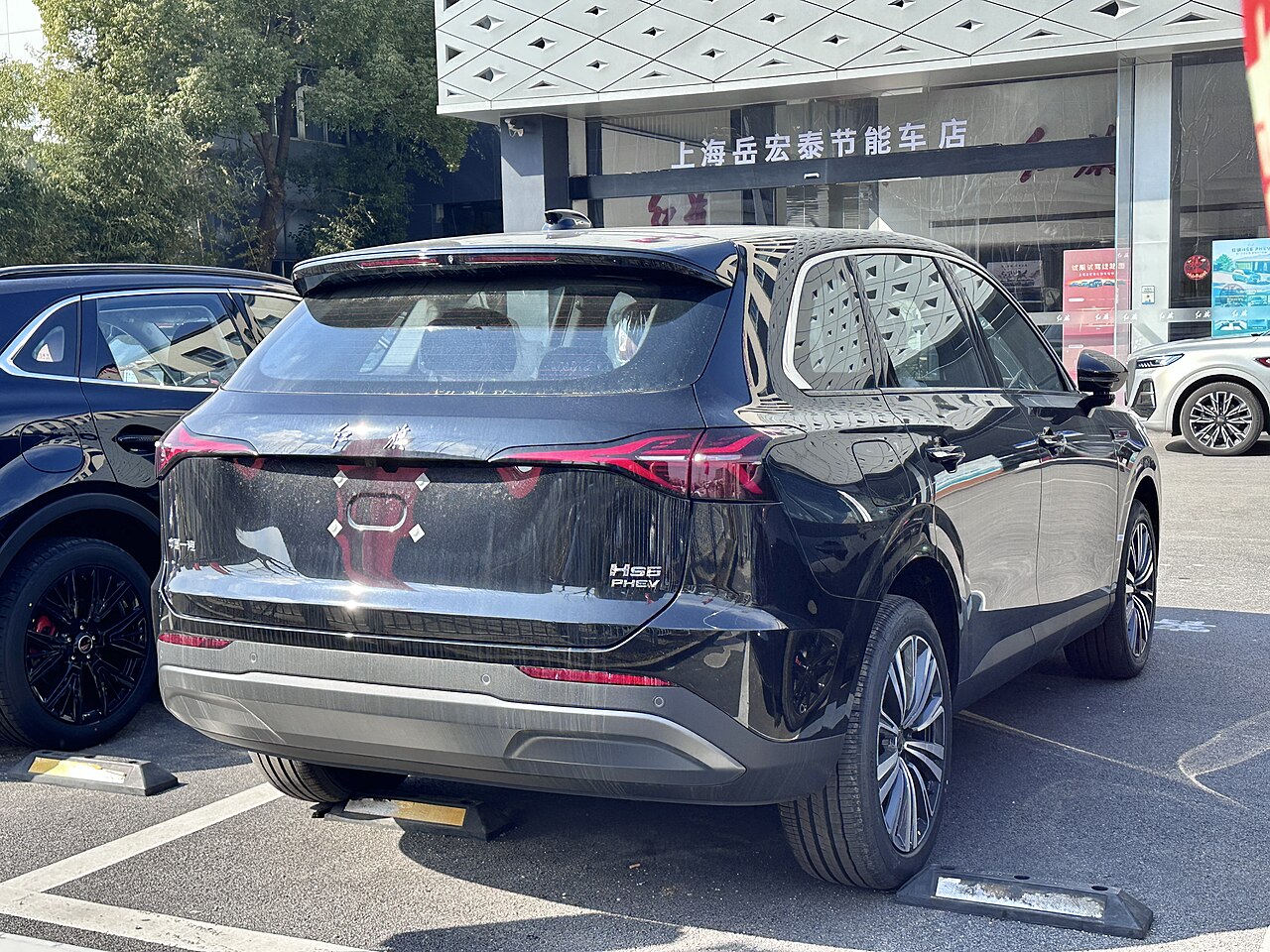
Image context: the cover uses a real Wikimedia Commons photograph of a Hongqi HS6 PHEV because this article is about an actual shipping vehicle lane. The strategic question is not what an agent demo can do on stage. It is what happens when a model-backed service bundle starts shipping inside everyday hardware.[6]
Hongqi changed the baseline from voice assistant to itinerary engine
Alibaba's April 13 Hongqi write-up is revealing because it does not pitch Lingxi Cockpit as a prettier speech UI.[2] It describes a workflow in which Qwen acts as a cloud-based decision hub, breaks down ambiguous natural-language requests, coordinates multi-step tasks, and uses Amap's geographic data and point-of-interest graph to optimize the result before the vehicle executes the visible part locally.[2]
The example Alibaba chose is worth taking literally. A driver asks to go to Peking University, find a convenient roast-duck stop on the way, and still reach the airport's Terminal 3 before 5 p.m.; the system parses navigation, dining, and deadline constraints together instead of treating them as isolated commands.[2] That is materially different from the older in-car pattern where the assistant could adjust climate settings, place a call, or read a headline but not reliably turn a fuzzy request into a service workflow.
Alibaba's own phrasing makes the delta explicit. It calls this a move from basic chatbot-style Q&A and simple cabin management toward service execution grounded in live data.[2] Future iterations are supposed to add more of Alibaba's own ecosystem, including Taobao Quick Commerce, Damai, and Fliggy.[2] Once those services appear, the model stops being only a speech layer and starts behaving like a routing layer for commerce, maps, and travel.
That is why Hongqi matters even before the multi-OEM expansion. It establishes the baseline claim that Alibaba wants the car cabin to become a place where an agent can do economically meaningful work, not only answer politely.[2]
The auto-show delta is distribution, not just branding
The Beijing Auto Show announcement on April 24 changed the scale of the story.[1] Alibaba said nine additional automakers would integrate Qwen and that selected models would offer Qwen-powered in-cabin services such as hotel booking, attraction-ticket purchases, food-delivery ordering, and parcel tracking.[1] The company framed the architecture as edge + cloud: Qwen-Omni on the edge to perceive the physical environment with low latency, agentic cloud capabilities to decompose intent and orchestrate scenario-specific services, and Alibaba Cloud infrastructure underneath to handle inference throughput efficiently.[1]
That matters because it converts Hongqi from an interesting single-brand pilot into a proof of replicability. The broader automotive context makes the timing more important. AP reported that the 2026 Beijing Auto Show opened with more than 1,450 vehicles on display and 181 global debuts, which means Alibaba chose the largest possible domestic vehicle stage to signal that its model is now a candidate default layer across many OEMs rather than a one-off luxury-brand feature.[5]
An inference from the combined sources is that Alibaba is trying to do in cars what mobile operating systems did to app distribution: make the default access point matter more than any one isolated feature. In this case, the access point is the cabin assistant surface, and the payload is a bundle of mapped places, travel inventory, retail fulfillment, and payment-adjacent execution.[1][2][3]
Qwen App explains why this is really an ecosystem bundle
The January Qwen App release is the missing bridge in this story.[3] On a phone, Alibaba had already shown the pattern clearly: one interface tied into Taobao, Instant Commerce, Alipay, Fliggy, and Amap so the system could move from intent to completion without forcing the user to hop between apps.[3] In other words, Alibaba had already built the service grammar before it pushed hard into the cabin.
Seen through that lens, the car move is less surprising. The vehicle is simply a new high-frequency surface for the same bundle. A driver already has recurring needs that maps, food, ticketing, commerce, and time-sensitive routing can satisfy. The cabin also has two distribution advantages a phone screen does not always have:
- it is a default interface during travel time rather than an app the user must remember to open
- it creates repeated, voice-first situations where multi-step requests are more natural than tapping through separate forms
This is where Alibaba's older strategic language helps. At Apsara Conference 2025, the company said large AI models would become more like operating systems, with persistent memory, cloud-edge coordination, and device-level integration, and it described Qwen3-Omni as well suited to low-latency interaction in intelligent cockpits.[4] The car push in 2026 reads like one concrete attempt to make that operating-system metaphor commercially real.[1][4]
What this means in AI-China
The ai-china implication is that model competition is drifting away from a pure benchmark race and toward execution surfaces with native distribution. A model inside a car is not automatically valuable. It becomes valuable when it can reliably route a user's spoken intent into a stack of maps, inventory, ticketing, retail, payments, and timing constraints, then do so often enough that both the OEM and the platform owner want to keep the integration in place.[1][2][3]
Alibaba's position is stronger here than that of a model vendor selling a generic API alone. It owns or coordinates several of the services that make an in-car agent feel useful, and it has both the cloud infrastructure and the consumer-service graph to turn that usefulness into something more repeatable.[1][3][4] That does not mean the strategy is guaranteed to win. There are still hard boundaries:
- drivers may trust navigation and media controls long before they trust commerce and booking flows from the cabin
- OEMs may resist letting any one platform become the permanent orchestration layer
- the strongest parts of Alibaba's service bundle are China-specific, which limits how cleanly the model can travel abroad
Even with those limits, the directional change is clear. The Hongqi deployment showed that Alibaba could turn ambiguous voice into a multi-step service workflow inside one vehicle line.[2] The Beijing Auto Show expansion showed that the company now wants to multiply that workflow across many OEMs at once.[1] The more durable reading of Alibaba's auto push, therefore, is not "Qwen enters cars." It is that Alibaba is trying to make the car cabin another default distribution lane for its maps-travel-retail bundle.[1][2][3][4][5]
Sources
- Alibaba Cloud Community, "Leading Chinese Automakers Announce Integration with Qwen at 2026 Beijing Auto Show" (April 24, 2026).
- Alibaba Cloud Community, "Qwen Powers Next-Generation Intelligent Cockpit for FAW Hongqi" (April 13, 2026).
- Alibaba Cloud Community, "Alibaba's Qwen App Advances Agentic AI Strategy by Turning Core Ecosystem Services into Executable AI Capabilities" (January 15, 2026).
- Alibaba Cloud, "Alibaba Cloud Unveils Strategic Roadmaps for the Next Generation AI Innovations" (September 24, 2025).
- Associated Press, "At Beijing auto show, Chinese carmakers flaunt new technologies as global competition heats up" (April 24, 2026).
- Wikimedia Commons, "File:Hongqi HS6 PHEV 002.jpg" - source page for the cover photograph used in this article.