As of 2026-04-22 UTC, the useful AI-China question around open models is not only which Qwen, DeepSeek, GLM, or Baichuan checkpoint looks strongest on release day. The harder supply-chain question is what turns those checkpoints into a repeatable adaptation path for teams with their own data, hardware, and evaluation habits.[1][2][3]
LLaMA-Factory sits exactly in that middle layer. Its public repository presents it as a framework for fine-tuning 100+ LLMs and VLMs, including Qwen3, Qwen3-VL, DeepSeek, GLM, Baichuan, LLaVA, Mistral, and others.[1][3] The accompanying ACL system-demo paper frames the same point more formally: efficient fine-tuning is valuable, but implementing those methods across many model families is non-trivial, so LLaMA-Factory packages the work behind a unified framework and a web UI called LlamaBoard.[2]
That makes it a stack signal, not just another open-source utility. China's model layer is moving too quickly for every enterprise team to maintain a bespoke supervised fine-tuning, LoRA, export, and serving harness for each release. A workbench layer that absorbs model-template churn, training-method churn, and hardware-package churn can become infrastructure in its own right.
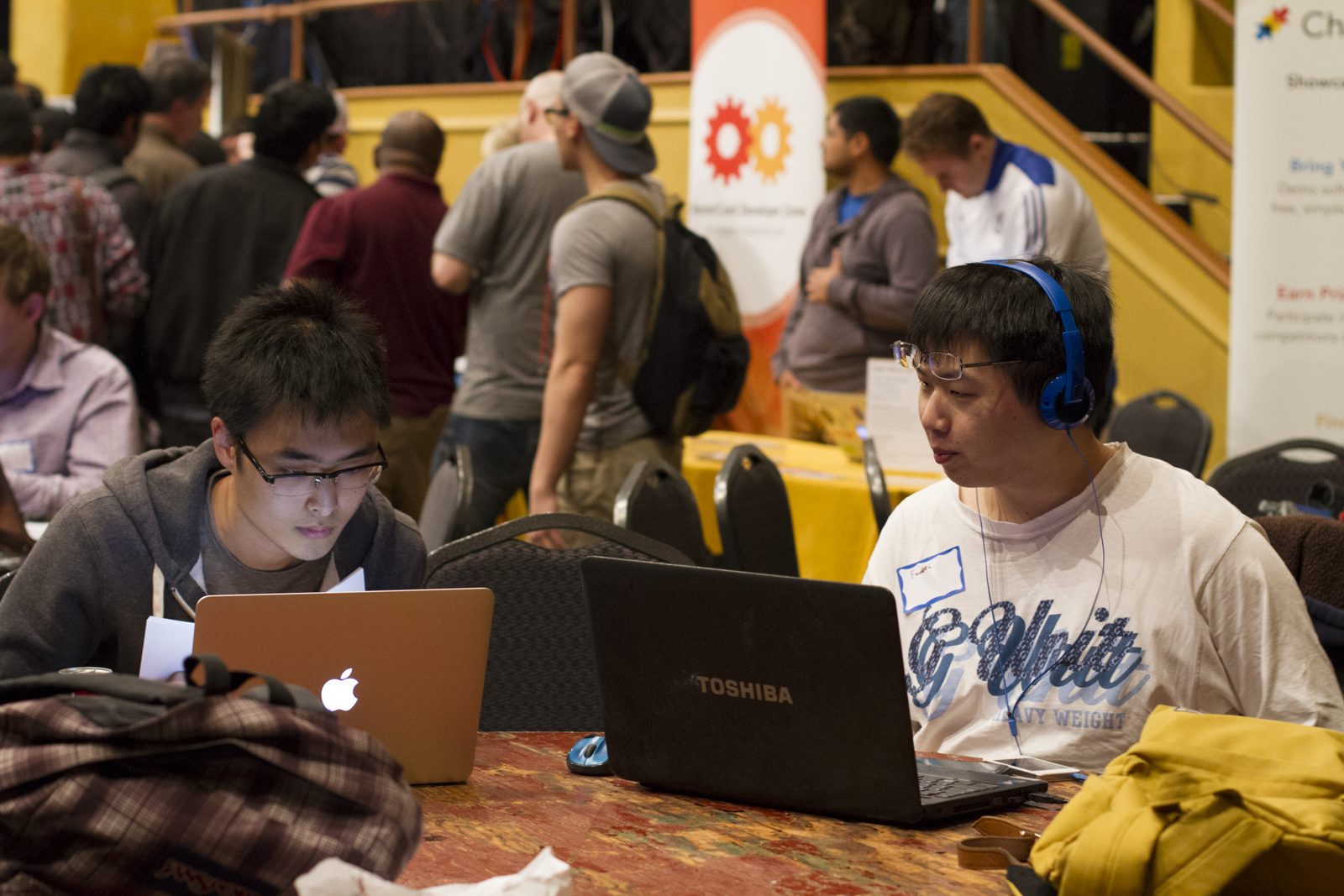
Image context: the cover uses a real 2015 hackathon photograph from Wikimedia Commons. It is not meant to depict the LLaMA-Factory team. It fits the article because the subject is the operator surface around open models: laptops, shared recipes, trial runs, and practical adaptation work rather than a polished launch-stage image.[5]
The real product is the adaptation loop
The repository's feature list is revealing because it does not stop at one training recipe. It groups the workbench around model breadth, training methods, resource scaling, practical acceleration tricks, experiment monitoring, and faster inference through OpenAI-style API, Gradio UI, CLI, vLLM worker, or SGLang worker paths.[1]
That breadth matters for Chinese open-model adoption. A team evaluating Qwen3 one week, DeepSeek-R1-distilled Qwen variants the next, and a GLM or Baichuan branch after that does not want three unrelated adaptation stacks. It wants one place where dataset format, chat template, LoRA target modules, evaluation command, export path, and serving route remain recognizable even as the underlying model family changes.[1][3]
The source material points to that workflow explicitly. LLaMA-Factory says it integrates pre-training, multimodal supervised fine-tuning, reward modeling, PPO, DPO, KTO, ORPO, freeze tuning, LoRA, QLoRA, and other methods; the paper says the framework is meant to customize fine-tuning without requiring users to write code through LlamaBoard.[1][2] In practice, that turns fine-tuning from a research script problem into an operator loop: choose a model, attach data, run an efficient adaptation method, watch metrics, export the artifact, then serve it for inspection or downstream use.
The important distinction is where risk moves. LLaMA-Factory does not make weak data good, and it does not turn a small checkpoint into a frontier model. It reduces the friction around running the same adaptation experiment honestly across many candidate models. For enterprise users, that is often the difference between a one-off demo and a controlled model-selection process.
Day-N support is the release-cadence feature
The repository's Day-N support table is a useful market signal. It lists Day 0 support for Qwen3, Qwen2.5-VL, Gemma 3, GLM-4.1V, InternLM 3, and MiniCPM-o-2.6, and Day 1 support for Llama 3, GLM-4, Mistral Small, PaliGemma2, and Llama 4.[1]
Read as engineering infrastructure, that table says the project is trying to keep pace with the model-release cycle rather than simply supporting a static catalog. The changelog reinforces the point: the repository records support for DeepSeek-R1 and Qwen2.5-VL on 2025-01-31, Qwen2-Audio on 2025-02-05, Qwen2.5-Omni on 2025-03-31, Kimi-VL and GLM-Z1 on 2025-04-14, InternVL3 on 2025-04-16, Qwen3 on 2025-04-28, and Megatron-core backend support on 2025-10-26.[1]
Those dates matter less as trivia than as a cadence pattern. The Chinese open-model market rewards fast trial. A new checkpoint does not become practically testable for many teams until the surrounding workbench knows the tokenizer, chat template, target modules, quantization path, and export constraints. LLaMA-Factory's value is partly that it tracks that surrounding work, not only the headline model names.
The LLaMA Factory Online mirror-list documentation shows the same pattern from a packaging angle. Its model catalog includes Chinese and China-linked families such as Baichuan, ChatGLM, Chinese-LLaMA, Chinese-Alpaca, CodeGeeX, DeepSeek, and many others, while its version notes tie LLaMA-Factory images to specific combinations of Transformers, PyTorch, CUDA, vLLM, and Hugging Face Hub versions.[3] That is exactly the kind of compatibility matrix that becomes invisible when people talk only about model cards.
Hardware packaging is part of the supply chain
The hardware table in the repository is blunt enough to be useful. It estimates that full 32-bit tuning of a 7B model needs about 120 GB of memory, while 4-bit QLoRA or QOFT can bring the same 7B class down to about 6 GB; for a 70B model, the table gives about 1,200 GB for full 32-bit tuning and about 48 GB for 4-bit QLoRA or QOFT.[1]
Those numbers should not be read as a guarantee for every dataset or sequence length. They are still useful because they make the adoption boundary concrete. For many teams, open-model adaptation starts when the training method fits the hardware they can actually reserve. That is why LoRA and QLoRA support is not a side feature. It is the bridge between "we downloaded a model" and "we can run a controlled adaptation experiment this week."
The deployment packaging also matters. The repository documents a Docker image built on Ubuntu 22.04, CUDA 12.4, Python 3.11, PyTorch 2.6.0, and Flash-attn 2.7.4, and it separately gives instructions for Ascend NPU users, including CANN Toolkit and Kernels requirements plus prebuilt NPU image tags.[1] AMD's ROCm developer tutorial independently treats LLaMA-Factory as a practical fine-tuning route on AMD Instinct hardware, with a tested setup around Ubuntu 22.04, ROCm 6.3, Docker, and an MI300X GPU.[4]
That spread is strategically important. A fine-tuning workbench becomes more valuable when it can travel across CUDA, ROCm, and Ascend-style lanes. It lets buyers separate model choice from hardware choice more cleanly, or at least exposes where that separation breaks.
What this changes for AI-China builders
For builders tracking China's AI stack, LLaMA-Factory changes the interpretation of open-model releases in three ways.
First, it makes post-release adaptation part of the default story. A checkpoint is no longer evaluated only by the paper, model card, or leaderboard. It is evaluated by whether it can enter an existing workbench with known recipes, datasets, and export paths.[1][2]
Second, it makes template and method maintenance a shared upstream job. When Qwen, DeepSeek, GLM, or Baichuan support lands in the workbench, individual teams inherit a more stable starting point than if each team writes its own chat-template and LoRA plumbing from scratch.[1][3]
Third, it makes hardware optionality more visible. The practical choice is not simply local versus API. It is which adaptation path can run on the hardware lane a team controls: CUDA server, ROCm box, Ascend NPU environment, or a managed cloud notebook.[1][4]
The watch item from here is not whether LLaMA-Factory becomes the only fine-tuning framework. It will not. The watch item is whether more Chinese model releases treat workbench compatibility as part of the launch checklist. If a new model lands quickly in LLaMA-Factory, ModelScope, vLLM, SGLang, and a cloud notebook recipe, then the open-model release has a shorter path from announcement to actual enterprise experiment.
That is the narrower signal worth keeping: LLaMA-Factory is not the model race itself. It is part of the supply chain that lets the race be tested, adapted, and repeated.
Sources
- hiyouga/LLaMA-Factory GitHub repository, README and changelog (model support, training methods, resource table, Docker, Ascend NPU notes, OpenAI-style serving paths).
- Yaowei Zheng et al., "LlamaFactory: Unified Efficient Fine-Tuning of 100+ Language Models," arXiv:2403.13372 / ACL 2024 System Demonstration Track.
- LLaMA Factory Online documentation, "查看模型镜像列表" (image-version matrix and model catalog including Baichuan, ChatGLM, DeepSeek, Chinese-LLaMA, and related families).
- AMD ROCm AI Developer Hub, "Fine-tune Llama-3.1 8B with Llama-Factory" (ROCm hardware setup and independent fine-tuning tutorial).
- Wikimedia Commons, "File:Hackathon NYC 092 (17377217072).jpg" (TechCrunch 2015 hackathon photograph used as this article's cover image).