
As of 2026-06-16T15:08:22Z UTC, the useful way to watch Kai-Fu Lee's December 2025 Stanford talk is not as a personality profile. It is a compact argument about where China AI competition may compound: not only in larger models, but in faster movement from model capability into usable applications, company workflows, and consumer habits.[1][2]
Stanford's event page frames the session as a discussion of innovation and leadership in Chinese AI, with Lee appearing as founder of 01.AI and chairman and CEO of Sinovation Ventures.[2] That context matters because the talk sits at the intersection of three roles: researcher, investor, and operator. Lee is not only describing the China market from outside. He is also defending an operating thesis for companies such as 01.AI: foundation models create the breakthrough, but the durable race is won when those models are packaged into products people actually use.[2][3]
The video is worth annotating because it helps keep ai-china coverage from shrinking into leaderboard tourism. Public evidence around 01.AI shows both sides of the argument. The Yi model materials describe open bilingual foundation models, long-context variants, multimodal extensions, and developer distribution through GitHub, Hugging Face, ModelScope, and an API platform.[3][4][5] The same company site presents Wanzhi as a personal AI workspace and says AI 2.0 will rewrite software and user interfaces, producing AI-first applications and AI-empowered business models.[3] My inference from the talk and the supporting materials is that Lee's strongest claim is about velocity across layers: model, tool, workflow, interface, and business habit.
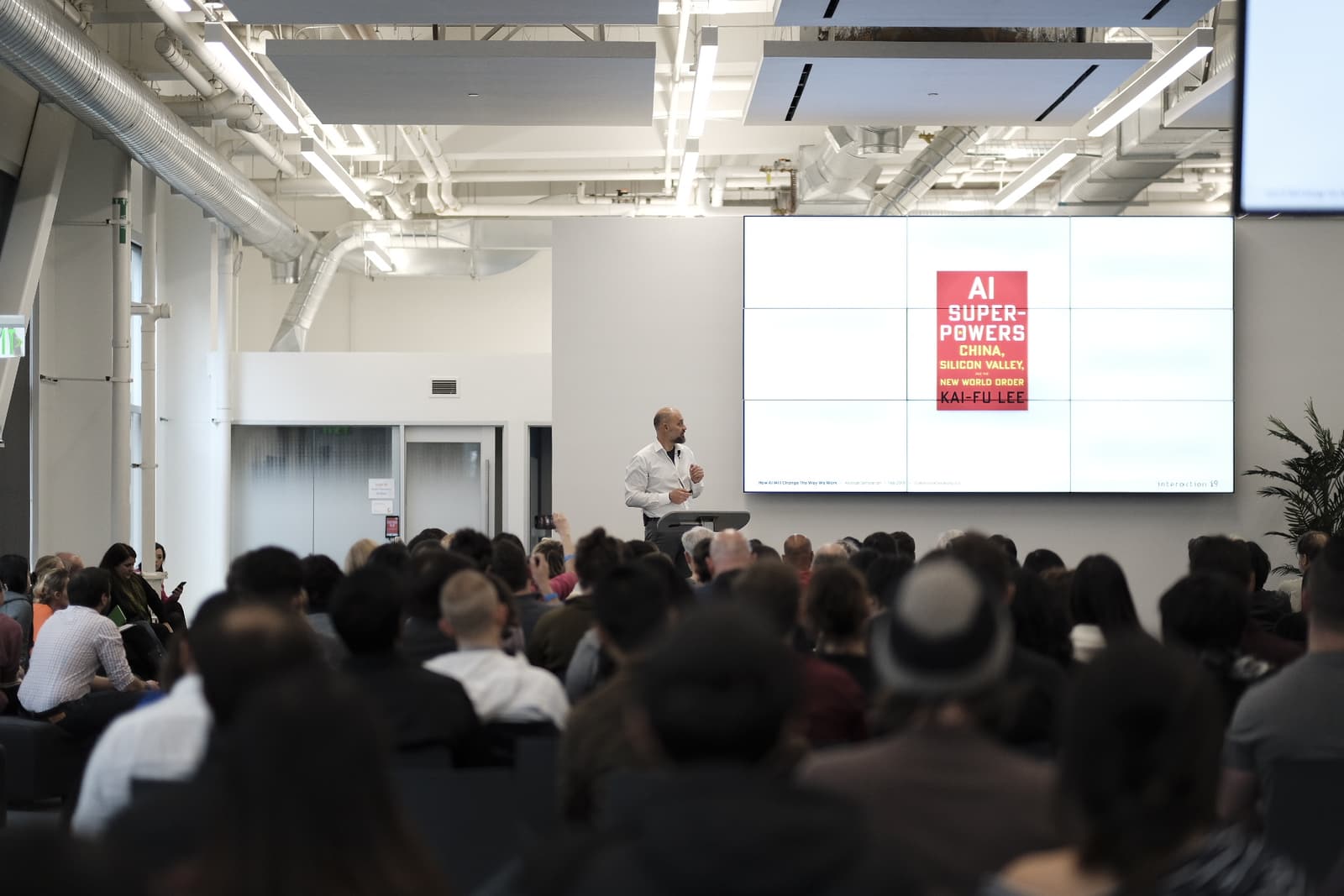
Image context: the cover uses a real photograph of Kai-Fu Lee speaking at IxDA 2019. A photographic speaker image is the right register here because the article is about a public strategic argument by a named operator, centered on the speaker and the argument rather than on benchmark imagery or generated AI visuals.[6]
The first thing to notice is the application frame
The Stanford framing tells the viewer to expect a talk about how Chinese AI development is shaping global trends, particularly across Asia.[2] That is broader than a single 01.AI product pitch, but it also explains why Lee returns to application logic. The China AI question is not just whether one lab can briefly catch one frontier benchmark. It is whether many capable models can be pushed quickly into tools for reading, writing, coding, meeting work, search, customer service, education, and enterprise operations.
01.AI's own English site makes this product framing unusually explicit. It lists Wanzhi as a personal AI workspace, then puts that beside an API platform for multiple Yi models and the Yi-VL multimodal branch.[3] That pairing is strategically revealing. One route goes through developers and enterprise builders who need APIs, model access, and commercial licensing. The other goes through end users who experience the model as a workspace, not as a model name.
That is the first useful annotation on the video: treat "China AI" here as an application-speed thesis. The model layer still matters. Without capable bilingual, long-context, and multimodal systems, application packaging becomes thin. But the argument's center of gravity is the conversion path. Can a team turn a model into a workflow before the market, the platform, or the model baseline changes again?
Around the model discussion, open supply is a distribution tactic
The Yi GitHub repository describes the Yi series as open-source large language models trained from scratch by 01.AI and targeted as bilingual systems trained on a 3T multilingual corpus.[4] The arXiv technical report adds the fuller architecture of the claim: 6B and 34B base models, chat models, 200K long-context extensions, depth-upscaled variants, and vision-language models.[5] Those details are not just research inventory. They show why open supply became a tactic for a younger Chinese model company.
Open releases help a startup recruit developers, get external testing, and make the model family legible outside its domestic product surface. They also lower the cost of experimentation for downstream builders. A company can try the model, inspect examples, tune assumptions, and compare behavior before committing to a managed path. In the AI-China context, that matters because Chinese model firms often compete against much larger platform companies with stronger cloud, app, and traffic assets.
The boundary is just as important. Open models do not automatically create a business. They create a funnel. Lee's application-speed thesis only becomes durable if open distribution feeds usage, reputation, enterprise trust, or product loops. The model card can bring a developer to the door. The product has to give that developer or customer a reason to stay.
The long-context point is really a document-work point
The Yi technical report's long-context section is easy to misread as a spec race. A 200K context window sounds like a headline number, and headline context numbers age quickly. The more useful reading is functional. The report describes extending the Yi base model to long context and notes a document question-answering data format that encourages the model to use the input rather than rely loosely on internal memory.[5]
That fits the application frame. Long context is valuable when it changes a task: reading a financial report, digesting a meeting transcript, comparing policies, summarizing a book, reconstructing a customer history, or preparing a slide draft from source material. 01.AI's Wanzhi positioning points in the same direction by framing the product as a workspace for reading and creating.[3] The product question is not "how many tokens can the model accept?" The product question is "can the assistant stay attached to the source material long enough for a person to trust the output?"
This is where China AI application speed can produce both advantage and risk. Fast packaging gets models into workflows quickly, but document work punishes loose handoffs. If a workspace summarizes without traceability, drafts without source discipline, or rewrites without preserving intent, the productivity claim collapses into review burden. Lee's argument is strongest when read with this constraint attached: speed matters only when the workflow remains auditable.
The lasting signal is a shorter model-to-software loop
Replay the talk with that loop in mind. The durable signal is not that one founder has a bullish view of China AI. The durable signal is that China AI firms are competing to shorten the distance between model release, developer adoption, product surface, and business use. 01.AI's public materials show the ingredients of that loop: open Yi models, bilingual training emphasis, long-context and vision-language capability, an API platform, commercial licensing, and Wanzhi as an application workspace.[3][4][5]
That does not prove that 01.AI, or any single Chinese AI company, owns the next application platform. It does clarify how to evaluate the race. Watch less for a single benchmark table and more for whether model capabilities are turning into repeatable software habits. Are APIs easy to adopt? Are source-heavy workflows trustworthy? Do consumer products hide model complexity without hiding evidence? Do enterprise deployments get enough governance to survive beyond a pilot?
Lee's Stanford talk is useful because it makes that evaluation frame visible. China AI should be read as a system of release speed, packaging speed, and adoption speed. The model is the engine, but the application loop is where the engine either becomes work or remains a demo.[1][2][3]
Sources
- Stanford event recording, "251202 Dr. Kai-Fu Lee on How the Rise of AI in China Can Benefit the World," YouTube video.
- Stanford Center for East Asian Studies, "How the Rise of AI in China Can Benefit the World with Dr. Kai-Fu Lee, Founder & CEO, 01.AI" (event page, December 2, 2025).
- 01.AI, English company and product page for Wanzhi, the Yi API platform, Yi-VL, Yi base models, and AI-first application framing.
- 01.AI,
01-ai/YiGitHub repository for the Yi open model family, bilingual model framing, model distribution, and developer materials. - 01.AI, "Yi: Open Foundation Models by 01.AI" (arXiv technical report; model family, 200K context, vision-language extension, and infrastructure notes).
- Wikimedia Commons, "File:2019 0405 16370000 IxDA 19 San Francisco.jpg" (real photograph of Kai-Fu Lee used as the article image source).