As of 2026-03-25 UTC, the clearest Alibaba signal in China AI is not another benchmark headline. It is that Qwen is being distributed as an interface ladder.
One year ago, the easiest way to read Qwen was as a model family: open checkpoints, hosted APIs, and a fast release cadence. In 2026Q1, that description is too narrow. Alibaba now presents the same underlying stack across open-weight models, a general-purpose assistant, an AI browser, and smart glasses.[1][2][3][4][5][6]
That matters because distribution power changes once a model stops waiting for users to open one chat box. It starts meeting intent where intent already lives: in search, on the desktop, inside shopping and travel workflows, and eventually in a voice-and-vision device.
What changed in the surface layer
The starting point remains the model family itself. Qwen3's April 2025 release formalized a broad open model line with hybrid reasoning controls, and Alibaba explicitly positioned Quark as one of the downstream products powered by that family.[2] That is the supply side of the ladder: the model keeps improving, and outside builders can still enter through open weights.
The next step is the consumer assistant surface. On qwen.ai, Alibaba now places Qwen Chat and API Platform under the same brand entry, with phone and desktop clients linked from the same front door.[1] That is a subtle but important packaging choice. The company is not separating "developer Qwen" and "consumer Qwen" into unrelated brands; it is teaching users and builders to think of them as adjacent surfaces.
Quark then widens the funnel. Alibaba's current Quark positioning is no longer just "browser plus search." The official product surface describes an AI browser, AI search, AI writing, AI coding, and a desktop assistant mode built on Qwen.[3] Alibaba's November 2025 update made the move explicit: Quark's revamped AI browser targeted more than 100 million desktop users and more than 200 million users in China, while adding an always-available Qwen "floating ball" on desktop.[4]
That is a different distribution geometry from a standalone chat app. A browser-level assistant can capture intent before the user decides whether the task belongs to chat, search, shopping, travel planning, document work, or coding.
Why the Qwen app matters more than a download number
The Qwen app is the clearest sign that Alibaba wants executable consumer AI, not only conversational AI. Official Qwen updates describe the app as Alibaba's consumer-facing AI product, then push beyond chat into task execution through integrations with Taobao, Alipay, Fliggy, and Amap.[5]
The behavioral signal is already non-trivial. Alibaba says the Qwen app passed 10 million downloads in its first week, then exceeded 100 million monthly active users in under two months. During the Chinese New Year campaign, the app generated more than 120 million orders tied to AI-assisted shopping flows.[4][5]
Those numbers should be read carefully. A campaign-order figure is not the same thing as durable retention, and Alibaba is the reporting party. But the directional signal is hard to miss: Qwen is being trained into a task surface where the output is not only text. It is an action path inside Alibaba's own services.
Glasses turn the same stack into ambient hardware
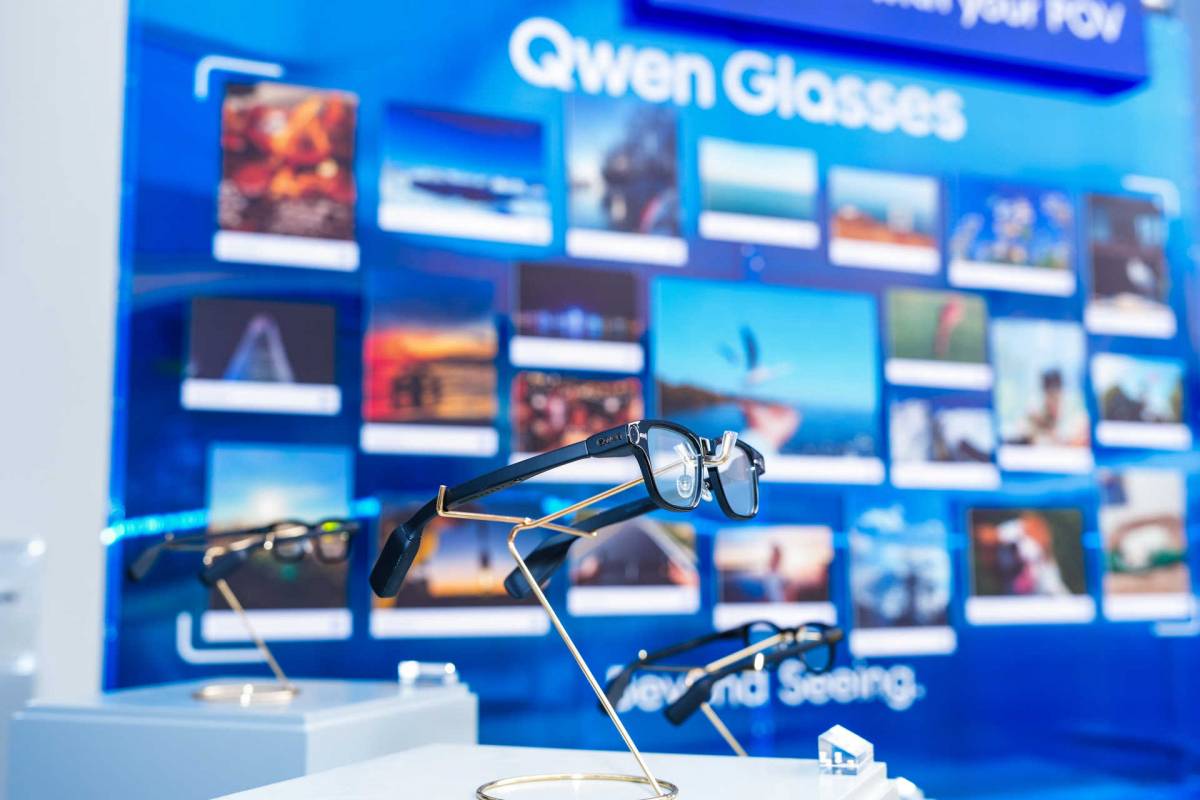
The MWC Barcelona debut of Qwen Glasses is what makes the "interface ladder" framing unavoidable. Alibaba's March 2026 announcement moved Qwen into a hardware surface built for voice, camera, and always-nearby interaction, with China sales beginning on March 8, 2026.[6]
This does not mean smart glasses suddenly become a mass-market AI moat. Hardware remains the weakest and least proven rung in the stack. But strategically it does something important: it extends Qwen from deliberate sessions into ambient capture.
That changes the product question. The competition is no longer just "which model answers better inside a prompt box?" It becomes "which stack is present when the user notices something, wants to remember something, or needs to trigger a service without opening an app first?"
Why this matters for builders, not only for consumers
Builders should care because consumer interfaces often become the upstream spec for later platform surfaces.
When one vendor can test search assistance, shopping execution, coding help, and wearable interaction on first-party consumer traffic, it gains earlier evidence about:
- where users actually tolerate latency,
- which tasks need tool invocation rather than longer text,
- which flows justify always-on assistant affordances,
- and which service bindings create repeat usage instead of novelty spikes.
Alibaba's March 2026 strategy update adds a second anchor: Qwen models have now surpassed 600 million downloads, more than 170,000 derivative models have been created, and more than 1 million corporate and individual users have used Qwen through Model Studio.[7] Put together with Quark, the Qwen app, and Qwen Glasses, the picture is not "one successful open model." It is a stack that can move evidence from open ecosystems to consumer usage and back into cloud distribution.
Boundary and falsifier
There is a fair boundary on this synthesis. Multiple surfaces do not automatically become one durable moat.
Quark and the Qwen app can still cannibalize each other. Glasses can stay a narrow premium device. Open-weight downloads do not guarantee monetized enterprise stickiness. And the order data disclosed by Alibaba says more about short-cycle task activation than about long-term habit quality.[4][5]
A clean falsifier for the interface-ladder thesis would be this three-part pattern appearing together over the next two to three quarters:
- Qwen's consumer surfaces stop adding differentiated task execution while peers keep shipping new use cases.
- Model Studio and API-side adoption flatten even as open-model downloads keep rising.
- Qwen Glasses remain a one-off device launch with no visible follow-through in software behavior or service bindings.
If all three happen together, the ladder is still packaging, not compounding distribution.
What to watch next
- Whether Quark and the Qwen app stay as separate front doors or converge into one stronger assistant identity.
- Whether Alibaba exposes more of the same task primitives from consumer surfaces into developer-facing APIs and tooling.
- Whether Qwen Glasses evolve beyond hardware novelty into a meaningful source of voice-and-vision interaction data.
Sources
- Qwen official site, linking Qwen Chat, API Platform, and phone/desktop clients under one brand surface.
- Qwen Team, "Qwen3: Think Deeper, Act Faster" (April 29, 2025).
- Quark official site, positioning Quark as an AI browser, AI search, AI writing, AI coding, and desktop assistant built on Qwen.
- Alibaba Cloud Community, "Alibaba's Quark Unveils Revamped AI Browser, Deeply Integrated with Qwen".
- Alibaba Cloud Community, "Qwen App's CNY Campaign Attracts Over 120 Million Orders".
- Alibaba Cloud Community, "Alibaba Unveils Qwen Glasses at MWC Barcelona, Accelerating AI Hardware Ambitions".
- Alibaba Group, "Alibaba Cloud unveils strategic roadmaps to accelerate global AI innovation".