As of 2026-05-10 UTC, Lenovo's AI push is easiest to misread if you look for one house model and stop there. The stronger ai-china signal is a governed endpoint loop. Lenovo is trying to make AI live first on owned devices, then across a user's device graph, and finally inside enterprise management surfaces that can automate, monitor, and constrain what those agents do.[1][2][3][4]
That distinction matters because Lenovo is not entering the market from the same starting position as a model-first cloud vendor. It already has global PC distribution, a large enterprise services arm, and a hardware estate where assistant behavior can be attached to actual endpoints.[4] The public materials are therefore more revealing when read together than when treated as isolated launch pages. AI Now makes the PC itself an AI work surface.[1] Qira turns that surface into a cross-device personal agent.[2][5] xIQ and Lenovo's broader Agentic AI push mirror the same logic for enterprise governance and automation.[3][4]
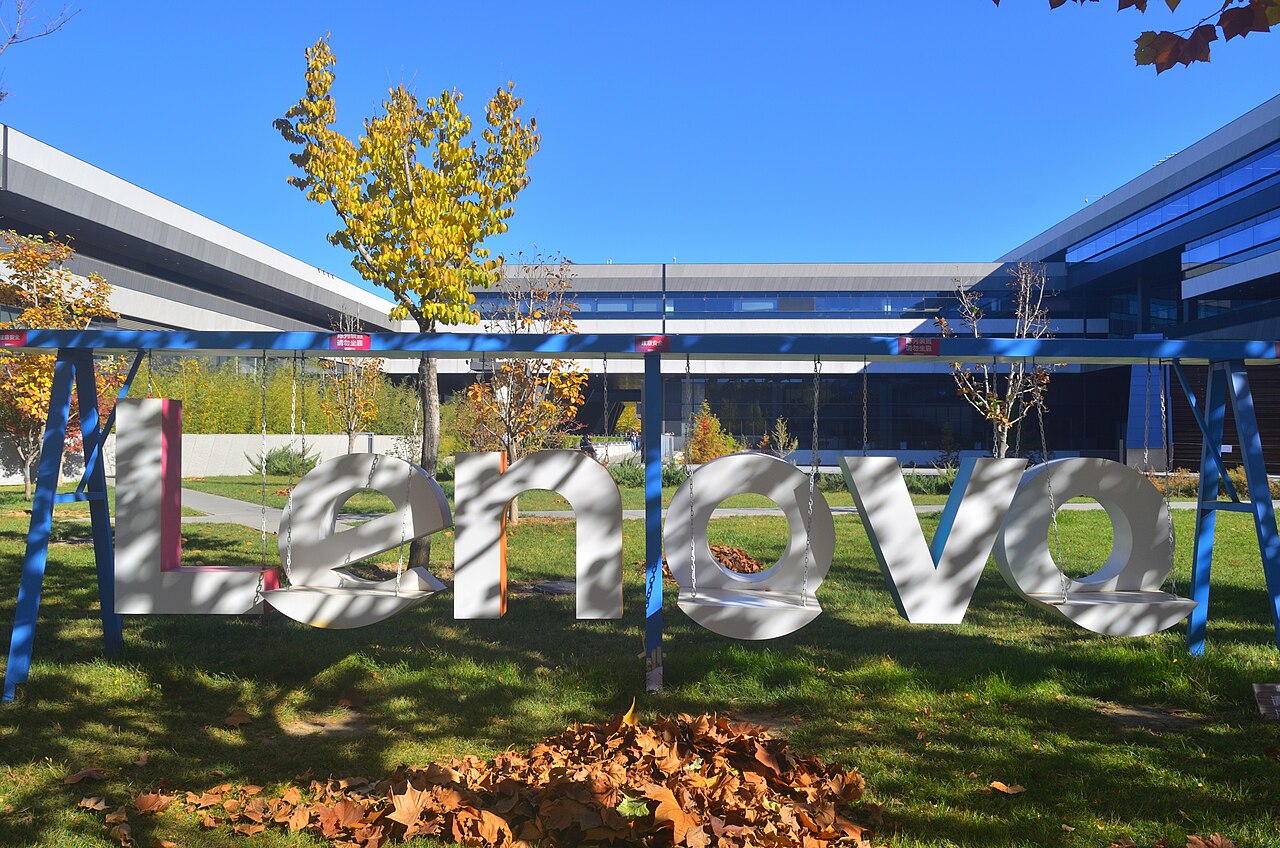
Image context: the cover uses a real Wikimedia Commons photograph of Lenovo's Beijing headquarters. That is the right anchor here because the article is about a company-level architecture, not about one benchmark chart. Lenovo is trying to join PCs, phones, services, and enterprise tooling into one managed AI story.[6]
AI Now made the AI PC more than a chatbot laptop
The first useful clue is AI Now. In Lenovo's CES 2025 release, AI Now is framed as an on-device assistant for selected Lenovo AI PCs that can search, summarize, answer device questions, manage settings, and work with local knowledge while keeping personal data on the device.[1] That matters because the product pitch is not "here is Lenovo's smartest model." It is "here is a workflow layer attached to the PC you already own."[1]
Lenovo's wording also shows where the company wanted the center of gravity to sit. The release emphasizes a personal knowledge base, natural-language device control, and an architecture that can use local inference while reaching outward when cloud support is needed.[1] In other words, AI is being introduced as behavior on the endpoint rather than as a detached web destination. That is an important classification signal in ai-china, where many companies still lead with an app shell or a model card first and only later explain how the agent meets real work.
My inference from the source is that AI Now was Lenovo's first clean attempt to make the PC itself the durable AI surface. The assistant sits close to files, settings, and local context, which gives Lenovo a different path from vendors whose main AI habit starts in a browser tab.[1]
Qira turns that endpoint into a cross-device agent
The second clue is Qira. Lenovo's January 6, 2026 launch describes Qira as a personal AI agent that can act across Lenovo and Motorola devices, preserve continuity across contexts, and connect to third-party services such as Notion, Google Calendar, Google Tasks, Perplexity, and Expedia.[2] Lenovo is not selling Qira as one more chat interface. It is selling it as a continuity layer that can remember, route, and complete tasks across a user's device environment.[2]
The language around privacy and architecture is just as important as the feature list. Lenovo says Qira uses a hybrid AI architecture that blends personalized local processing with cloud capability and includes privacy-by-design security.[2] That phrasing matters because it keeps the AI story tied to device ownership and governance. The point is not merely that Qira can do more tasks. The point is that Lenovo wants those tasks to happen inside a controlled device-and-service framework where the endpoint remains strategically central.
The MWC 2026 rollout makes the same direction easier to see. Lenovo's later release says Qira is arriving first on select premium Lenovo AI PCs and Motorola smartphones in the U.S., while also positioning it as part of a broader Hybrid AI portfolio rather than as a standalone consumer app.[5] That sequencing is revealing. Lenovo is not chasing the widest possible mass-market assistant launch first. It is starting where it already owns the hardware relationship and can manage quality, data boundaries, and cross-device continuity most tightly.[2][5]
xIQ and Agentic AI mirror the same logic for enterprise governance
The third clue is that Lenovo is building an enterprise reflection of the same loop. On the same CES 2026 cycle, Lenovo launched Lenovo xIQ with agentic AI, describing a no-code system where organizations can create specialized agents using internal knowledge and coordinate tasks across IT and business operations.[3] The examples in the release are not abstract benchmark theater. They are operational: help desks, workflow automation, support resolution, sales assistance, and service management.[3]
That matters because it tells us Qira is not an isolated personal-assistant bet. Lenovo is trying to build one company-wide pattern: agents close to endpoints on the user side, and agents inside managed governance surfaces on the enterprise side. The release also stresses transparency, control, and customization, which makes the product read less like generic AI enthusiasm and more like a services company translating AI into enterprise operating language.[3]
Lenovo's FY2025/26 Q3 release strengthens that reading. The company introduced Lenovo Hybrid AI Advantage with agentic AI services inside Solutions and Services Group, alongside the xIQ platform itself.[4] This is significant because it places agentic AI inside the services organization that already sells managed offerings to enterprise customers. Lenovo is therefore not only shipping assistants on devices. It is also creating a service-and-governance layer above those devices where enterprise adoption can actually be operationalized.[3][4]
The earnings release shows why Lenovo wants governance and distribution at the center
The financial context is what makes the structure legible. In Lenovo's February 20, 2026 Q3 release, revenue rose 20% year over year to US$18.8 billion, net income rose 106% to US$693 million, and the company said non-PC revenue reached 46% of the group total.[4] That mix already tells you Lenovo's AI story cannot be reduced to consumer-PC decoration.
The same release also gives each business group an AI role. IDG is where AI PCs and Qira make sense as distribution surfaces.[4] SSG is where xIQ and agentic services turn AI into managed enterprise workflow.[4] ISG is where Lenovo keeps building the infrastructure side, with AI server business described as hypergrowth and record revenue for the group.[4] Read together, the segments outline a full commercial stack: endpoint distribution below, governance and services in the middle, and infrastructure capacity behind the scenes.
This is the core field signal. Lenovo looks less interested in winning a clean public "model champion" contest than in owning the route through which AI behavior reaches users and enterprises. Devices provide context and habitual entry points. Enterprise tooling provides control and monetizable service layers. Infrastructure gives Lenovo a way to support the workloads that grow out of both.[2][3][4][5]
Why this matters in AI-China
Lenovo's materials point to a strategic lane that deserves attention inside ai-china. The company is treating AI as a distribution-and-governance problem before it treats it as a prestige-model problem.[1][2][3][4][5] That is a different wager from the one made by firms whose public identity depends on a named foundation model beating rivals in open comparisons.
The evidence also keeps the boundary clear. The public sources tell us a great deal about Lenovo's intended architecture and go-to-market path, but much less about long-term third-party developer adoption, sustained end-user engagement, or whether Qira becomes a default behavior rather than a premium-device feature.[2][5] The right watchpoints are therefore concrete. Watch whether Qira expands beyond a selective rollout while preserving its privacy-and-continuity claim.[2][5] Watch whether xIQ becomes a real enterprise control plane rather than a launch-category label.[3][4] And watch whether Lenovo can keep connecting endpoint assistants, services revenue, and infrastructure demand into one compounding loop.[4]
For now, the pattern is coherent enough to name. Lenovo's current AI story is not best understood as one more entrant in a standalone model war. It is a governed endpoint loop: the PC becomes an AI work surface, the agent extends across devices and connected services, and enterprise tooling turns that behavior into something manageable, automatable, and billable.[1][2][3][4][5]
Sources
- Lenovo, "Pioneering the future of AI-powered innovation for business, gaming, and creative users at CES 2025" (January 6, 2025; AI Now positioning, local knowledge base, natural-language device control, and on-device AI PC workflow framing).
- Lenovo, "Lenovo introduces personal AI agent Qira to transform devices into highly personalized AI companions" (January 6, 2026; Qira launch, hybrid local/cloud architecture, privacy-by-design framing, and third-party service integrations).
- Lenovo, "Lenovo unveils Agentic AI to drive faster innovation and greater productivity for organizations" (January 6, 2026; xIQ agent platform, no-code agent creation, workflow automation, and enterprise governance framing).
- Lenovo Group, "Lenovo reports strong Q3 results with revenue and net income significant growth" (February 20, 2026; Q3 FY2025/26 revenue mix, non-PC share, agentic-AI services, and infrastructure context).
- Lenovo, "Lenovo unveils broad hybrid AI portfolio with integrated devices and solutions at MWC 2026" (March 2, 2026; selective rollout of Qira on premium Lenovo AI PCs and Motorola smartphones, plus broader Hybrid AI portfolio context).
- Wikimedia Commons, "File:LenovoHeadquartersBeijing.jpg" (source page for the documentary headquarters photograph used as the article image).