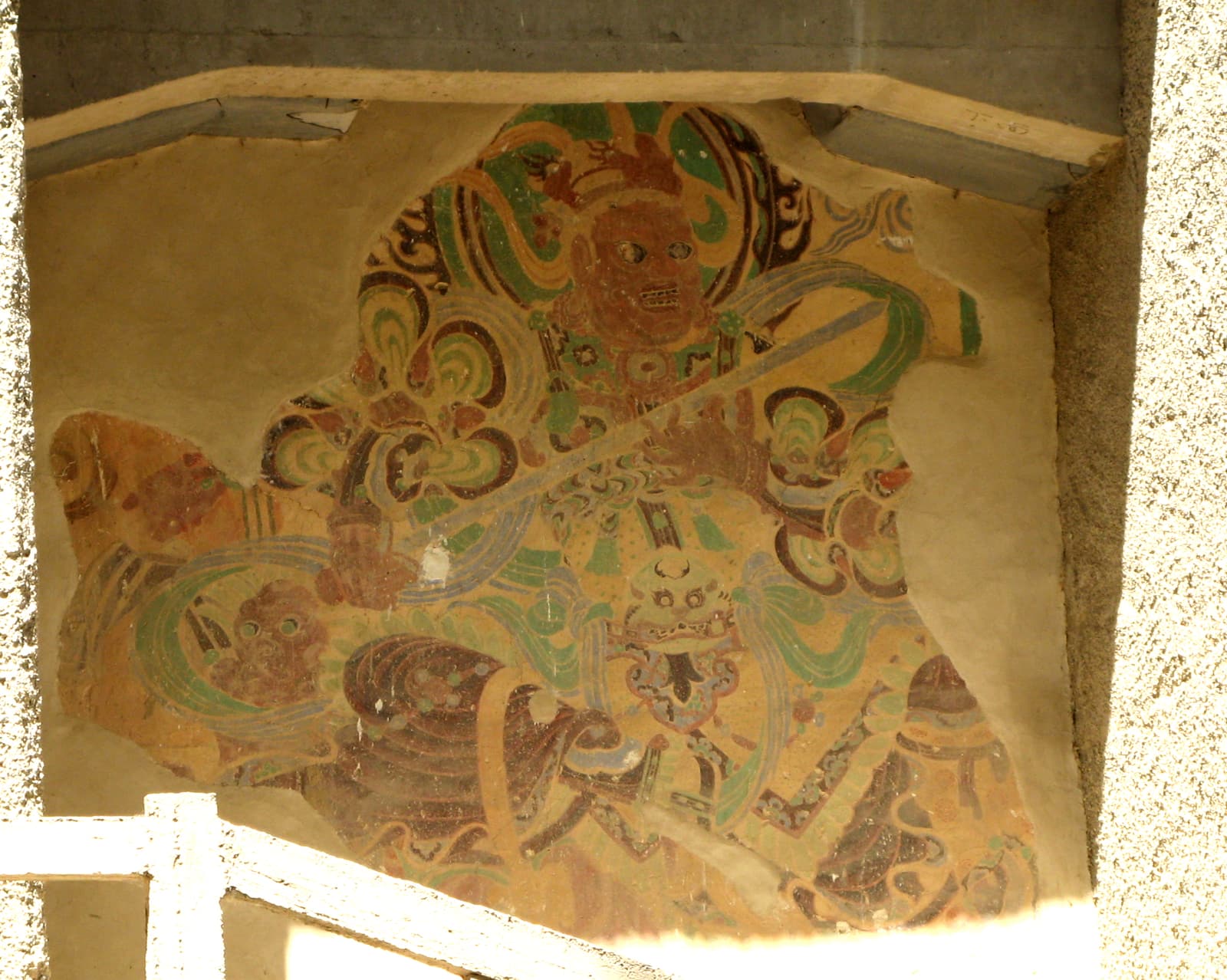
Between Mogao Caves 305 and 306, a painted guardian holds a sword against an enemy that no artist intended: open weather. The front of the cave that once sheltered the figure has crumbled away, leaving pigment and earthen plaster exposed. In the 2007 photograph above, abrasion is not an abstract “defect.” It is part of the object's history, and every missing contour carries a question.[7]
That makes Dunhuang a particularly demanding place to judge China's progress in generative vision. A model can fill a gap in seconds. Conservation has to ask what kind of gap it was, which evidence survives around it, whether a proposed line belongs to the right cave and period, and how clearly conjecture is separated from record. The most important field signal is therefore not that AI can make an old mural look new. It is that a Chinese research pipeline is gradually being forced to define the evidence behind a restoration—and the limits of what a generated image can claim.
The change is visible across four research moments. An Academy-linked project in 2022 framed virtual restoration as one task inside a much larger digital-heritage system. A 2024 dataset made damage masks and super-resolution pairs reusable. A 2025 study confronted the shortage of matched faded and restored examples. In May 2026, a new mural-restoration method trained without using clean images as restoration targets.[1][3][4][5] Each step reduces one technical bottleneck. Each also makes provenance and expert review more important, not less.
The baseline was a camera system, not a generator
The 2022 paper Artificial Intelligence for Dunhuang Cultural Heritage Protection came from researchers at Tianjin University, the Dunhuang Academy, Jinan University and other institutions. Its chronology matters. Before proposing neural restoration, the team described three decades of acquisition work: specialized lighting and camera rigs, color-controlled imaging, panoramic capture and three-dimensional scanning. It reported high-accuracy capture for 258 caves at 300 dpi, with geometric distortion held below two millimetres, plus three-dimensional reconstruction work on painted sculptures.[1]
Those numbers are not glamorous AI metrics. They are the upstream conditions that make later models meaningful. A generated patch cannot be more trustworthy than the photograph, color calibration, object record and cave location from which it learned.
The same project released an “AI for Dunhuang” dataset with 10,000 images for restoration, 3,455 for style transfer and 6,147 for property retrieval. Its tasks extended beyond filling losses: the researchers also tested object detection and retrieval as ways to help scholars navigate repeated figures, motifs and attributes across a collection too large to inspect image by image.[1] That is a more useful definition of heritage AI than a single before-and-after reveal. Search and comparison can assist scholarship without asserting that an invented pixel was once on the wall.
Most importantly, the paper distinguishes virtual restoration from intervention on the object. Its models operate on digital images. The output may support study, exhibition or a conservator's deliberation, but it does not stabilize plaster, control humidity or reattach pigment. The official Digital Dunhuang platform now exposes that digital layer through a resource library, an open-material library, a digital Library Cave and a research-literature database.[2] The Academy's physical conservation work remains a different discipline.
In 2024, the bottleneck became legible data
MuralDH, published in Scientific Data in September 2024, turned the restoration problem into several bounded datasets. It contains more than 5,000 mural crops standardized to 512 × 512 pixels, including 1,000 images with pixel-level damage annotations and 500 high-quality images prepared as paired material for super-resolution research. The associated framework separates damage segmentation, inpainting and resolution enhancement instead of treating “restore this mural” as one opaque command.[3]
That decomposition is progress. It lets a reviewer ask three different questions: Did the system correctly locate damage? Did it fill only the marked region? Did enhancement preserve rather than fabricate small structure? A beautiful final image can otherwise conceal a bad mask or a plausible but unsupported invention.
MuralDH also exposes the next constraint. Its authors say the source pool was assembled from internet-accessible mural images, then cleaned, deduplicated and cropped. The dataset record includes metadata such as original location, historical period and cultural notes—an important layer of context. But a square patch is not yet a full conservation record, and the published materials do not establish capture-event lineage for every derivative image: date, device, color target, wall position, illumination and material diagnosis. The paper restricts the dataset to academic and educational use and points readers to a public GitHub dataset repository with basic processing scripts; the harder form of openness would keep every training crop traceable back to a documented source object and capture event.[3]
This is not a reason to dismiss the dataset. It is the reason provenance should become part of the data model rather than a footnote. For heritage work, lineage is a feature.
A 2025 experiment shows why “ground truth” is scarce
A February 2025 Heritage Science paper attacked color fading with a global-attention model. The researchers drew 6,843 faded 256 × 256 crops from high-resolution Digital Dunhuang material and 5,933 manually restored crops from scanned restoration books. Because the same mural rarely exists both as a perfectly aligned faded image and an authoritative restored counterpart, they trained across two unpaired domains. The disclosed setup used a 5:1 train-test split, Ubuntu 20.04, PyTorch 2.2, CUDA 11.8 and a single RTX 3090 with 24 GB of memory.[4]
That boundary matters more than any isolated score. The experiment asks whether a model can learn a distribution of restored color from one collection and apply it to faded material from another. It does not recover a photographed original state that happens to be hidden from us. A convincing blue or red is a model-supported proposal shaped by the manually restored reference set, not direct evidence that this exact patch once carried that exact value.
The study is still valuable because it works with real faded images and openly describes its training domains. It moves beyond the easier practice of artificially decolorizing intact images and asking a model to reverse a degradation that the researchers themselves created.[4] But the closer a system gets to real damage, the less adequate “looks right” becomes as validation. Period-specific pigment knowledge, neighboring iconography, prior documentation and conservator review have to enter the decision.
In 2026, training stopped asking for a clean twin
The newest signal comes from an independent research team working with Dunhuang-derived benchmarks. A May 2026 npj Heritage Science paper proposes an unsupervised residual-diffusion method that does not use a clean restoration target during training. The reported benchmark pipeline still begins with clean or high-quality Dunhuang images, adds sampled degradation, and retains the clean originals as ground truth for evaluation. Its low-rank prior is intended to suppress difficult high-frequency noise during sampling. The authors report performance comparable to or better than supervised alternatives, although the DUNHUANG results vary by metric.[5]
That result should be read directionally. The article was released as an early, unedited manuscript; its benchmark experiments use DUNHUANG and MuralV2 rather than documenting a deployment at Mogao; and a model-level comparison is not a conservation approval. What it demonstrates is a change in research strategy: clean images remain part of synthetic benchmark construction and evaluation, but they no longer serve as restoration targets during model training.[5]
This is technically attractive and still leaves the real-world evidence problem open. A gain on synthetically corrupted images—where the clean original is known—does not show how the same model handles an actual loss whose original pixels cannot be recovered for comparison. The right product is not one frictionless “restored” JPEG. It is a review package: original capture, calibrated metadata, damage mask, one or more proposed fills, confidence or disagreement map, model and checkpoint identity, and a reversible record of the human decision.
The deployment test is whether uncertainty survives the interface
Physical wall-painting conservation at Mogao shows the standard that software has to meet. The Getty Conservation Institute and Dunhuang Academy's Cave 85 project combined condition recording, preventive measures, post-treatment monitoring, lighting, visitor management and a statement of cultural significance. Faced with roughly 45,000 square metres of wall paintings across the site, the collaboration favored preventive conservation over an illusion of making every surface pristine.[6]
AI restoration should inherit that restraint. Four signals would show that the research is becoming dependable heritage infrastructure:
- Object-level provenance. Every crop remains linked to cave, wall, date of capture, device, color target, known intervention and usage terms.
- Expert evaluation before aesthetic ranking. Conservators and Dunhuang specialists judge structural and iconographic errors, not only pixel similarity or perceptual realism.
- Visible alternatives. Interfaces preserve competing reconstructions and uncertainty instead of flattening them into a single authoritative image.
- A declared handoff. Project reports state whether an output is for search, public interpretation, virtual display, conservation planning or physical treatment. Evidence for one purpose is not silently borrowed by another.
The falsifier is straightforward. If newer models produce increasingly seamless images while training sources, cave context and expert decisions become harder to inspect, then the field is improving synthesis while weakening conservation evidence. If, instead, better models arrive with better lineage and more explicit uncertainty, Dunhuang can offer China a consequential AI use case: not automation that erases the expert, but computation that gives the expert more traceable possibilities to examine.
The exposed guardian between Caves 305 and 306 should remain the test. A useful system may help us see how the missing wall could once have read. A trustworthy one also keeps the break visible—and tells us exactly where knowledge ends.
Sources
- Tianxiu Yu et al., “Artificial Intelligence for Dunhuang Cultural Heritage Protection: The Project and the Dataset,” International Journal of Computer Vision 130 (2022)—Dunhuang Academy-linked digitization history, AI for Dunhuang dataset, task definitions and evaluation scope.
- Dunhuang Academy, “Digital Dunhuang”—official entry point for the Digital Resource Library, Open Material Library, Digital Library Cave and Digital Library for Dunhuang Studies.
- Zishan Xu et al., “A comprehensive dataset for digital restoration of Dunhuang murals,” Scientific Data 11 (September 2, 2024)—MuralDH composition, annotations, restoration pipeline, source collection, usage limits and code availability.
- Zhen Liu, Silu Liu and Shuo Fan, “Research on the virtual restoration of faded Dunhuang murals with a global attention mechanism,” Heritage Science 13 (February 24, 2025)—data sources, unpaired domains, experimental environment and color-restoration boundary.
- Yao Yan et al., “Learning mural restoration from degraded data via unsupervised low-rank residual diffusion,” npj Heritage Science (May 17, 2026)—training without clean-target supervision, synthetic benchmark construction, low-rank prior, paper-level results and publication status.
- Getty Conservation Institute, “Wall Paintings Conservation at Mogao Grottoes”—Cave 85 methodology, preventive conservation, monitoring, visitor management and collaboration with the Dunhuang Academy.
- G41rn8, “Mural—Mogao Caves, Dunhuang” (photographed 2007), Wikimedia Commons—source page and physical context for the real documentary cover photograph.