There are now two radically different ways to put a Chinese dialect into a machine.
One begins in a room. A researcher chooses a speaker, positions a microphone, notes age and place, asks for words or stories, listens again, and keeps the recording beside its human context. The other begins with the feed. Software finds likely dialect videos, cuts long audio into utterances, separates speakers, asks several recognition models what was said, and lets another model reconcile their answers.
The first microphone produces a small record whose provenance can be read. The second can produce enough material to train a modern speech system. China's important dialect-AI signal is that both methods now exist at meaningful scale—and that their strengths do not cancel each other's weaknesses.
WenetSpeech-Chuan makes the new regime unusually visible. Released by researchers from Northwestern Polytechnical University, Beijing AISHELL, China Telecom's TeleAI institute, Nanjing University, and the WeNet community, it contains 10,013 hours of speech identified as Sichuanese or Chuan–Yu dialect. The team also released a processing pipeline, recognition and speech-synthesis models, and evaluation data.[1][2] That is a genuine opening for a language variety that general Mandarin systems can hear as noise, accent, or transcription error.
It is not 10,013 hours of equivalent evidence. Most of the audio came from short-video, entertainment, and livestream platforms; most of its transcripts carry the project's weaker label grade; and much of the annotation was produced by the same class of models the corpus is meant to improve.[1] The release is therefore best read as two achievements at once: a new training supply and a new audit problem.
The feed delivered the missing order of magnitude
Before WenetSpeech-Chuan, the paper identifies two public Sichuanese datasets with just 4.53 hours of conversational speech and 6.4 hours of scripted daily-use sentences. KeSpeech had already shown a different path in 2021: 1,542 hours, 27,237 speakers, and recordings across 34 Chinese cities, covering Standard Mandarin and eight regional Mandarin varieties.[1][4] WenetSpeech-Chuan's authors draw a deliberate boundary around that precedent. They treat KeSpeech's Southwestern samples as accented Mandarin rather than a corpus of sustained dialectal speech.
That distinction explains why WenetSpeech-Chuan is more than a larger spreadsheet. An assistant may recognize Standard Mandarin pronounced with regional phonology yet still fail on local vocabulary, discourse particles, syntax, code-switching, or a speaker who never converges toward the standard. A dialect system needs naturally occurring stretches in which those features coexist.
The open web supplied them. The paper assigns 52.83% of the corpus to short videos, 20.08% to entertainment, and 18.35% to livestreams. Together, those three sources account for 91.26% of the hours. Documentaries, audiobooks, interviews, news, reading, and drama form a much thinner tail.[1] This is valuable because spontaneous speech comes with interruption, performance, compression, music, room noise, and slang—the conditions in which clean laboratory models often fail.
It also defines the corpus's center of gravity. Ten thousand hours drawn mainly from platforms are not a demographic survey of Sichuan and Chongqing. They are a survey of dialect speech that became public, searchable, and attractive enough to circulate online. Popular creators can generate more audio than an entire under-connected locality. Older speakers, private household speech, and varieties with little online media may remain scarce even as the hour count looks enormous.
The label is assembled by a model committee
WenetSpeech-Chuan does not pretend that web audio arrives ready to train on. Its Chuan-Pipeline first uses manual checks to confirm that candidate sources contain Sichuanese speech. Voice-activity detection then cuts recordings into 5-to-25-second clips. Pyannote isolates single-speaker regions; CAM++ embeddings cluster utterances by speaker; other models estimate gender, age band, emotion, and audio quality.[1][2]
Transcription is the revealing step. FireRed-ASR, SenseVoice-Small, and TeleASR each produce a candidate. Qwen3 receives those candidates and performs generative error correction, after which agreement among the outputs contributes to a confidence score. The paper reports that this process improved accuracy by about 15% on average over the individual recognizers on its test material.[1]
This is a clever way to turn scarce human transcription into a scalable quality-control layer. It is also why the word “label” needs care. Gender, age, and emotion are model estimates, not verified biographies. A high-confidence transcript reflects the pipeline's evidence and agreement rules, not ten thousand hours of line-by-line approval from native speakers. If the recognizers share a bias toward Standard Mandarin, or if Qwen3 smooths an unfamiliar dialect form into a more probable standard expression, agreement can preserve the same error with great confidence.
The release makes one useful concession to that uncertainty. Only 3,714 hours sit in the “Strong Label” partition with confidence at or above 0.90. The other 6,299 hours are “Weak Label” data between 0.60 and 0.90, retained for semi-supervised and related uses.[1] That split is more informative than the headline total. It tells model builders to treat the corpus as a graded reservoir rather than one uniformly clean transcript.
The next useful artifact would be a native-speaker audit stratified by confidence, source domain, locality, age estimate, and amount of code-switching. That would reveal whether the scoring system ranks genuine transcription quality or merely rewards cases on which its model committee already tends to agree.
The hard set shows why hours cannot stand alone
Training data and evaluation data follow different rules here. The team manually refined a 9.7-hour recognition benchmark: 8.55 hours of easier audiobook and reading material, plus a 1.15-hour hard split drawn from short videos, entertainment, and drama.[1][2] The imbalance is important. The hard set is small, but it faces the domains that dominate the training corpus and that carry more noise, performance, and informal language.
The published results show a consistent gap. Paraformer records a 24.61% character error rate on the hard split versus 14.34% on the easy split. Fine-tuning it on WenetSpeech-Chuan lowers those figures to 22.60% and 12.15%. Qwen2.5-Omni-3B moves from 26.01% to 24.14% on the hard set after the same kind of adaptation.[1][2] The improvement supports the narrow claim that the corpus helps these model recipes under this evaluation. The stubborn hard-set error is the more useful field signal: web-scale dialect data does not make web speech easy.
These numbers should remain attached to their setup. They are character error rates on the authors' own benchmark and model variants, not evidence that one product will perform the same way in a call center, clinic, car, or village interview. The paper does not turn the table into a hardware, latency, or cost comparison. Its strongest result is a data ablation: dialect-specific training shifts recognition in the right direction, while acoustic and linguistic difficulty survives.
Speech synthesis has an even narrower proof. The published listening study covers 30 generated samples, with ten native Sichuanese raters and ten non-expert listeners; one commercial comparator uses a fixed speaker and is excluded from speaker-similarity scoring.[1] Those choices are disclosed, which is good. They establish a promising demonstration, not region-wide naturalness across ages, places, or conversational styles.
Open is an artifact chain, not an adjective
The project has released more than a paper. The repository links the training and evaluation data, ASR and TTS models, demos, and pipeline code. The Hugging Face training artifact carries an Apache 2.0 label and exposes downloadable files.[2][3] That makes inspection and adaptation possible in a way a vendor-only dialect API does not.
As of July 28, 2026, however, the WSC-Train dataset viewer fails to build the complete preview because its packaged JSON files do not share one schema: some rows expose source-level paths and others expose clip-level transcript, confidence, speaker, timing, and paralinguistic fields.[3] This does not mean the audio is absent. It means the public handoff still asks adopters to understand the archive layout rather than loading one normalized table.
That small integration failure points to the larger supply-chain question. A durable speech corpus needs versioned manifests, stable schemas, model and prompt revisions for generated labels, removal and correction procedures, and enough source metadata to test skew without exposing speakers unnecessarily. Otherwise, the community can download the bytes but cannot easily explain which transformation produced a given sentence.
The same applies to representation. The public paper gives rich domain and confidence totals, but not a population sampling frame or a locality-by-speaker distribution. Hours alone cannot answer whether Chengdu speech overwhelms rural varieties, whether a few prolific accounts dominate, or whether young platform voices substitute for older speakers. Those are empirical questions for the next data card, not reasons to dismiss the release.
What the field microphone preserves
China's older language-resource institutions offer the complementary method. Sichuan's provincial language-resource program reported completing 91 projects by the end of 2018. Its workflow assigned local institutions, recruited speakers, trained field teams, and required standardized phonetic, lexical, grammatical, audio, and video records.[5] A broad review of Chinese dialect recognition likewise treats recording equipment, speaker information, transcription, and annotation design as constitutive parts of a corpus rather than clerical details.[6]
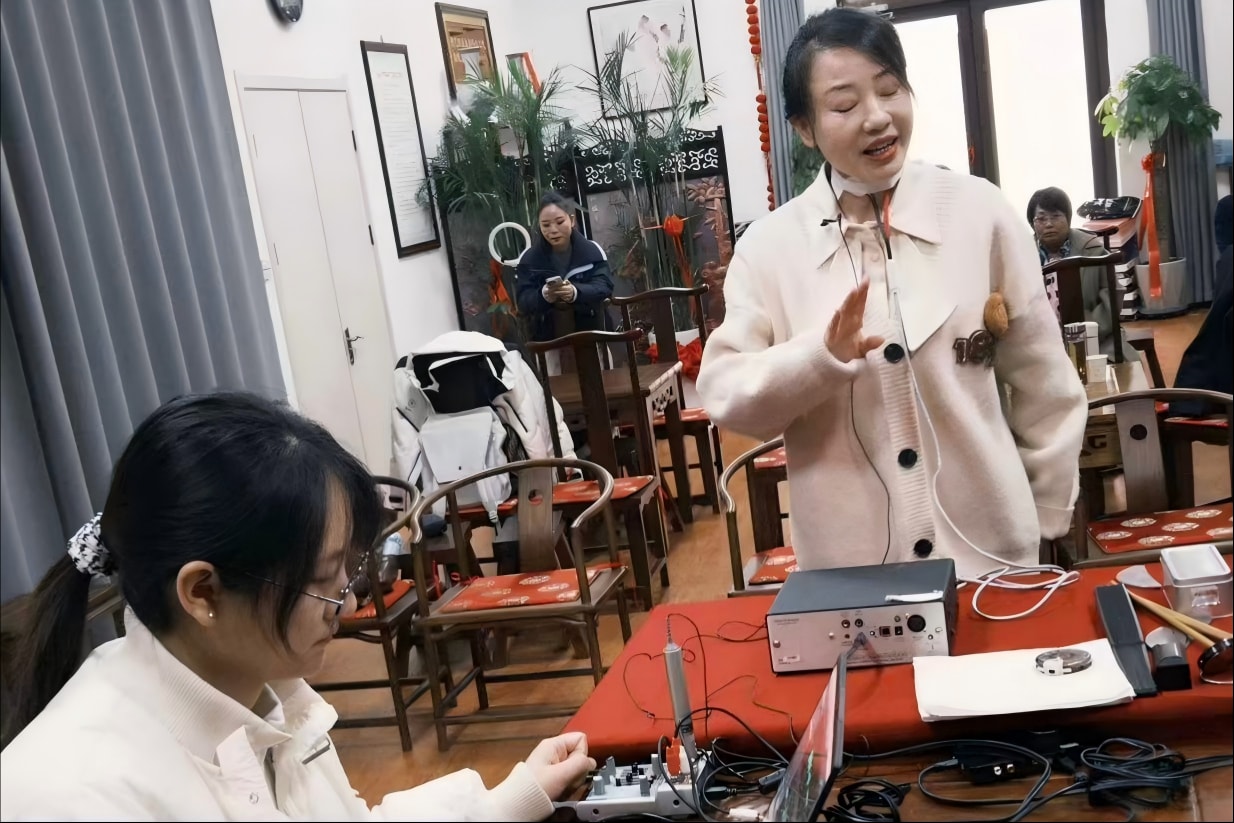
That tradition remains active. In February 2026, a Shandong University team established a temporary recording station in a Caoxian village, sampled residents from 18 to 80 years old, used standardized audio equipment, and built an initial corpus of 20 recordings.[7] The resulting photograph shows why field data stays valuable: the microphone has a visible owner, the speaker occupies a known room, and a researcher can ask why an utterance changed rather than infer everything from a waveform.
Fieldwork is not automatically representative, neutral, or error-free. Twenty carefully elicited recordings cannot train the same model as ten thousand hours of spontaneous media. But field collection can deliberately seek the speakers and forms that the feed omits; native collaborators can distinguish a rare expression from a bad transcript; and later researchers can understand why the material was recorded.
The strongest dialect-AI institution would connect the two microphones. It would use web audio for breadth and acoustic mess, field surveys for geographic and generational coverage, and native-speaker review for the cases where model agreement is least trustworthy. Its benchmark would report results by source domain and locality rather than hiding both inside one average.
WenetSpeech-Chuan makes that hybrid future more plausible because it turns Sichuanese speech from a boutique dataset into an inspectable training layer. The next proof is not another order of magnitude. It is whether gains survive locally collected audio, difficult code-switching, older and less-online speakers, and new model revisions without silently rewriting the dialect toward Standard Mandarin.
A dialect becomes machine-readable twice: first when a voice is recorded, and again when the missing context around that recording becomes auditable.
Sources
- Yuhang Dai et al., “WenetSpeech-Chuan: A Large-Scale Sichuanese Corpus with Rich Annotation for Dialectal Speech Processing,” arXiv:2509.18004 (submitted September 22, 2025)—corpus construction, partitions, evaluation setup, and model results.
- ASLP Lab,
WenetSpeech-Chuanofficial repository—project artifacts, current benchmark tables, Chuan-Pipeline description, models, and dataset links. - ASLP Lab,
WSC-Trainon Hugging Face—public training artifact, Apache 2.0 label, packaged fields, and dataset-viewer status inspected July 28, 2026. - Zhiyuan Tang et al., “KeSpeech: An Open Source Speech Dataset of Mandarin and Its Eight Subdialects,” NeurIPS Datasets and Benchmarks 2021—prior multi-city speaker and subdialect corpus.
- Sichuan Provincial Department of Education, “91 projects for Sichuan's China Language Resources Protection Program completed” (December 28, 2018, Chinese)—field standards, institutions, recruitment, recording, and archive construction.
- Qian Li et al., “Chinese dialect speech recognition: a comprehensive survey,” Artificial Intelligence Review 57, 2024—corpus design, recording, annotation, and dialect-ASR evidence review.
- Shandong University School of Literature, “The ‘Caosheng Yunji’ research team conducts a dialect phonetics field survey in Caoxian” (February 22, 2026, Chinese)—fieldwork method and source of the documentary photograph.