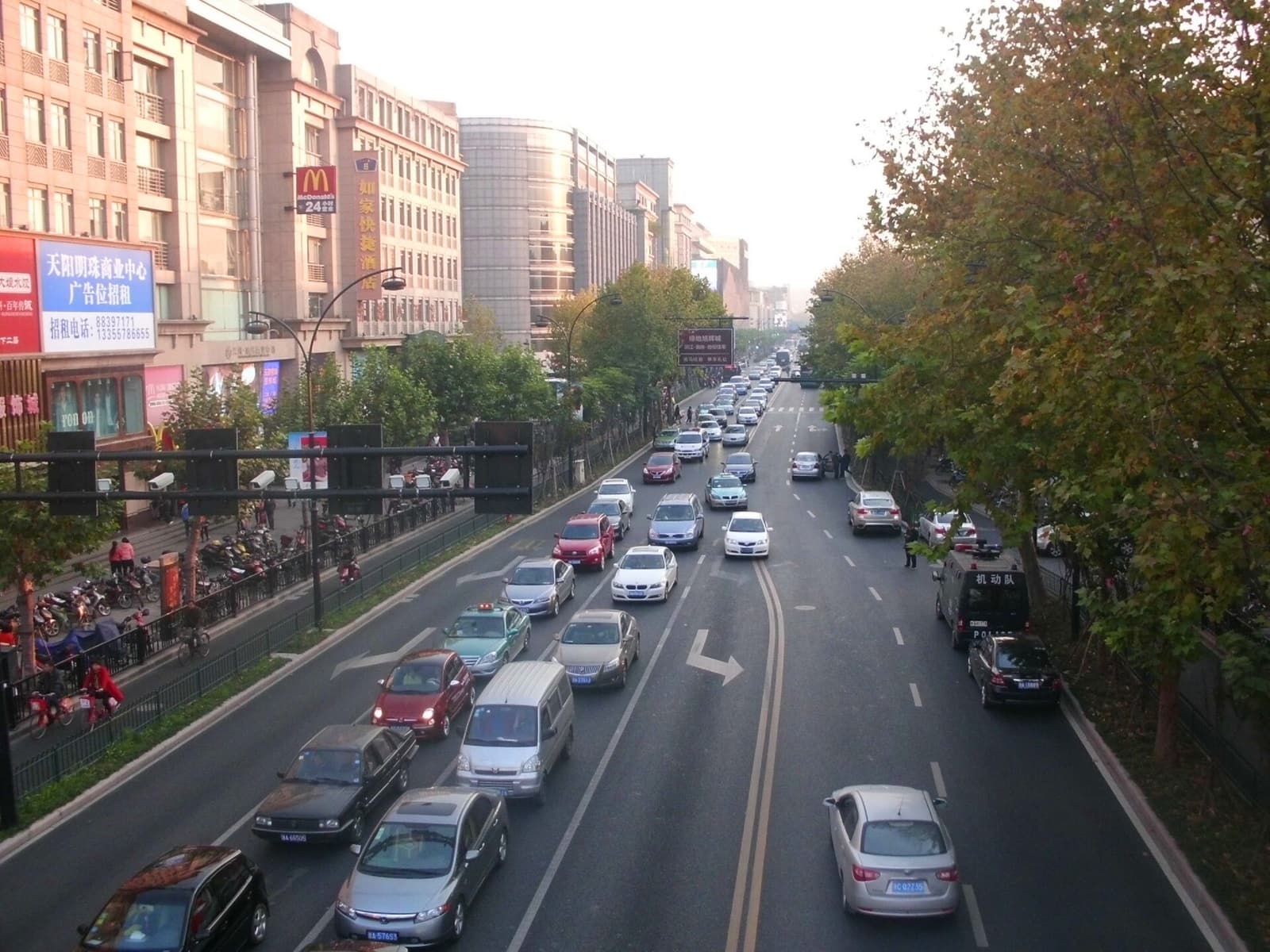

As of 2026-06-26 UTC, Alibaba Cloud's older ET City Brain video is useful precisely because it is not a model-launch clip.[1] It comes from the pre-LLM era of AI-China, when the strongest public pitch was not a conversational assistant, a coding agent, or a leaderboard jump. It was a city-scale operating loop: cameras, traffic lights, mapping data, emergency dispatch, cloud compute, and municipal authority connected tightly enough that software could intervene in streets.
That makes the video worth rewatching now. China's AI story is often told through frontier model families, chip constraints, open-weight releases, and agent demos. City Brain shows a different but equally durable pattern: AI becomes powerful when it owns the workflow surface. In Hangzhou, the workflow surface was urban mobility. Alibaba Cloud's own written materials described the system as a platform that processed videos, logs, and sensor streams, then used deep-learning and big-data infrastructure to help city agencies manage traffic, accidents, bus routes, and emergency response.[2]
The key question is therefore not whether the video looks futuristic. It does, in the polished corporate way of late-2010s smart-city media. The better question is what kind of AI-China thesis it reveals. City Brain treats intelligence as coordination under permission: if a provider can connect enough municipal data, compute, and operational authority, then the AI layer becomes less like an app and more like a control plane.
Watch the demo as a control loop
The video's surface story is traffic relief.[1] That is the right place to start, but it is too narrow if read only as congestion tech. Alibaba Cloud's companion article says ET City Brain analyzed live streams from traffic cameras in downtown Hangzhou, improved incident-identification accuracy above 92 percent, shortened daily commutes in Xiaoshan District by three minutes, increased travel speeds by 15 percent, and helped emergency vehicles arrive seven minutes earlier.[2] Those are first-party claims, so they should be treated as product-positioning evidence rather than neutral measurement. Still, they define the operating ambition clearly.
The system's promise is not one smart model. It is closed-loop timing. Traffic cameras see congestion or accidents. Mapping and public-safety systems add context. Cloud compute processes the signal. Traffic lights, dispatch channels, and municipal staff receive the output. The video sells that loop as smooth and civic-minded, but the underlying engineering challenge is less cinematic: data quality, latency, false positives, agency handoff, and whether automated recommendations are auditable when the street is messy.[1][2]
China Daily's 2018 Xinhua report gives the scale claim behind the polished video. Alibaba Cloud said City Brain 2.0 could cover 420 square kilometers of Hangzhou's urban area, while a Hangzhou public-security official described optimization across 1,300 traffic-light intersections and connection to 4,500 traffic-monitoring cameras.[4] That is why the demo matters in an AI-China feed. The hard asset is not only the algorithm; it is access to city-scale sensors and actuators.
The real product is municipal integration
Around the moment the video asks viewers to imagine a city that can "think," the important thing to watch is institutional, not visual.[1] City Brain depends on a public-private arrangement: Alibaba Cloud supplies cloud and AI infrastructure, while city agencies contribute data, deployment sites, and authority over traffic operations. WIRED's reporting made that dependency explicit by noting that Alibaba Cloud provided the software while the city owned the data.[3] That distinction is easy to say and hard to govern.
For builders, this is the practical lesson. AI systems that enter high-value workflows do not win merely by producing a better answer. They win by sitting where decisions are already routed. In City Brain's case, that meant traffic bureaus, public-safety response, cameras, lights, mapping feeds, and command-center routines. The Atlas of Urban Tech describes the Hangzhou case as a smart-traffic-management system that used AI and big data to monitor and manage flow from sources such as lights, cameras, and vehicle GPS data.[5] That is a deployment pattern, not a demo effect.
This also explains why City Brain belongs beside newer Chinese agent and model-stack stories. Today's model race often asks which provider can handle tools, memory, visual inputs, long context, retrieval, or enterprise APIs. City Brain asked an older version of the same question: who controls the interface between intelligence and action? In Hangzhou, the action interface was urban infrastructure. In 2026 model products, it may be a spreadsheet, code editor, call center, hospital workflow, robotics platform, or cloud console. The strategic shape is similar.
What the video leaves outside the frame
The video emphasizes relief: less congestion, faster response, better public services.[1] That is the understandable product story, but it leaves out the governance story. WIRED's 2018 coverage raised privacy, surveillance, centralization, and oversight concerns around a system that monitors vehicles and urban activity at large scale.[3] Those concerns are not decoration. They are part of the product boundary. A traffic-control AI has to prove not only that it can reduce delay, but that data access, retention, secondary use, cybersecurity, procurement accountability, and citizen remedy are visible enough to be challenged.
This is where the official metrics need careful reading. A claim such as faster ambulance arrival is meaningful only if readers know the baseline, geography, sample period, traffic condition, dispatch rule, and whether the improvement persisted after the pilot period.[2][4] A claim about incident detection needs the false-positive rate, the false-negative rate, and the cost of sending responders to the wrong place. A claim about citywide coverage needs a budget, maintenance plan, and explanation of who can inspect the system after procurement.
The absence of those details does not make City Brain fake. It makes the video a corporate artifact with a clear boundary. It is strong evidence of how Alibaba Cloud wanted governments and global customers to imagine urban AI in the late 2010s. It is weaker evidence for independent public performance. The best viewing posture is neither hype nor dismissal. Treat the clip as a map of assumptions: more data will make the city legible; centralized compute can coordinate the street; public agencies can operationalize algorithmic recommendations; citizens will accept the bargain if congestion and emergency response improve.[1][2][3]
Why this older demo still matters
City Brain is now historically useful because it predates the current chatbot grammar. It reminds us that AI-China was already about infrastructure, distribution, and workflow capture before foundation models became the front page. The post-2023 model era changed the interface: prompts, agents, multimodal inputs, and tool calls became the visible layer. But the business problem did not vanish. Valuable AI still needs data rights, integration channels, operating authority, and a credible answer to "what happens when the model acts?"
That is why the City Brain video should be read as a control-plane lesson. A model can summarize traffic; a deployed city system can change the lights. A model can detect a crash in a frame; a governed system has to decide who is alerted, what evidence is retained, and whether the intervention was justified. The gap between perception and action is where AI systems become political, operational, and expensive.
For AI-China watchers, the most durable signal is the deployment thesis. City Brain says Chinese AI capability is not only built in labs or benchmark tables. It can also be built by combining cloud infrastructure with a dense institutional surface: government bureaus, state-backed pilots, municipal data, and city-scale procurement. That combination can create faster iteration and bigger real-world sandboxes. It can also concentrate power and make public audit harder.
The video's real value is that it shows both sides at once.[1] It gives a concrete picture of AI as civic optimization, and it also exposes the governance questions that optimization cannot answer by itself. In that sense, City Brain remains one of the clearest early artifacts of the AI-China operating style: capability is important, but control over the loop is the prize.
Sources
- Alibaba Cloud, "Alibaba Cloud's ET City Brain - Empowering Cities to Think," official YouTube video.
- Alibaba Cloud Community, "How ET City Brain Is Transforming the Way We Live - One City at a Time" (June 11, 2018; official explanation of ET City Brain use cases, Hangzhou traffic claims, emergency-response claims, and AI capabilities).
- Abigail Beall, WIRED, "In China, Alibaba's data-hungry AI is controlling (and watching) cities" (May 30, 2018; reporting on Hangzhou City Brain, Kuala Lumpur expansion, data ownership framing, and privacy concerns).
- Xinhua via China Daily, "Alibaba Cloud's City Brain solution improves urban management in Hangzhou" (September 20, 2018; City Brain 2.0 coverage, Hangzhou deployment scale, traffic-light and camera figures, and emergency-vehicle claim).
- The Atlas of Urban Tech, "Hangzhou City Brain" (case summary of Hangzhou smart-traffic management, data sources, and AI/big-data framing).
- Huandy618, "File:Hangzhou Yan'an Road 01.jpg," Wikimedia Commons (real photograph of Yan'an Road in Hangzhou, source page for the article image).