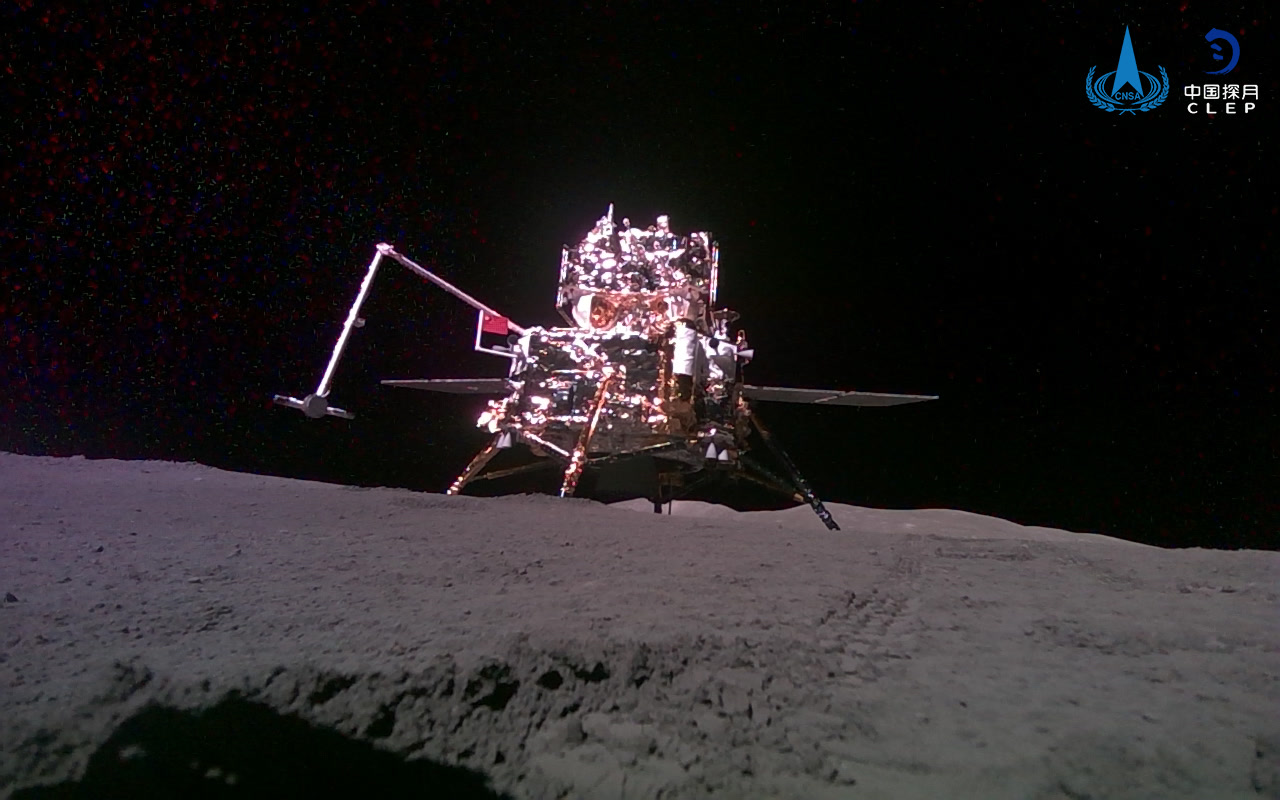
The most persuasive AI result from Chang'e-6 is not a benchmark table. It is a slightly noisy photograph from June 3, 2024: gray lunar soil in the foreground, absolute black behind it, and the lander-ascender combination bright in the hard sunlight. The camera that made the picture is absent because it had rolled away to take it.
That camera was a rover named Jinchan. It weighed 4.5 kilograms, measured 0.47 × 0.29 × 0.23 meters, and flew as a small attachment on the Chang'e-6 lander. Once sampling was complete, it separated onto the lunar far side, found the spacecraft, chose a shooting position and attitude, and returned the third-person portrait above.[1][3]
The achievement sounds modest beside a sample-return mission. That is precisely why it is useful. Jinchan shows a version of embodied AI stripped of the usual theatrical scale: one physical job, severe limits on mass and compute, model weights fixed before flight, and an output anyone can inspect. Its intelligence mattered because it was narrow enough to be engineered all the way from perception to a finished artifact.
The job was the architecture
Jinchan was not a miniature general-purpose lunar explorer. Its principal contract was explicit: survive release in an uncertain orientation, move across nearby terrain, obtain a real external image of the lander and ascender at work, and relay that image through the lander. The engineering paper reports a maximum autonomous speed of 300 meters per hour, an obstacle-crossing requirement of at least 8 centimeters, and a slope capability of at least 15 degrees.[1]
Those numbers do not describe a long traverse. They describe enough mobility to create a viewpoint. The distinction shaped the whole machine. Cameras were mounted on both faces so the rover could operate even if release left the other side facing upward.[5] A differential drive kept steering mechanically simple. The lander carried the corresponding wireless unit, making the rover-to-lander link part of the camera system rather than an independent deep-space communications stack.[1]
Even the autonomy target was photographic. Ordinary wheel odometry accumulates error, while full visual odometry asks more of the camera, terrain texture, and processor. Jinchan instead used the lander itself as a visual reference. A learned model recognized existing feature points on the spacecraft and estimated the rover's relative position and bearing without requiring a special active target. The route was therefore organized around a known subject: keep finding the lander, move to improve the view, and stop when the frame is good enough.[1]
This is job-shaped AI. The robot did not need a global lunar map or an open-ended world model. It needed a reliable relationship between three things it could sense or control: the lander in the image, traversable ground immediately ahead, and the quality of the prospective photograph.
Three learned judgments, not one magic model
The public engineering account separates Jinchan's learned perception into distinct problems.
First, relative navigation located characteristic points on the lander. The team trained with extreme lighting and style-transformed samples so the feature detector would be less brittle when the real spacecraft appeared under lunar illumination.[1]
Second, terrain recognition supplemented geometric perception. Jinchan's camera sat only about 13 centimeters above the ground and looked down at an angle of roughly 80 degrees, a viewpoint in which a small rock can dominate the near field and useful horizon context largely disappears. The segmentation network used HRNet as its multi-resolution backbone, with atrous spatial-pyramid pooling and attention to widen its effective field of view and distinguish hazards in unstructured terrain.[1]
Third, intelligent framing judged the picture itself. The position and attitude of a tiny rover change how much lunar foreground enters the image, whether the lander fits, and how its reflective surfaces sit against a black sky. The system scored an actual captured view for the target's position, size and tilt; chose among six movement directions; captured and scored again; and ultimately selected the best image produced by that loop.[1][4]
These were neural components inside a larger control system, not an end-to-end policy entrusted with every motor command. That boundary matters. Learned perception handled conditions that were awkward to enumerate; conventional control, state management, communications, and fault handling kept the task bounded. The companion computing paper describes a compact AI computer built from commercial off-the-shelf hardware and software, then hardened at the system level through environmental testing and reliability measures before its lunar flight.[2]
The disclosed budget was austere: an unnamed four-core ARM processor running at up to 1.5 GHz, 4 GB of LPDDR memory, Ubuntu Linux, and a 2.4 GHz Wi-Fi link to the lander. Across reported test conditions, the computing system drew roughly 2.5 to 4.2 watts. The paper deliberately does not identify the processor model, so claims that Jinchan flew a particular phone chip go beyond the published evidence.[2]
The design trade is revealing. Commercial components offer a compact, low-power and faster-developed computing path, but they do not arrive with the same radiation pedigree as purpose-built space electronics. Jinchan's answer was not to pretend the environment had become benign. It paired a narrow workload with multilevel watchdogs, fault detection, restart and recovery logic, and environmental testing. The important hardware claim is therefore architectural—not that a named consumer chip conquered the Moon, but that a small COTS-based computing stack was made dependable enough for this contained flight experiment.[2]
The Moon was not in the training set
Jinchan could react to new images after landing, but it could not update or fine-tune its model weights there. Training was offline; runtime inference drove an iterative capture-score-move loop without turning lunar images into new training rounds.[1] The useful adaptation happened before launch, in the design of the training environment.
That was harder than pointing a terrestrial camera at a scale model. On Earth, photographs usually contain diffuse sky light, atmospheric scattering, familiar backgrounds, and shadows softened by the environment. On the Moon, the dominant illumination is effectively parallel sunlight; the sky is black; the lander is highly reflective; and the soil and background return comparatively little light. CNSA's account says the team bought different lamps to reproduce those conditions and teach the framing system what a successful lunar picture should look like. It also reports more than 100 ground tests of various kinds across the rover's development.[4]
The engineering paper adds a second clue: style transformation and extreme-light samples were used to improve recognition of the lander's features.[1] Together, the sources describe a practical simulation-and-augmentation problem. The team could not collect representative examples from the deployment site before launch, so it varied the controllable physics—light direction, contrast, terrain and viewpoint—around the exact object the rover needed to recognize.
This is not proof that the model would generalize to an unfamiliar spacecraft, another landing site, or a long scientific traverse. It is evidence that training-data design can be successful when the task boundary is held still. The target was known. The likely terrain envelope was rehearsed. The output criterion was legible. The rover then met that contract in the environment that mattered.
Autonomy did not mean ground control disappeared
The lunar far side cannot communicate directly with Earth, so Chang'e-6 depended on the Queqiao-2 relay satellite.[7] That made local closure valuable: a robot that needs a ground command for every small correction spends time waiting on a chain of links and operators.
But Jinchan should not be turned into a story about replacing mission control. Chang'e-6 as a whole used different autonomy boundaries for different risks. During landing, the probe used visible-light imagery to identify a comparatively safe region, hovered at about 100 meters, and then used laser 3D scanning to select its final site.[6] For sampling, the mission plan called for ground specialists to reproduce the observed terrain and verify strategies while the probe executed bundled actions and checked results with onboard sensors.[6] An after-action interview makes the human boundary concrete: when drilling passed one meter and resistance suggested rock, experts on Earth decided to stop.[5] Jinchan's photographic sortie was another, much smaller loop.
The common principle was selective delegation. Put fast, local perception and correction near the hardware; keep mission goals, high-consequence choices, and contingency authority within an engineered human-machine system. Calling every loop “AI” would blur the achievement. The landing sequence, sample workflow and camera rover used different sensors, algorithms and fallback logic because failure had different meanings in each one.
The photograph is a result, not a benchmark
The developer's engineering account reports each internal step: terrain perception, relative localization, movement, framing and transfer. The returned image independently makes the integrated result concrete—a 4.5-kilogram machine survived the ride and release and completed its assigned photographic job on June 3. The Planetary Society's mission overview identifies the picture as the work of the small rover and places it within the first successful sample return from the lunar far side.[7]
What the flight did not publish is just as important. The cited accounts do not provide a public lunar test set, feature-localization error distribution, terrain-segmentation confusion matrix, energy cost per inference, count of rejected frames, or comparison against a fully scripted camera move. One successful image demonstrates end-to-end task completion; it does not measure open-world navigation reliability or general visual intelligence.
That is not a defect in the mission. It is the correct evidence boundary. A flight demonstration answers “did this integrated system complete its designed job here?” A benchmark answers “how does a component behave across a defined distribution, compared with alternatives?” Jinchan supplies the first answer vividly and leaves much of the second unpublished.
For China's AI ecosystem, the durable signal is smaller than a lunar foundation model and more substantial than a publicity “selfie.” Learned vision earned a place in a real spacecraft because the team constrained its authority, shaped the data around the environment, and preserved conventional machinery around the model. The result was not intelligence without limits. It was a limit precise enough to fly.
Sources
- Xing Yan et al., “The Technology of Autonomous Intelligent Miniature Robot and its Application on Lunar Surface,” Aerospace Control and Application 50(6), 2024 — Jinchan's task, dimensions, mobility envelope, learned perception, navigation and framing architecture.
- Gong Jian et al., “COTS Components Based Artificial Intelligence Computation System for the Microminiaturized Lunar Autonomous and Intelligent Rover,” Aerospace Control and Application 50(6), 2024 — onboard computing architecture, environmental qualification and reliability design.
- China National Space Administration, “专属机器人‘摄影师’,拍下嫦娥六号月背‘证件照’,” June 6, 2024 — official image provenance and the rover's separation, movement, angle selection and transmission sequence.
- China National Space Administration, “月背上的‘小小摄影师’,” August 8, 2024 — neural-network use, lunar-light training, constrained compute and ground-test account.
- China National Space Administration, “嫦娥六号总设计师胡浩:探月工程是一项复杂的系统工程,” July 2, 2024 — dual-sided camera layout, independent rover operation, ground-control capability and the human decision to stop drilling.
- China National Space Administration, “China's Chang'e-6 lands on moon's far side to collect samples,” June 2, 2024 — landing sensors, autonomous obstacle avoidance, relay support and planned ground-simulation workflow.
- The Planetary Society, “Chang'e-6: Collecting the first lunar farside samples” — independent mission chronology, far-side communications context and mini-rover identification.