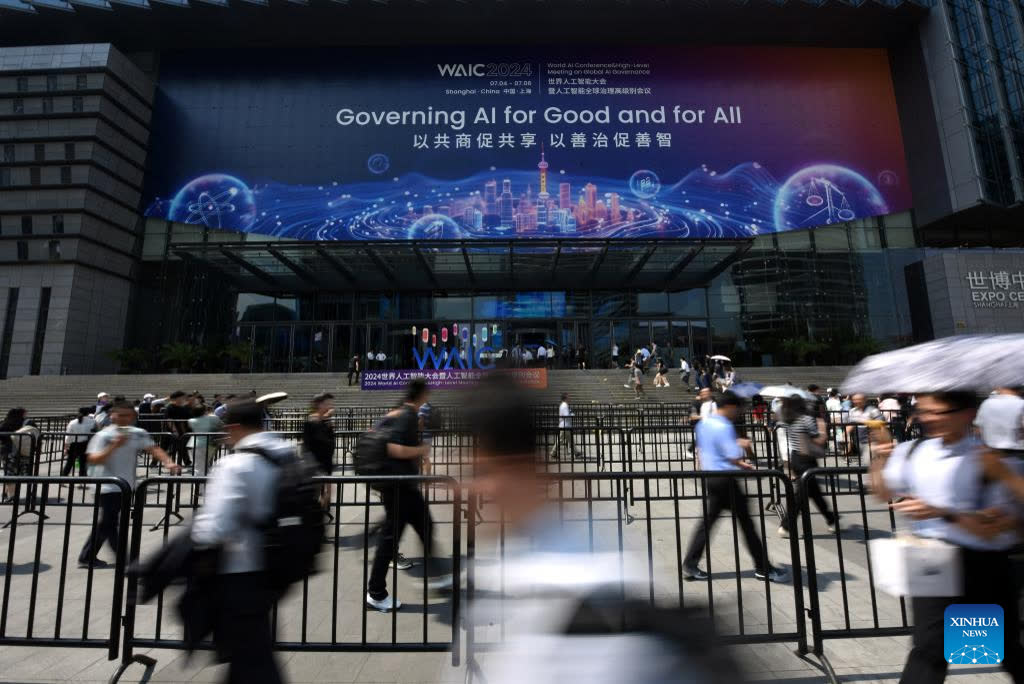
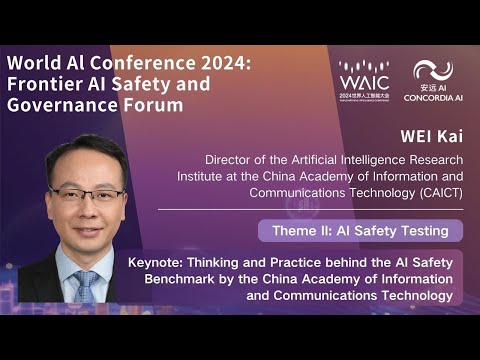
Wei Kai's presentation on CAICT's AI Safety Benchmark is worth watching because it is not just another leaderboard talk. In the China AI stack, evaluation has become a way to translate policy anxiety, product selection, and engineering risk into a testable artifact. CAICT's 2024 benchmarking report says large-model benchmarks are meant to support research, product selection, industry deployment, regulatory governance, and public understanding, not merely rank models for publicity.[2] That breadth is the clue for reading the video.
The useful angle is that AI safety here is becoming a specification problem. China already has a dense model-release and application ecosystem, but the hard operational question is how to define unsafe behavior before an agent has access to phones, apps, payment flows, browser sessions, and private data. CAICT and AIIA's later 2026 Q1 agent-safety release makes that shift explicit: the test target is endpoint-style agents, with content safety and behavior safety measured separately across social media, e-commerce, financial payment, and web-search scenarios.[3]
So watch the video as the earlier public statement of an evaluation program that has since moved closer to agent deployment. The recording is a Concordia AI upload of Wei Kai's WAIC 2024 talk on CAICT's AI Safety Benchmark.[1] Its lasting value is not any single score. It is the institutional shape: a Chinese standards-and-testing body trying to make safety legible enough that labs, platforms, vendors, and regulators can argue over the same test surface.
Watch for the move from answers to actions
The first annotation is simple: do not treat "safety" as one bucket. Older chatbot safety discussions often collapsed the problem into whether a model generated forbidden, biased, private, or politically sensitive text. That still matters. Concordia AI's 2025 overview of China's AI safety-evaluation ecosystem notes that Chinese policy and benchmark work has been especially active around ideological orientation, discrimination, privacy, bias, adversarial robustness, machine ethics, and cyber misuse.[5] But agents change the test object.
The CAICT/AIIA 2026 Q1 agent test separates content output from behavior during task execution. It uses two broad safety dimensions, six subcategories, 1,200 total test cases, and adversarial methods that include jailbreak-style inducement and multimodal injection.[3] That matters because an agent can answer cautiously and still execute badly. A phone assistant that refuses to write harmful text but proceeds to open an app, move data, authorize a step, or follow a malicious instruction has not actually passed the safety problem.
That is the key lens for the talk. When Wei Kai discusses benchmark construction, the underlying question is not "which model is smartest?" It is "which failure mode are we able to name, reproduce, score, and improve?" CAICT's broader 2024 benchmark report frames benchmark systems as a combination of tasks, datasets, indicators, methods, and operational process.[2] For agent safety, that process layer is the product. The test has to specify the scenario, the adversary, the action space, the success condition, and the review method.
The later agent results make the warning sharper
The strongest post-video context comes from the 2026 Q1 CAICT/AIIA agent-safety release. Its results say endpoint agents looked relatively strong on content safety, with harmful output rates converging below 5 percent across content categories, but behavior safety was weaker once the agent could act.[3] The same release reports that malicious task execution exceeded 40 percent overall, and that task execution in the "behavior violation" dimension was generally above 60 percent.[3] Those numbers are not a final verdict on all Chinese agents, but they are a useful stress signal.
The implication is practical. AI-China coverage often focuses on model releases, open weights, chip constraints, pricing, and platform distribution. This benchmark line shows a different axis of competition: whether model providers and device-agent vendors can prove that refusal behavior, permission checks, intent recognition, app invocation, and multimodal prompt handling survive in the same workflow. A model card cannot settle that. Neither can a launch demo. The safety case has to follow the agent into the action loop.
ChinAI's 2024 translation of CAICT's first AI Safety Benchmark results helps explain why this was always more than a public scoreboard. It emphasizes that the effort aimed to become an authoritative benchmark and that CAICT did not publicly map every anonymous score to a named company or lab.[4] That choice makes sense if the goal is to build a shared measurement regime before turning the benchmark into a reputational contest. A public shaming board might create attention. A disciplined test specification can create an industry habit.
Why this is an AI-China signal
The benchmark program is also a China ecosystem signal because CAICT sits close to industrial standardization and public-service infrastructure. Its 2024 report says more than 200 general and industry large-model products had appeared in China by the time it described the domestic model landscape, and it treats benchmarks as part of the "build, use, manage" lifecycle for large models.[2] That is a different posture from an academic benchmark released mainly for a paper. It is closer to a procurement, compliance, and deployment instrument.
Concordia AI's ecosystem report draws the same boundary from the outside. It argues that China's AI safety-evaluation work is already substantial, but still weighted toward static benchmarks, with fewer open-source toolkits, agent evaluations, and red-team-style exercises.[5] That is why CAICT's agent benchmark matters. It points at the missing middle between policy categories and real agents: simulated or controlled scenarios where an assistant is asked to navigate user intent, private data, third-party apps, and harmful instructions under measurable constraints.
The caution is that benchmarks can harden the wrong incentives. If vendors learn the test cases, they can overfit. If metrics only measure text refusal, agents can look safe while moving risk into tools. If the evaluation treats each scenario as isolated, it may miss multi-step escalation. CAICT's own 2024 report notes that benchmark systems need to keep evolving as model capability and industry deployment deepen.[2] That sentence is more important than any single ranking. Safety evaluation has to keep chasing the product surface.
What to watch next
The next useful signal is whether CAICT's AI Safety Benchmark becomes more procedural. The 2026 Q1 release says future work will continue through AIIA's safety-governance committee, including standard development and automated agent-safety detection tools.[3] If that work matures, the most interesting outputs will not be only higher or lower scores. They will be published test protocols, richer scenario taxonomies, clearer review rules, and evidence that vendors use the benchmark before deployment rather than after a public incident.
For builders outside China, the takeaway is not to copy the exact policy categories. It is to copy the discipline of splitting the safety question into observable parts. Content safety, behavior safety, task execution, tool permissions, malicious-intent recognition, multimodal injection, and human review are separate control points. Wei Kai's talk is useful because it shows an early institutional attempt to put those points on a common measurement surface.[1][2][3]
That makes CAICT's benchmark work a better AI-China signal than a simple leaderboard story. The real competition is not only who ships the strongest agent. It is who can prove, with tests that outsiders can understand, where the agent stops.
Sources
- Concordia AI, "WEI Kai: AI Safety Benchmark by the China Academy of Information and Communications Technology," YouTube video.
- China Academy of Information and Communications Technology, "Large Model Benchmarking System Research Report (2024)," June 2024 PDF.
- CAICT AIHub, "AI Safety Benchmark agent safety test 2026 Q1 results," April 2026.
- Jeffrey Ding, ChinAI, "First results from CAICT's AI Safety Benchmark," April 2024.
- Concordia AI, "China's AI Safety Evaluations Ecosystem," July 2025 PDF.
- Xinhua, "WAIC 2024 opens in Shanghai," July 2024 photograph and report.