As of 2026-05-11 UTC, the most useful way to read Xiaomi's MiMo-V2-Flash is not as one more Chinese MoE model with a fast-throughput headline. The sharper ai-china signal is that Xiaomi now has a measurable eval envelope. On the public launch page for MiMo-V2-Flash, Xiaomi does more than announce a model name and a few isolated scores. It publishes cross-vendor benchmark tables, explicit agent-task results, speed-and-price claims, architectural explanations for its hybrid attention and MTP path, and a concrete statement that the model is meant for reasoning, coding, and agentic scenarios with 256k context and compatibility with Claude Code, Cursor, and Cline.[1]
That matters because Xiaomi has usually been easier to read through distribution than through model evaluation. The earlier company-level story was about HyperOS, HyperAI, and Xiaomi's device graph.[4] MiMo-V2-Flash changes the balance slightly. It does not erase the distribution thesis, but it gives Xiaomi a more inspectable model artifact underneath it. The point is not that Xiaomi has suddenly won a universal API race. The point is that it has made its model claims more legible, more benchmark-shaped, and more falsifiable than a pure device-feature story would require.[1][2][3]
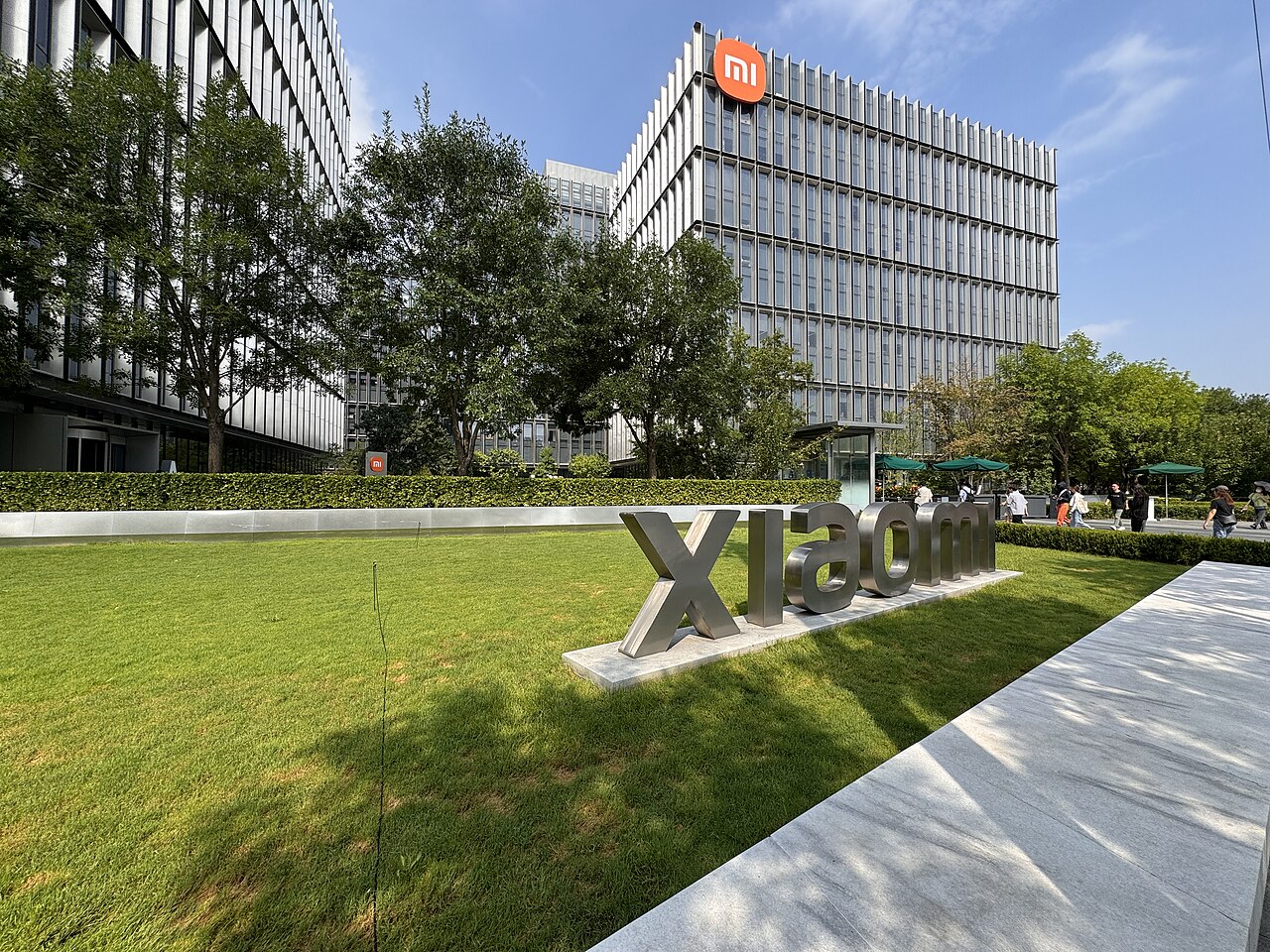
Image context: the cover uses a real Wikimedia Commons photograph of Xiaomi's science and technology park in Beijing. That is the right anchor here because the article is about an institutional model-and-distribution stack, not a floating benchmark chart.[5]
The release page is useful because it exposes a real comparison surface
The first reason MiMo-V2-Flash deserves a benchmark note is simple: Xiaomi put enough on the table to support one. The launch page calls the model a 309B total-parameter / 15B active-parameter MoE model with hybrid attention, an ultra-long 256k context window, 150 tokens per second throughput, and pricing of $0.1 per million input tokens and $0.3 per million output tokens.[1] It then publishes a multi-category comparison table spanning reasoning, general writing, long context, code-agent work, and general-agent work.[1]
That table is not trivial. Xiaomi gives 73.4 on SWE-Bench Verified, 71.7 on SWE-Bench Multilingual, 38.5 on Terminal Bench 2.0, 45.4 on BrowseComp, and 58.3 on BrowseComp with context management.[1] It also posts long-context numbers such as 60.6 on LongBench V2 and 45.7 on MRCR, while placing those next to named rivals including K2 Thinking, DeepSeek V3.2 Thinking, Gemini-3.0 Pro, Claude Sonnet 4.5, and GPT-5 High where available.[1]
That is already more disciplined than a generic launch note, but the real significance is that Xiaomi is choosing to make its claims machine-room legible. It wants engineers to compare the model on software engineering, terminal use, browsing, and long-context retrieval, not only admire a polished chat demo.[1]
The older MiMo materials explain why some of those numbers should be taken more seriously than others
The second reason this release matters is that Xiaomi already left a paper trail for evaluation discipline in the older MiMo line. The public MiMo README states that its evaluations were run at temperature=0.6, that AIME24 and AIME25 were averaged across 32 repetitions, and that LiveCodeBench v5/v6, GPQA-Diamond, and IF-Eval were averaged across 8 repetitions.[2] The linked MiMo paper gives more of the training logic under that family name: 25 trillion pretraining tokens, a curated 130K verifiable math-and-code RL set, and explicit infrastructure work around MTP and rollout efficiency.[2][3]
Those sources do not fully solve MiMo-V2-Flash's comparability problem, because Xiaomi does not publish the same level of run-detail on the V2-Flash launch page itself.[1] Still, they change the burden of proof. Xiaomi is no longer a black box saying "trust us, the model is good." It has already shown, in adjacent MiMo materials, that it understands why temperature, repetitions, reward design, and inference support shape the meaning of scores.[2][3]
My inference from that combination is narrow but important: MiMo-V2-Flash should be read as Xiaomi's first public model release where the evaluation surface starts to look intentional rather than ornamental.
The boundary is exactly where the missing harness details begin
That does not make the tables universally portable. The strongest caution is that MiMo-V2-Flash's public page still withholds several evaluation boundaries that matter for serious cross-vendor reading.[1]
Xiaomi tells us the model works with coding scaffolds such as Claude Code, Cursor, and Cline, but it does not publish the exact harness settings for the headline code-agent scores on the page.[1] It reports BrowseComp both with and without context management, which is useful, but those are not the same workload and should not be collapsed into one "search score."[1] The price-vs-speed chart also uses a 3:1 input/output blend sourced from Artificial Analysis, which is fine as a normalized visualization but not a substitute for the token mix or cache behavior of a specific production workload.[1]
The long-context story has the same issue. Xiaomi's release page argues that MiMo-V2-Flash surpasses K2 Thinking on long-context evaluations, which may well be directionally meaningful.[1] But public readers still need to know which prompt templates, truncation rules, retrieval setup, and answer-format constraints were used before converting that claim into an operational routing decision.
This is why "measurable eval envelope" is the right phrase. Xiaomi has exposed enough structure to make the release inspectable. It has not exposed enough to make every benchmark row travel cleanly into every buyer's environment.
The engineering claims matter because Xiaomi is trying to prove efficiency, not only rank
The release's most distinctive move may actually sit below the scores. Xiaomi says MiMo-V2-Flash uses a 1:5 hybrid of global attention and sliding-window attention, that its MTP path reaches an accepted length of 2.8 to 3.6 tokens, and that this yields an effective 2.0x to 2.6x speedup in its measurements.[1] The same page says its MOPD post-training path needs less than 1/50 of the compute of traditional SFT-plus-RL pipelines to match peak teacher performance.[1]
Those are still first-party engineering claims, but they matter because they change what Xiaomi is trying to prove. The company is not only saying, "our model is smart." It is saying, "our model is smart in a way that can run fast and cheaply enough to matter in agent workloads."[1] That is a higher bar for a company whose ultimate advantage still sits in devices and operating surfaces rather than in selling naked API prestige.
HyperAI shows where the benchmark story cashes out
The final reason this benchmark note matters is distribution. Xiaomi's global HyperAI page still describes the user-facing AI layer through writing, meetings, image editing, translation, and Google Gemini integration across named Xiaomi phones and tablets.[4] In other words, Xiaomi's mass-market story is still not "come buy MiMo endpoints." It is "AI arrives on Xiaomi hardware through a branded productivity layer."[4]
That is precisely why MiMo-V2-Flash matters. It gives Xiaomi a more credible internal model substrate beneath that distribution system.[1][4] The release page proves Xiaomi can talk in the language of SWE-Bench, Terminal Bench, BrowseComp, throughput, cost, and inference architecture.[1] HyperAI proves where the company still expects the highest-value traffic to land: on devices, in workflows, and inside a controlled OS and feature stack.[4]
The narrow conclusion supported by the sources is therefore clear. MiMo-V2-Flash does not prove Xiaomi has already won a neutral external model market. It does prove that Xiaomi now has a much more inspectable model-evaluation story beneath its device-distribution strategy.[1][2][3][4]
Sources
- Xiaomi MiMo Team, "Introducing MiMo-V2-Flash" (December 16, 2025; 309B/15B architecture, 256k context, benchmark tables, agent scores, price-speed chart, MTP efficiency claims, and MOPD description).
- XiaomiMiMo,
MiMoGitHub README (evaluation protocol notes includingtemperature=0.6, multi-run averages, 25T pretraining tokens, 130K RL data, and deployment guidance). - LLM-Core Xiaomi, "MiMo: Unlocking the Reasoning Potential of Language Model -- From Pretraining to Posttraining" (arXiv version 2; pretraining, RL, MTP, and evaluation framing for the MiMo family).
- Xiaomi, "Xiaomi HyperAI" global product page (user-facing writing, meetings, image, and translation features plus named device distribution surfaces).
- Wikimedia Commons, "File:Xiaomi Headquarters.jpg" (source page for the real headquarters photograph used as the article image).